Egypt’s Al-Azhar calls for boycott over Quran burning

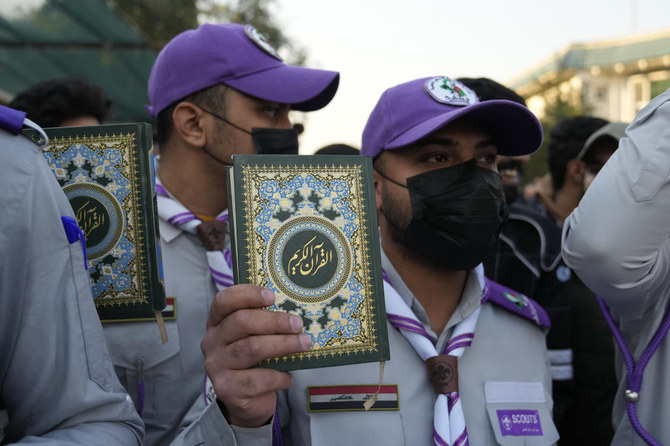
Protesters raises of the Quran, the Muslims' holy book, during a demonstration in front of the Swedish embassy in Baghdad in response to the burning of Quran in Sweden (AP)
Short Url
Updated 25 January 2023
Follow

Egypt’s Al-Azhar calls for boycott over Quran burning

  • On Saturday, Danish anti-Islam activist Rasmus Paludan burned the Qur’an outside the Turkish Embassy in the Swedish capital, Stockholm

CAIRO: Egypt’s top religious institution on Wednesday called on Muslims world over to boycott Swedish and Dutch products over the desecration of Islam’s holy book by far-right activists in the two European countries.
The call by Egypt’s Al-Azhar, the Sunni Muslim world’s foremost religious institution, is the latest in a series of backlashes from the Muslim world over the incidents in Sweden and the Netherlands.
On Saturday, Danish anti-Islam activist Rasmus Paludan burned the Qur’an outside the Turkish Embassy in the Swedish capital, Stockholm. On Sunday, Edwin Wagensveld, Dutch leader of the far-right Pegida movement, tore pages out of the Qur’an near the Dutch parliament in The Hague and stomped on them.
Egypt’s Al-Azhar called the desecrations an ‘’offense” to Muslims and said a boycott of both countries would be an appropriate response to governments that protect ‘‘barbaric crimes under the inhuman and immoral banner they call freedom of expression.”
In Pakistan’s eastern city of Lahore, hundreds protested on Tuesday and condemned the desecration. Protests also took place in the two main Turkish cities, Istanbul and Ankara.
After the incident in Stockholm, Turkish President Recep Tayyip Erdogan told Sweden not to expect Ankara’s support in its ongoing bid to join NATO’s military alliance amid Russia’s war on Ukraine. He also criticized Sweden for allowing pro-Kurdish demonstrations later on Saturday outside Turkiye’s Embassy.
European countries have long defended the right to freedom of expression, although incitement to violence or hate speech is largely prohibited. Both Paludan and Wagensveld were granted permission by authorities for their protests.


Turkiye’s Kurdish party says Syria deal leaves Ankara ‘no excuses’ on peace process

Updated 2 sec ago
Follow

Turkiye’s Kurdish party says Syria deal leaves Ankara ‘no excuses’ on peace process

ANKARA: Turkiye’s pro-Kurdish DEM Party said on Monday that the Turkish government had no more “excuses” to delay a peace process with the Kurdistan Workers Party (PKK) now that a landmark integration deal was achieved in neighboring Syria.
On Sunday in Syria, the Kurdish-led Syrian Democratic Forces (SDF) agreed to come under the control of authorities in Damascus — a move that Ankara had long sought as integral to ‌its own peace ‌effort with the PKK. “For more than a ‌year, ⁠the ​government ‌has presented the SDF’s integration with Damascus as the biggest obstacle to the process,” Tuncer Bakirhan, co-leader of the DEM Party, told Reuters, in some of the party’s first public comments on the deal in Syria.
“The government will no longer have any excuses left. Now it is the government’s turn to take concrete steps.” Bakirhan cautioned President Tayyip Erdogan’s ⁠government against concluding that the rolling back Kurdish territorial gains in Syria negated the need ‌for a peace process in Turkiye. “If the ‍government calculates that ‘we have weakened ‍the Kurds in Syria, so there is no longer a ‍need for a process in Turkiye,’ it would be making a historic mistake,” he said in the interview.
Turkish officials said earlier on Monday that the Syrian integration deal, if implemented, could
advance the more than year-long process with the ​PKK, which is based in northern Iraq. Erdogan urged
swift integration of Kurdish fighters into Syria’s armed forces. Turkiye, the strongest ⁠foreign backer of Damascus, has since 2016 repeatedly sent forces into northern Syria to curb the gains of the SDF — which after the 2011–2024 civil war had controlled more than a quarter of Syria while fighting Islamic State with strong US backing.
The United States has built close ties with Damascus over the last year and was closely involved in mediation between it and the SDF toward the deal.
Bakirhan said progress required recognition of Kurdish rights on both sides of the border.
“What needs to be done is clear: Kurdish rights must be recognized ‌in both Turkiye and Syria, democratic regimes must be established, and freedoms must be guaranteed,” he said.