

US ties with Pakistan and India ‘stand on their own’ — State Department 

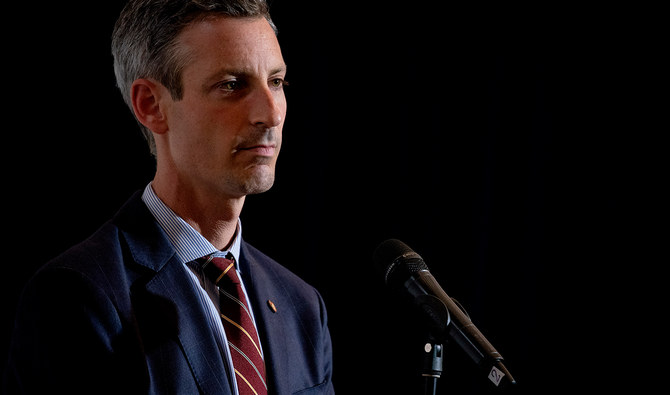
US State Department spokesman Ned Price during a press conference in Bangkok on July 10, 2022. (Photo courtesy: AFP/FILE)
Short Url
Updated 24 January 2023
Follow

US ties with Pakistan and India ‘stand on their own’ — State Department 

  • Pakistan PM recently offered India ‘sincere’ talks over Kashmir and other outstanding issues 
  • State Department says any dialogue between India, Pakistan is a matter between two states 

ISLAMABAD: The United States (US) relations with Pakistan and India “stand on their own” despite the fact that Washington has long called for regional stability in South Asia, the State Department said on Monday, more than a week after Prime Minister Shehbaz Sharif offered “sincere” talks to India on all issues. 

PM Sharif this month told Al Arabiya News Channel he had recently requested the United Arab Emirates (UAE) to facilitate Islamabad’s talks with India over Kashmir and all other outstanding issues, adding that Pakistan had “learnt its lesson” and wanted to “live in peace with India.” 

The Indian foreign ministry responded to Sharif’s offer and said it was ready to normalize relations with Pakistan, given a “conducive atmosphere free of terror, hostility, or violence.” 

On Monday, State Department spokesman Ned Price said while the US wanted to see stability in the region, any dialogue between India and Pakistan was a matter between the two nuclear-armed arch-rivals. 

“We have – you’re right, we’ve long called for regional stability in South Asia. That’s certainly what we want to see. We want to see it advanced. When it comes to our partnership – our partnerships with India and Pakistan, these are relationships that stand on their own,” Price said at a weekly press briefing. 

“We do not see these relationships as zero-sum. They stand on their own. We have long called for regional stability in South Asia, but the pace, the scope, the character of any dialogue between India and Pakistan is a matter for those two countries, India and Pakistan.” 

The Muslim-majority Himalayan region of Kashmir has been a flashpoint between Pakistan and India since their independence from the British rule in 1947. Both countries rule parts of the territory, but claim it in full and have fought two of their four wars over the disputed region. 

Relations between bitter rivals India and Pakistan hit a new low on August 5, 2019 after New Delhi revoked Kashmir’s special status, taking away the territory’s autonomy and dividing it into three federally administered territories. 

The two nations were last engaged in a dialogue during the tenure of former premier Nawaz Sharif, the elder brother of PM Sharif. 


Kazakhstan offers to finance rail link to Pakistan ports via Afghanistan

Updated 4 sec ago
Follow

Kazakhstan offers to finance rail link to Pakistan ports via Afghanistan

  • Kazakh envoy says country ready to fully fund Central Asia-Pakistan rail corridor
  • Project revives Pakistan’s regional connectivity push despite Afghan border disruptions

ISLAMABAD: Kazakhstan has offered to fully finance a proposed railway linking Central Asia to Pakistan’s ports via Afghanistan, according to a media report, a move that could revive long-stalled regional connectivity plans and deepen Pakistan’s role as a transit hub for landlocked economies.

The proposal would connect Kazakhstan to Pakistan’s ports of Karachi and Gwadar through Turkmenistan and Afghanistan, providing Central Asia with direct access to warm waters and offering Pakistan a long-sought overland trade corridor to the region.

“We are not asking Pakistan for a single penny,” Kazakhstan’s ambassador to Pakistan, Yerzhan Kistafin, said in an interview with Geo News on Tuesday. “This is not aid. It is a mutually beneficial investment.”

Pakistan has for years sought to position itself as a gateway for Central Asian trade, offering its ports to landlocked economies as part of a broader strategy to integrate South and Central Asia.

However, its ambition has faced setbacks, most recently in October last year when border skirmishes with Afghanistan prompted Islamabad to shut key crossings, suspending transit and bilateral trade.

Kistafin said the rail project would treat Afghanistan not as an obstacle but as a transit partner, arguing that trade and connectivity could help stabilize the country.

“Connectivity creates responsibility,” he said. “Trade creates incentives for peace.”

Under the proposed plan, rail cargo would move from Kazakhstan through Turkmenistan to western Afghanistan before entering Pakistan at Chaman and linking with the national rail network.

Geo News reported the Afghan segment, spanning about 687 kilometers, is expected to take roughly three years to build once agreements are finalized, with Kazakhstan financing the project.