

Iranian currency falls to record low amid EU plans to expand sanctions against Tehran

Protesters march in central London on January 21, 2023, calling for proscription of Iran's troublesome Islamic Revolutionary Guard Corps. (AFP
Short Url
Updated 22 January 2023
Follow

Iranian currency falls to record low amid EU plans to expand sanctions against Tehran

  • 4th round of sanctions eyed over Tehran's repression against demonstrators 
  • Other EU members want to classify the Iran's IRGC as a terrorist organization

JEDDAH: Iran’s troubled currency rial fell to a record low against the US dollar on Saturday amid discussions in the European to impose new sanctions on 37 Iranian officials and organizations over the regime's brutal crackdown on protesters.

Iran's increasing isolation in the global community also comes amid warnings over Tehran's expanding role in stirring unrest within the Mideast region and for supplying drones that are causing massive death and destruction in Ukraine.

Ties between the EU and Tehran have deteriorated in recent months as efforts to revive nuclear talks have stalled. Iran has detained several European nationals and the bloc has become increasingly critical of the violent treatment of protesters and the use of executions.

Foreign ministers from the EU bloc are to agree to adopt the fourth package of sanctions on Tehran over its repression of demonstrators at an already-scheduled meeting in Brussels on Monday. 

The European Parliament called on Wednesday for the EU to list Iran’s Guards as a terrorist group, blaming the powerful force for the repression of protesters and the supply of drones to Russia. The assembly cannot compel the EU to add the force to its list, but the text was a clear political message to Tehran.

Panama’s vessel registry, the world’s largest, has withdrawn its flag from 136 ships linked to Iran’s state oil company in the last four years, the country’s maritime authority said this week.

Demonstrations have swept Iran since the Sept. 16 death of Iranian Kurdish woman Mahsa Amini, 22, after her arrest in Tehran for allegedly failing to adhere to the Islamic republic’s strict dress rules.

Iran has arrested at least 14,000 people in the wave of protests, according to the UN.

Authorities have executed four people for their role in the unrest and imposed the death penalty on a total of 18, triggering widespread international outrage.

The EU has already imposed asset freezes and visa bans on more than 60 Iranian officials and entities over the crackdown on protesters, including targeting Tehran’s “morality police,” Revolutionary Guard Corps commanders and state media.

The dollar was selling for as much as 447,000 rials on Iran’s unofficial market on Saturday, compared with 430,500 the previous day, according to the foreign exchange site Bonbast.com.

The rial has lost 29 percent of its value since nationwide protests began.
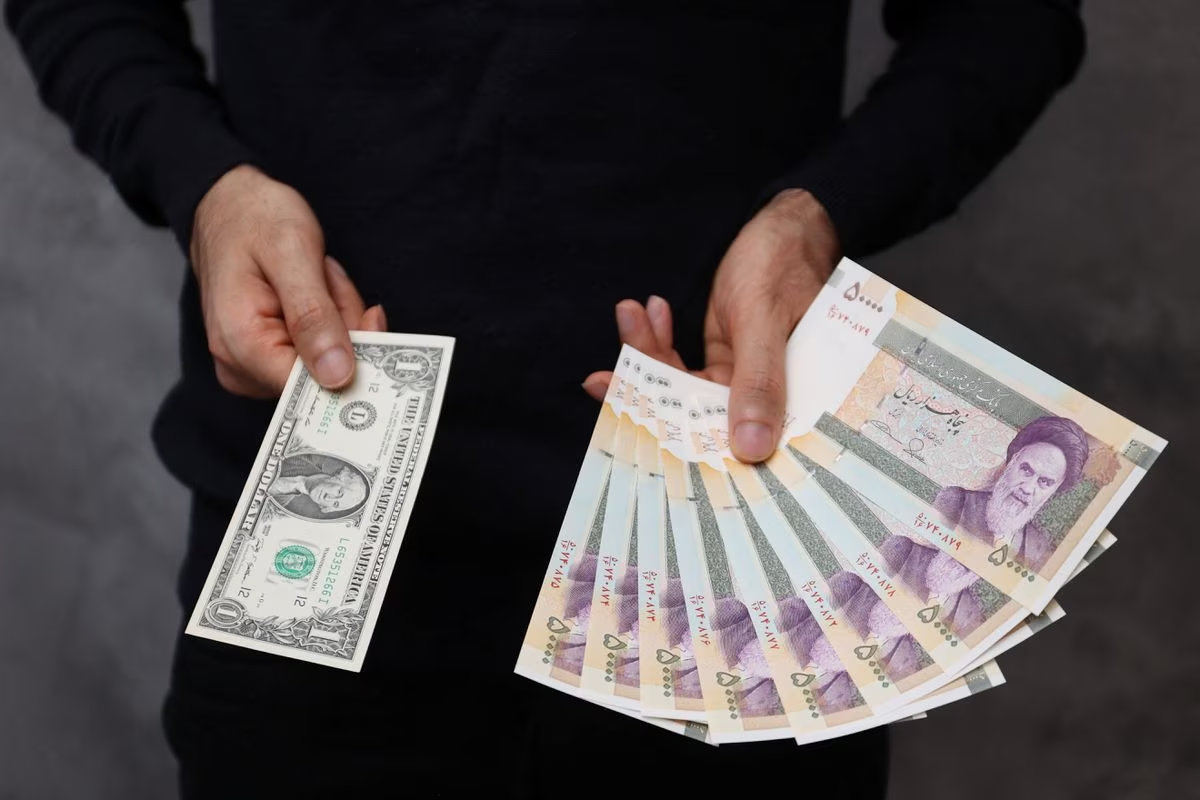


Iran's currency has lost 29 percent of its value since the Mahsa Amini nationwide protests started on Sept. 16. (WANA photo via REUTERS/File photo)

Iran’s central bank governor Mohammad Reza Farzin on Saturday blamed the fall of the rial on “psychological operations” which Tehran says its enemies are organizing to destabilize the Islamic Republic.

“Today, the central bank faces no restrictions in terms of foreign currency and gold resources and reserves, and media deceit and psychological operations are the main factors behind the fluctuation in the free exchange rate,” state broadcaster IRIB cited Farzin as saying.

Facing an inflation rate of about 50 percent, Iranians seeking safe havens for their savings have been trying to buy dollars, other hard currencies or gold.

The economic Ecoiran website blamed the continued fall of the rial on an apparent “global consensus” against Iran.

“Increasing political pressures, such as placing the Revolutionary Guards on a list of terrorist organizations, and imposing restrictions on Iran-linked ships and oil tankers ... are factors pointing to a global consensus against Iran, (which may affect) the dollar’s rate in Tehran,” Ecoiran said.

Separately, Iran’s sports minister has ordered a probe into allegations of sexual assault targeting teenagers at a football academy in the country’s northeast.

“A former media manager for the Shahr Khodro football team has claimed on social media that the parents of 15 players from this club and its academy have filed a complaint against the club and its coaches for sexually assaulting their children,” state news agency IRNA reported. Shahr Khodro football club is based in Mashhad.

On Friday, the local newspaper Shahrara reported on its website that the families of players from the club had gathered outside the headquarters of the provincial football organization to protest the “tragedy.”

(With Reuters, AFP)


A look at Ramadan and how Muslims observe the holy month

Updated 57 min 58 sec ago
Follow

A look at Ramadan and how Muslims observe the holy month

  • Ramadan is the ninth month of the Islamic lunar calendar; the month cycles through the seasons
  • Ramadan is followed by the Islamic holiday of Eid Al-Fitr

CAIRO: Observant Muslims the world over will soon be united in a ritual of daily fasting from dawn to sunset as the Islamic holy month of Ramadan starts. For Muslims, it’s a time for increased worship, religious reflection and charity. Socially, it often brings families and friends together in festive gatherings around meals to break their fast.
Ramadan is followed by the Islamic holiday of Eid Al-Fitr.
First day of Ramadan expected around Feb. 18-19
Ramadan is the ninth month of the Islamic lunar calendar; the month cycles through the seasons.
The start of the month traditionally depends on the sighting of the crescent moon. This year, the first day of Ramadan is expected to be on or around Feb. 18 or 19. The actual start date may vary among countries and Muslim communities due to declarations by multiple Islamic authorities around the globe on whether the crescent had been sighted or different methodologies used to determine the beginning of the month.
This year, the start of Ramadan is expected around the same time as Ash Wednesday, a solemn day of fasting and reflection that signals the start of Lent, the most penitential season of the church calendar for Catholics and many other Christians.
Fasting is one of the pillars of Islam
Fasting is one of the Five Pillars of Islam, along with the profession of faith, prayer, almsgiving and pilgrimage.
Muslims see various meanings and lessons in observing the fast.
It’s regarded as an act of worship to attain piety and one of submission to God. The devout see benefits, including practicing self-restraint, cultivating gratitude and empathizing with people who are poor and hungry.
The daily fast in Ramadan includes abstaining from all food and drink — not even a sip of water is allowed — from dawn to sunset, before breaking the fast in a meal known as “iftar” in Arabic.
Muslims typically stream into mosques for congregational prayers and dedicate more time to religious contemplation and the reading of the Qur’an, the Muslim holy book.
Charity is a hallmark of Ramadan. Among other ways of giving, many seek to provide iftar for those in need, distributing Ramadan boxes filled with pantry staples, handing out warm meals alongside such things as dates and juice or helping hold free communal meals.
Muslims eat a predawn meal, called “suhoor,” to hydrate and nurture their bodies ahead of the daily fast.
Exemptions from fasting
There are certain exemptions, such as for those who are unable to because of illness or travel. Those unable to fast due to being temporarily ill or traveling need to make up for the missed days of fasting later.
Cultural and social traditions associated with Ramadan
Muslims are ethnically and racially diverse and not all Ramadan traditions are rooted in religion. Some customs may transcend borders, while others can differ across cultures.
Many social rituals center on gathering and socializing after the daily fast. Some Muslims decorate their homes, put out Ramadan-themed tableware and centerpieces or throng to markets and Ramadan bazaars.
In Egypt, Ramadan is typically a festive time. Colorful lanterns, in different shapes and sizes, dangle from children’s hands and adorn homes. Ramadan songs may be played to welcome the month.
Ramadan’s soundscape in Egypt has traditionally included the predawn banging on drums by a “mesaharati” who roams neighborhoods, calling out to the faithful, sometimes by name, to wake them up for the suhoor meal.
New TV shows and communal meals
A lineup of new television series is another social fixture of the month in some countries, and advertisers compete for viewers’ attention.
In various regions, some Muslims worry that the month is getting commercialized, and say an emphasis on decorations, TV shows, outings or lavish iftar banquets can detract from Ramadan’s religious essence. Others say that a balance can be struck and that, in moderation, such rituals are part of the month’s festive spirit.
In Indonesia, Ramadan rituals vary across regions, reflecting the diversity of cultures. In deeply conservative Aceh province, animals are slaughtered during Meugang festivities, the meat cooked and shared with family, friends, poor people and orphans.
Hundreds of residents in Tangerang, a city outside the capital, Jakarta, flock to the Cisadane River to wash their hair with rice straw shampoo and welcome the fasting month with a symbolic spiritual cleansing.
Across the island of Sumatra, after evening prayers, many boys and girls parade through the streets, carrying torches and playing Islamic songs.
In the United States, where Muslims make up a racially and ethnically diverse minority, gathering at mosques and Islamic centers when possible for iftar meals and prayers provides many Muslim families with a sense of community. Some Muslims also organize or attend interfaith iftar meals.