

Sugarcane season kicks off strongly in Egypt

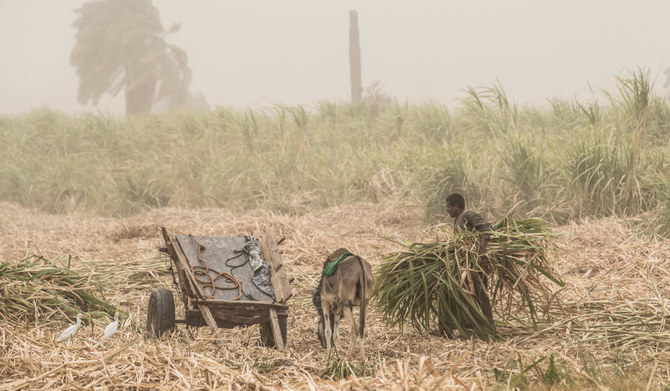
A farmer carries sugarcane in Egypt's southern city of Luxor. (AFP file photo)
Short Url
Updated 22 January 2023
Follow

Sugarcane season kicks off strongly in Egypt

  • Abdel Fattah Mahmoud Abdullah told Arab News: “The Armant sugar factory receives more than 1.15 million tons of sugar cane every year, and produces around 110,000 tons of sugar … and around 50,000 tons of molasses”

CAIRO: The sugarcane harvesting season has begun in Egypt, with the governorate of Upper Egypt in the country’s south a key cultivation site.

“The target is to receive approximately 7.7 million tons of sugarcane during the current harvest season to produce about 850,000 tons of sugar,” Maj. Gen. Essam El-Din El-Budaiwi, head of the Sugar and Integrated Industries Co., told Arab News.

He added that the company has eight factories in five governorates across Egypt — Aswan, Luxor, Qena, Sohag, Minya — to produce sugar from cane and beets.

Egypt’s minister of supply, Dr. Ali Al-Moselhi, recently said the country was 90 percent self-sufficiency in sugar production, following suggestions elsewhere that it was facing a shortage of the foodstuff.

Egypt will be 100 percent self-sufficient in sugar next year, the minister added.

Al-Budaiwi, however, noted that the supply price had increased to 1,100 Egyptian pounds ($37) per ton from 810 pounds last season, upping farmers’ dues to 8.47 billion pounds.

In addition, cultivated land fell by 235,000 feddans (987 sq. km) this year, compared to 248,000 feddans last year, said the official.

Despite these problems, El-Budaiwi confirmed that he was seeking to maintain supply rates within safe limits and pay farmers’ dues while implementing a plan to raise the production capacities of factories.

Abdel Fattah Mahmoud Abdullah, head of the sugar cane factories in Luxor governorate, southern Egypt, told Arab News: “The Armant sugar factory receives more than 1.15 million tons of sugar cane every year, and produces around 110,000 tons of sugar … and around 50,000 tons of molasses.”

He said that all the workers at the factory were ready to play a major role in the success of the season this year.

In Aswan governorate, southern Egypt, farmers began harvesting the cane crop from dawn, wearing gloves to protect their hands.

Commenting on the stages of sugar production, Sami Ahmed, head of Kom Ombo Sugar Factories, said that the sugar production season would continue until mid-May.

Factories operate 24 hours a day for a period of 140 consecutive days without stopping during this period, he added, and that his facilities would produce about 200,000 tons of sugar.


Oman and Lebanon call for full Israeli withdrawal, urge end to attacks

Updated 6 sec ago
Follow

Oman and Lebanon call for full Israeli withdrawal, urge end to attacks

  • Joseph Aoun and Sultan Haitham bin Tariq make a joint call for an immediate halt to Israeli attacks on Lebanese territory
  • Reaffirmation of the unified Arab position on ending the Israeli occupation and establishing an independent Palestinian state based on the 1967 borders

BEIRUT: Lebanese President Joseph Aoun and his Omani counterpart Sultan Haitham bin Tariq on Wednesday made a joint call for an immediate halt to Israeli attacks on Lebanese territory and a full withdrawal from all occupied Arab lands, warning that continued violations pose a direct threat to regional stability.

The statement came during a high-level summit in Muscat, where both leaders voiced “serious concern over the ongoing Israeli aggression” and described the occupation as a “clear violation” of UN Security Council Resolution 1701 and other international resolutions.

The two sides also expressed support for international efforts to de-escalate tensions, stabilize the situation on the ground, facilitate the return of displaced persons, and advance post-conflict reconstruction.

Aoun led a Lebanese ministerial delegation to Oman that included Lebanon’s ministers of foreign affairs, interior, defense, health, and agriculture for talks with Omani officials.

The joint statement emphasized the strengthening of bilateral ties and expanding cooperation in key sectors including politics, the economy, investment, banking, tourism, transport, and logistics.

Both sides called for early preparations to hold the first session of the Omani-Lebanese Joint Committee, chaired by the two foreign ministers in Muscat, and to pursue new agreements and memorandums of understanding intended to enhance collaboration in trade, culture, and science. The statement also highlighted the need to boost private sector engagement in shared development opportunities.

The Omani side reaffirmed its full support for Lebanon’s sovereignty, independence, and territorial integrity, as well as for strengthening Lebanese state institutions, particularly the army and legitimate security forces, and backing the country’s ongoing economic, financial, and administrative reforms.

The two sides reaffirmed the unified Arab position on ending the Israeli occupation and establishing an independent Palestinian state based on the 1967 borders, with East Jerusalem as its capital. They also underscored the importance of strengthening Arab solidarity, respecting the sovereignty of states, and upholding the principles of good neighborliness and international law.

Aoun’s official visit to Oman took place within the context of Muscat’s established role as a regional and international mediator. During his meetings, Aoun praised Oman’s diplomatic standing and approach, describing it as “wise and responsible.”

He commended Oman’s foreign policy, grounded in dialogue, mediation, balance, and good neighborliness, saying it had earned the sultanate a “distinguished status and a pivotal role in promoting stability and resolving conflicts through peaceful means.”

Aoun said that, in Lebanon, “we hold this wise approach in high regard and deeply value the sultanate’s steadfast support for Lebanon in various international forums, as well as its support as we confront the challenges before us.”

For his part, Sultan Haitham bin Tariq reaffirmed Oman’s continued commitment to Lebanon’s stability and its close monitoring of the latest developments in the country.

He emphasized the deep-rooted relations between the two countries and the importance of strengthening bilateral cooperation and coordination. The sultan also praised the positive contributions of the Lebanese community in Oman.

On the sidelines of the visit, Lebanese Interior Minister Ahmed Al-Hajjar held a meeting with his Omani counterpart Hamoud bin Faisal Al-Busaidi at Al-Alam Palace in Muscat. They underlined the enhancement of joint cooperation, particularly in security and policing.

According to a joint statement, the discussions also covered Lebanon’s efforts to consolidate internal security and maintain stability.

Participating on the Omani side in the expanded talks were Al-Busaidi; Shihab bin Tarik Al-Said, deputy prime minister for defense affairs; Badr bin Hamad Al-Busaidi, foreign minister of Oman; Hamad bin Said Al-Aufi, head of the private office; Mahad bin Said Ba’owain, minister of labor and head of the honorary mission; Saud bin Hamoud Al-Habsi, minister of agricultural, fisheries and water resources; and Hilal bin Ali Al-Sabti, minister of health.