

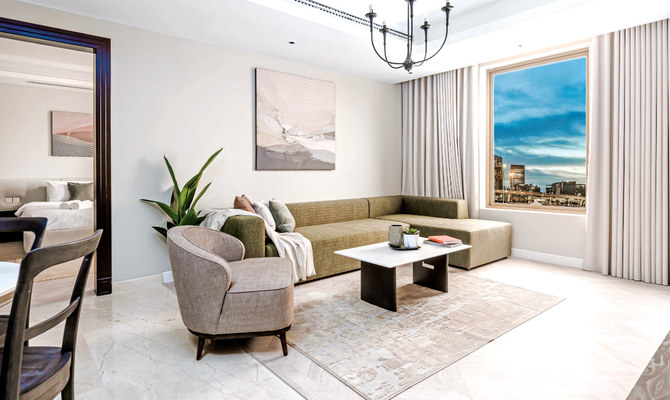


RIYADH: Aiming to reimagine the global living experience through its portfolio of tech-enabled branded residences Stella Stays is planning to become the biggest residential hospitality player in the region, said its co-founder and CEO.
Speaking to Arab News in an exclusive interview, Mohannad Zikra said that the Dubai-based proptech startup that is disrupting the global residential real estate sector with its innovative business model will be adding about 2,500 apartments regionally this year of which 50 percent is going to be in Saudi Arabia.
“We’re adding just over 1,200 apartments mainly focused on Riyadh but we’re also planning to launch soon in Jeddah,” he said. “We’re also looking at Dammam and Alkhobar.”
Zikra went on to add that he is eyeing opportunities in projects in the Kingdom where they are creating new cities. The Saudi Downtown Co., a master and lead developer owned by the Public Investment Fund, with 12 projects located in 11 regions across the Kingdom, for instance, is witnessing a lot of growth and Zikra is keen to tap opportunities in such projects.
Having started in 2019 by creating an offering where people can find and rent and move into a place within a few minutes, Stella Stays has rapidly grown its portfolio. It is keen to continue its expansion across major cities in the Middle East and North Africa region, Europe and North America.
Zikra wants to continue to focus on the region over the next 18 months. “We will obviously continue our growth in the UAE, Saudi Arabia, Egypt, and Turkey but we’re also looking at Morocco as a huge market for us,” he said. “Then we’re looking at Qatar as a potential market as well after what happened in the World Cup.”
Moving forward, he explained, Stella Stays will be looking at some of the emerging markets that have huge growth opportunities. Particularly countries like India, Indonesia, and Vietnam.
“You have Portugal as well that’s introduced the freelance visas,” he informed. “So in the next 24 months, we’ll go to markets like Asia that have huge growth potential and are among the top contenders in gross domestic product growth.”
Staying focused
When Stella Stays started it had some private investors in the UAE but today a lot of what the company is doing is partnering up directly with real estate developers. “When we partner with real estate developers, we’re able to take the buildings and we’re able to rebuild technology that allows us to reach 100-percent occupancy in our buildings within eight weeks,” Zikra informed.
“Hence, we’re able to generate cash flow very quickly from these buildings. And that’s been helping us fund a lot of our growth. So we took a different approach than some of these other startups that are just raising money to raise money.”
Unlike a lot of startups that are struggling because they focused on growing without caring about profitability, Zikra was always clear about building a profitable business from the very outset.
Not surprisingly, Stella Stays is not only profitable but also cash flow positive.
“We’re growing increasingly fast,” said Zikra. “Our average growth rate is about 250 to 300 percent per year since we started in 2019 until 2022.”
Having been successful in utilizing its funds, Zikra is now working with banks as well to help build a strong foundation and grow the team.
Stella Stays is also looking at partnering up with real estate investment trust funds because, according to Zikra, they have often faced difficulties in finding the right real estate investments. His company could be a good match for these funds as it has a successful business model with around 80 percent of its furnished apartments at full capacity at any one time.

We’re growing increasingly fast. Our average growth rate is about 250 to 300 percent per year since we started in 2019 until 2022.
Mohannad Zikra
By all accounts, there is a lot of demand for such apartments and people are also willing to pay a premium for them.
He added: “By 2024 we are looking at adding around 5,100 units. And for that, we’re starting to look at strategic partners and investors in the region, especially investors that are backed by sovereign investment funds because we’re seeing that there’s a very close relationship between what we’re doing and what we can contribute toward a lot of the government initiatives from a housing perspective.
“You look at Saudi Arabia and Vision 2030, there is a huge plan to grow the population,” Zikra continued. “And with that, they have needs to add over 100,000 homes over the next three years. And this means that these homes are going to have to be rented out. And they’re looking for partners where they can simplify that process.”
This is where a company like Stella Stays comes in. “We want to come in as a professional furnished apartment operator where we can come in and provide that consistency that you get in a hotel and provide that service,” said Zikra.
Branded, tech-enabled experience
“We don’t just take single apartments but we actually work with real estate developers and we take over buildings,” Zikra said.
“When you book a furnished apartment at Stella Stays, you are coming into a fully managed, branded tech-enabled operator, where from the moment you walk into the building, it’s our brand,” he added.
“In all of the apartments that are managed by us we provide that same consistency where you know you’re going to get a clean place and you know there’s going to be 24/7 support for your stay, whether it’s for one night, one week or one month or more.”
To its credit, Stella Stays has digitized the whole guest journey. It has done much the same thing with home rentals that Uber did with ride-hailing. A lot of its guests and residents come to its app or website, see all the different apartments that they have across the different cities, and choose the one they want.
“They can then choose their dates and pay by credit cards or pay by crypto,” explained Zikra.
“Then after that, they receive information for them to check-in. We have smart door locks across all of our units and access. They find the place, they pay for it, they move in, they can request services and all this without having to ever deal with a person.”
He added: “There’s no need to deal with real estate agents, no need to pick up the phone and make calls. Instead, we have completely digitized the experience.”
Way forward
Asked who his competitors were, and pat came Zikra’s reply: “Our competitors today are nothing other than just traditional landlords who own properties and rent them out on Property Finder and all these different marketplaces or these building owners who want to rent out their apartment on their own. That’s what we want to take over.”
“And that’s why more than anything, we’re partnering up with them and saying, listen, we can take over your assets,” he explained. “Just like Amazon’s done with shopping goods, we can do that with furnished apartments.”
He added that they have entered a brand new space that they have termed “residential hospitality.” According to Zikra residential hospitality is the ability to rent a residential apartment in a branded way.
“We want to take over and become the biggest landlord globally with our concept of allowing people to just show up and start living,” he concluded.


