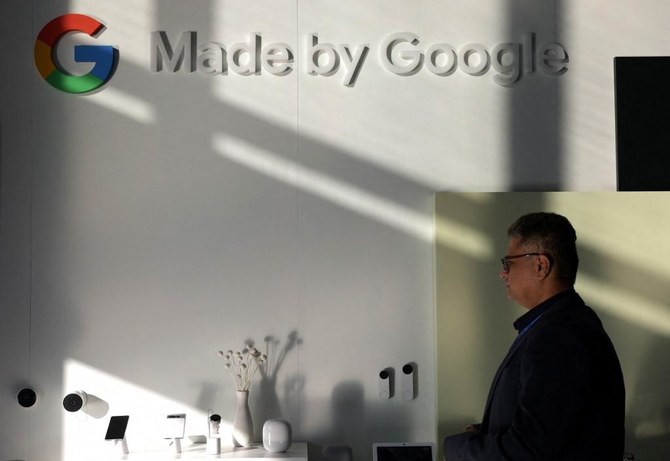
LONDON: Google is laying off 12,000 workers, or about 6 percent of its workforce, becoming the latest tech company to trim staff as the economic boom that the industry rode during the COVID-19 pandemic ebbed.
CEO Sundar Pichai informed staff Friday at the Silicon Valley giant about the cuts in an email that was also posted on the company’s news blog.
The firings adds to tens of thousands of other job losses recently announced by Microsoft, Amazon, Facebook parent Meta and other tech companies as they tighten their belts amid a darkening outlook for the industry. Just this month, there have been at least 48,000 job cuts announced by major companies in the sector.
“Over the past two years we’ve seen periods of dramatic growth,” Pichai wrote. “To match and fuel that growth, we hired for a different economic reality than the one we face today.”
He said the layoffs reflect a “rigorous review” carried out by Google of its operations.
The jobs being eliminated “cut across Alphabet, product areas, functions, levels and regions,” Pichai said.
In a regulatory filing late last year, the company said that it employed nearly 187,000 people.
Pichai said that Google, founded nearly a quarter of a century ago, was “bound to go through difficult economic cycles.”
“These are important moments to sharpen our focus, reengineer our cost base, and direct our talent and capital to our highest priorities,” he wrote.
There will be job cuts in the US and in other countries, according to Pchai’s letter.
Earlier this week, Microsoft announced 10,000 job cuts, or nearly 5 percent of its workforce. Amazon has said its cutting 18,000 jobs, although that’s a fraction of its 1.5 million strong workforce. Facebook parent Meta is shedding 11,000 positions, or 13 percent of its workers, while business software maker Salesforce is laying off about 8,000 employees, or 10 percent of the total. Twitter CEO Elon Musk has slashed jobs at the company after he acquired it last fall.
Employment in the US has been resilient despite signs of a slowing economy, and there were another 223,000 jobs added in December. Yet the tech sector grew exceptionally fast over the last several years due to increased demand as employees began to work remotely.
CEOs of a number of companies have taken blame for growing too fast, yet those same companies, even after the latest round of job cuts, remain much larger than they were before the economic boom from the pandemic began.

Google axes 12,000 jobs, layoffs spread across tech sector
https://arab.news/ced4j
Google axes 12,000 jobs, layoffs spread across tech sector
- CEO Sundar Pichai said layoffs reflect a “rigorous review” carried out by Google of its operations
Lebanon’s official media scale back Hezbollah coverage after Cabinet ban
- Information Minister Paul Morcos instructs outlets to comply with government decision
- Journalists, social media urged to avoid content that could provoke hate speech, incitement
BEIRUT: Lebanon has begun implementing a Cabinet decision taken earlier this month to ban Hezbollah’s security and military activities by scaling back coverage of the group on official media platforms.
The measure, which was described in political circles as a significant and bold step, came after decades during which news about the party and the speeches of its leaders were published verbatim and broadcast live through official media outlets, like the state-run National News Agency, TV station Tele Liban and Radio Lebanon.
“No one is imposing censorship,” an official source told Arab News.
“Rather, there is a commitment to the decisions of the state. It is no longer possible for a speech that attacks the Lebanese government and the state to be published through its official media outlets.”
Information Minister Paul Morcos issued a circular instructing directors of official media outlets to comply with the government’s decision to ban the broadcast of speeches or statements by Hezbollah Secretary-General Sheikh Naim Qassem and statements issued by the group’s armed wing, particularly when they contain criticism of the state.
Morcos also ordered that Hezbollah statements be handled in the same manner as those issued by other political parties, meaning they should not be published verbatim. He further instructed media outlets to avoid using the term “Islamic resistance,” except when it appears directly within Hezbollah statements.
The first manifestations of the decision were Tele Liban’s abstention from live broadcasting a speech by Qassem and a statement made on Tuesday by lawmaker Mohammed Raad, who heads the Hezbollah parliamentary bloc.
The group’s supporters described the move as an attempt “to restrict the resistance, Hezbollah and its leadership in the official media.”
Some argued on social media that preventing the use of terms like “resistance” or “holy warriors (Mujahedin)” and replacing them with expressions such as “Hezbollah” and “fighters” was “aimed at brainwashing and stripping the party of its resistance identity.”
During a Cabinet session on Thursday, Morcos raised the issue of content circulating on social media that incites murder and sectarian strife. This comes against the backdrop of the war that Hezbollah waged from Lebanon against Israel on March 2, without state approval, which led to a sharp division in Lebanese public opinion.
Morcos, who is also Cabinet spokesperson, said after the session that what was being published “exceeds the bounds of freedom of opinion, the press and expression.”
Prime Minister Nawaf Salam considered it to fall under the penal code, specifically regarding crimes that harm national unity, he said, and that “we are against strife in all its forms.”
Morcos also urged journalists, influencers and social media users to remain aware of the sensitivity of the current situation and to avoid content that could provoke strife, hate speech or incitement.
He acknowledged, however, that, according to a legal study, he has no authority over social media, even on media-related matters.
“The Ministry of Information does not exercise a guardianship role and lacks judicial police powers,” he said.
“These authorities rest with the public prosecution offices, which are overseen by the minister of justice and fall within the domain of criminal law and criminal prosecution.”
The ban was agreed during a Cabinet session on March 2, after Hezbollah launched six rockets from Lebanese territory toward northern Israel, the first such attack since the November 2024 ceasefire, prompting retaliatory strikes.
The Cabinet reaffirmed that “the decision of war and peace rests exclusively with the Lebanese state and its constitutional institutions,” and called on Hezbollah to hand over its weapons to the state while limiting its role to political activity within the legal and constitutional framework.


