

Saudi farmer invests in stevia to promote healthier food production

1 / 3
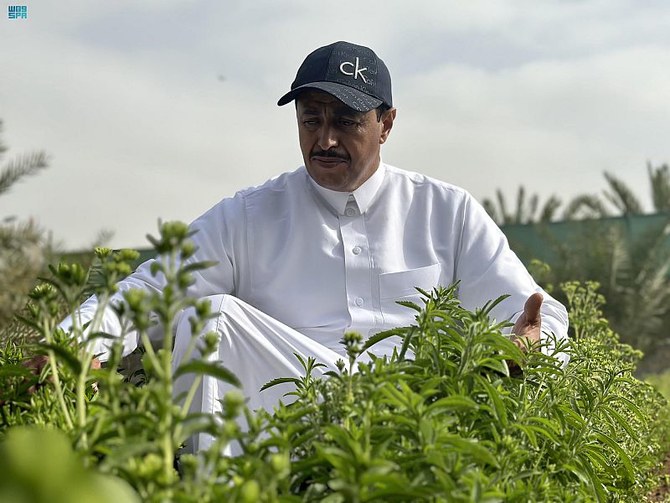
Hamad Mansour Al-Abbas a proffessional farmer with over 35 years of experience in the field of agriculture. (SPA)
2 / 3
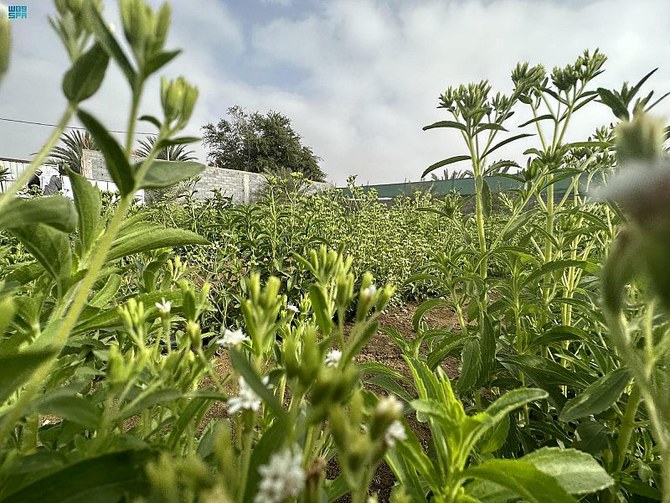
A Saudi farmer dedicated 2000 square meters of his huge farm to grow stevia in Najran. (SPA)
3 / 3
A Saudi farmer dedicated 2000 square meters of his huge farm to grow stevia in Najran. (SPA)
Short Url
Updated 20 January 2023
Follow

Saudi farmer invests in stevia to promote healthier food production

  • Hamad Mansour Al-Abbas provides alternative to sugar
  • Najran’s fertile soil ideal for fast-growing, hardy plant

JEDDAH: Many regions in the Kingdom have rich, fertile soil suitable for cultivating a variety of crops, including stevia which has been considered a natural and healthy alternative to sugar according to the European Food Safety Authority.

Hamad Mansour Al-Abbas, a Saudi farmer from Najran city in the southwestern region, with over 35 years of experience, has set aside 2,000 square meters of his 100,000-square-meter farm to grow stevia because of its health benefits.

Al-Abbas told Arab News: “It is known that the stevia plant is a herb that stays in the soil for up to seven years and is characterized by its very high sweetness. It is an alternative to sugar for those who follow a regular or keto diet or suffer from diabetes. As an admirer of natural alternatives and organic agriculture, I chose this plant because the soil fertility in Najran is high and can grow any crop.”


Hamad Mansour Al-Abbas a proffessional farmer with over 35 years of experience in the field of agriculture. (SPA)

Stevia leaves contain natural compounds and are as sweet as traditional sugar. The plant also has considerable nutritional and therapeutic properties, is safer than artificial sweeteners, with fewer calories, and several vitamins and minerals.

Al-Abbas was able to grow 15,000 stevia plants, aiming to introduce new herbal plants and trees into the local environment for marketing and distribution inside and outside the region.

Stevia is planted in rows, spaced out at five centimeters, and can be harvested and processed every three months, which helps to provide a large amount in one year.

“The plant grows within 30 days, after that it goes through three phases including harvesting, drying away from direct sunlight, then grinding through a machine. Once it is turned into a loose green powder, it is then packed into six packs of two grams each.”

The natural sweetener is then wrapped and distributed to markets in Najran. “My farm produces 5,000 packs of pure stevia loose powder per month, and I am currently studying the idea of establishing a factory so I can distribute it throughout the Kingdom as a healthy and natural product.”


A Saudi farmer dedicated 2000 square meters of his huge farm to grow stevia in Najran. (SPA)

Natural green powder

The difference between the natural stevia that Al-Abbas offers and others in many stores, is that his produce is a real natural sweetener in the form of green powder made only from dried leaves. Most store-bought stevia comes in the form of white powder, which has been through a water-extraction method, is semi-processed and up to 300 times sweeter than sugar.

The greenish powder helps to maintain healthy gums and teeth, and can be used as a natural sweetener with tea and warm drinks. Al-Abbas also offers it in a white powder similar to regular sugar, which is the extract of the stevia plant with a higher concentration. He also produces organic soap made of stevia extract that is beneficial for the skin.

Apart from stevia, Al-Abbas grows a variety of vegetables, herbs and strawberries, and his farm’s rich soil — in the moderate climate, with adequate water — is ideal for organic agriculture.
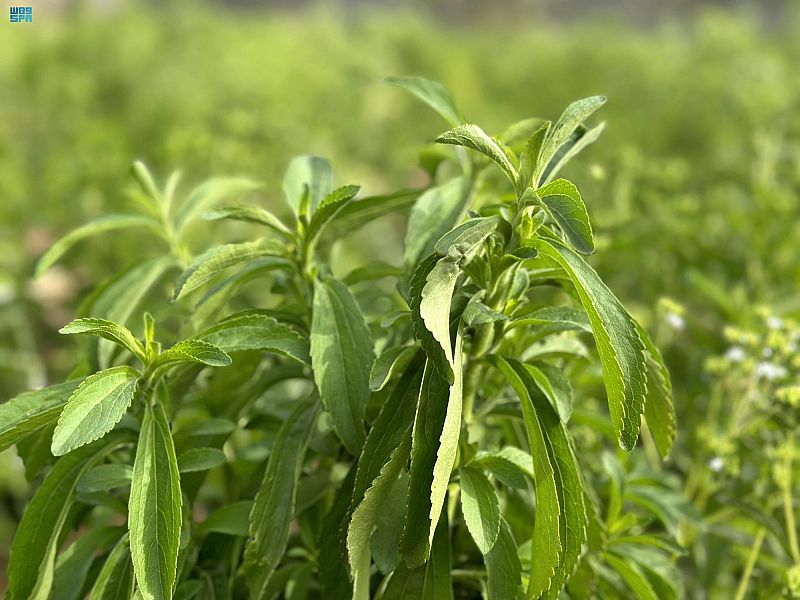


A Saudi farmer dedicated 2000 square meters of his huge farm to grow stevia in Najran, (SPA)

Al-Abbas said the Ministry of Environment, Water and Agriculture has held many workshops on his farm for trainees and specialists. He thanked the ministry for the support, which has included fertilizers, seeds and advice.

“I would like to mention that I have grown many crops during my life as a professional farmer, and I am very happy to see many new crops prospering in the region, such as pomegranates and coffee — especially that it is being cultivated with Saudi hands, where Saudis are supervising their farms and looking after it by themselves.”

He said the ministry continues to support all types of agriculture in Najran, including rare plants, assists with streamlining supply chains, and provides training and regulatory oversight. It also helps farmers move to safer, organic farming practices without the use of chemical fertilizers and pesticides, or genetically modified materials, that could be harmful to consumers and the environment.


Shaping future society: How intellectual forums contribute to cultural development

Updated 7 sec ago
Follow

Shaping future society: How intellectual forums contribute to cultural development

RIYADH: Modern nations do not transform on technological progress alone, but evolve through various factors such as values, religion, culture and assumptions that guide how societies interpret development.

Philosophy is one aspect of understanding civilization. Although it is often seen as abstract or far from reality, it plays an essential role in shaping a nation’s understanding of modernization.

It impacts how people see progress and discuss cultural identity, along with measuring the ethical implications of joining the global mindset.

Yet, by examining the philosophical thoughts that shape national narratives, people gain a deeper understanding of why societies adopt certain ideologies for development, resist others, and struggle to balance tradition with innovation.

Saudi Arabia, for example, defines its place on the global stage and navigates the complex tensions between heritage, aspiration and global responsibility through its own philosophy.

The Philosophy Forum, organized in Riyadh this week for the fifth year, witnessed the attendance of both local and international thinkers. During the conference, some Arab philosophers shared their beliefs in the idea that there is no absolute truth; while other philosophers differed, considering the Arab view on truth, culture and relativism.

“We must distinguish between the existence of relativity in science — the world is changing because it is relative — and our belief in absolute truths within our culture. For example, the only truly absolute thing in the world is death, which is mentioned in the Holy Qur’an,” Essam Gameil, professor of logic and critical thinking at Cairo University, told Arab News on the sidelines of the forum.

He added: “Our morals are unchanging; ethical principles are fixed. For example, respecting others is a fundamental principle; how can it be altered?

“Some concepts can be changed within the framework of science, but not in the humanities, not in religion, not in ethics. There are constants.

“It is the moral principles and rules that drive me forward,” Gameil said, adding that philosophy was created to solve issues that occurred in society during the time of Aristotle and Plato.

“It appeared to solve social problems … it was created to address lying, deception and more. Socrates was a moral philosopher and nothing else,” he said.

Gameil described Saudi Arabia as an example of “an extraordinary leap” in the Arab world in terms of development and philosophy.

He said that the Kingdom’s interest in philosophy and its organization of a major conference in the field stems from a crucial concept discovered by the Saudi leadership, which is that humanity has two aspects: A spiritual aspect and a material aspect, represented by the body.

“Studies typically focus on the body — artificial intelligence, engineering, and so on — but have often neglected the spiritual dimension. Philosophy is a human science; the more you emphasize it, the more certain concepts become firmly established and ingrained,” said Gameil.

Eman Al-Mulhem, a researcher in the philosophy of science at King Faisal University in Al-Ahsa, believes that the Kingdom’s situation presents three very promising paths: The philosophy and ethics of artificial intelligence, science and technology studies, and a re-reading of the Arab philosophical heritage using contemporary methodologies.

“This field is no longer a luxury, but a necessity. The question is no longer: What can a machine do? Rather, it has become: How do we preserve our humanity in a world where we share the power of decision-making with machines?” she said, highlighting the philosophy and ethics of AI.

She added: “We have a rich heritage, but we need modern tools to understand and reconstruct it, not just explain it. These fields are not only promising, but they are also capable of reshaping the role of philosophy in the Arab world.”

Al-Mulhem also works to connect Arab philosophical heritage to questions of contemporary science. She believes that philosophy is not detached from reality, but rather helps to reevaluate our relationship with science, humanity and the world.

On the question of whether Arab philosophical heritage is still suffering from global misconceptions, she said: “(It) still suffers some global misconceptions, such as being reduced to a mere extension of Greek philosophy or a stagnant tradition.”

However, the Riyadh International Philosophy Conference, which hosts philosophical minds from around the world, is helping to correct this image, she added.

“They present Arab heritage in a dynamic context, through the voices of its own scholars. At this conference, the world encounters Arab thoughts that engage in dialogue, produce ideas and critique — not as a static heritage, but as an integral part of contemporary global philosophy,” said Al-Mulhem.

“Philosophy is not far removed from humanity; it is closer than we imagine. Every question we ask, every attempt to understand the world, is a philosophical step,” she said.

“I believe that the Arab region today has a great opportunity to reclaim its role in producing knowledge, not just consuming it. And the Arab researcher is capable — given the right environment — of making a lasting impact that transcends geographical boundaries,” she added.