
UMERKOT: At a time when Pakistan is reeling from major agricultural losses due to worst-ever floods this summer that washed away thousands of acres of crops, a man in the southern Sindh says he is earning substantial cotton, sugarcane, and vegetable crop yields by using an innovative farming method that promises massive profits for agriculturalists.
Paedar Qudrati Nizam-e-Kashtkari (PQNK) – a term sometimes described as “paradoxical farming” – was pioneered in 2008 by a Lahore-based agronomist, Asif Sharif, who encouraged growers to adopt natural means to increase agricultural production.
Paradoxical farming combines farming practices like hardpan breaking, no tilling, raised beds, precision planting, and organic mulching to invent an effective cropping system.
It is this technique that is being used by Bhom Singh Sodho, a farmer from the district of Umerkot in Sindh where much of the agricultural land was submerged during the recent floods.
Sodho combined raised bed cropping, which helped reduce excess surface water, as well as hardpan breaking, which increased the absorption capacity of his land in the absence of thick agrochemical layers.
“The floods devastated thousands of acres of agricultural land which were using traditional production methods around my farm,” Sodho told Arab News. “However, PQNK saved me from incurring any losses. In fact, I earned substantial profit and was even preparing to cultivate my next crop when a majority of farmers were trying to drain water from their fields.”
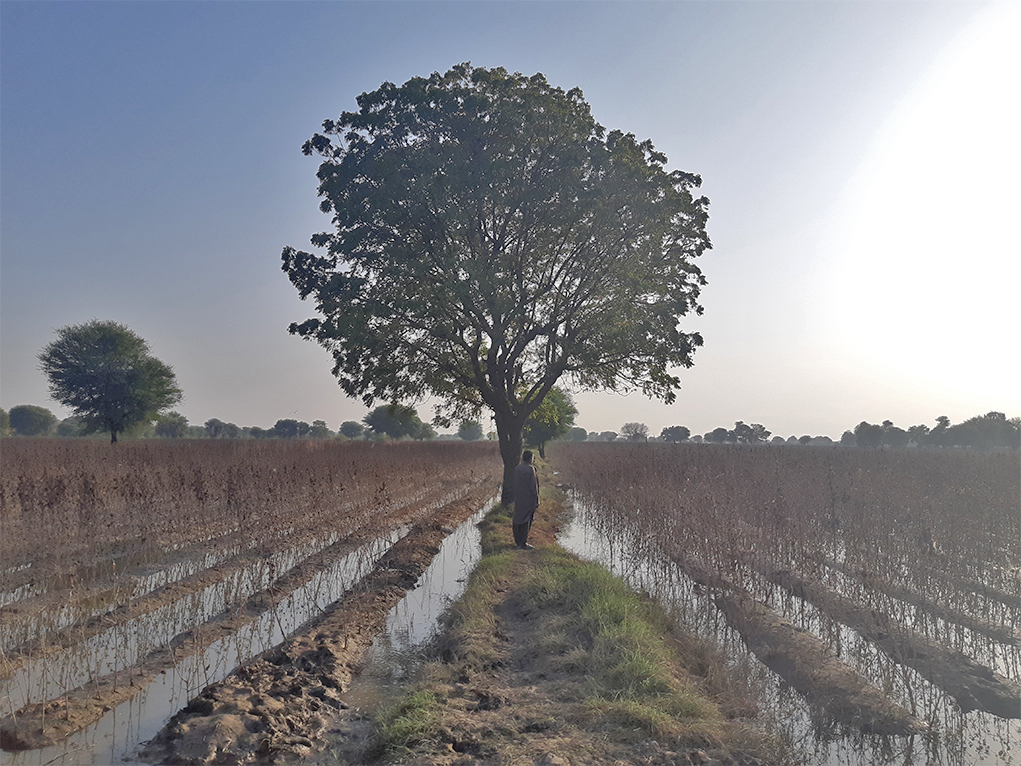
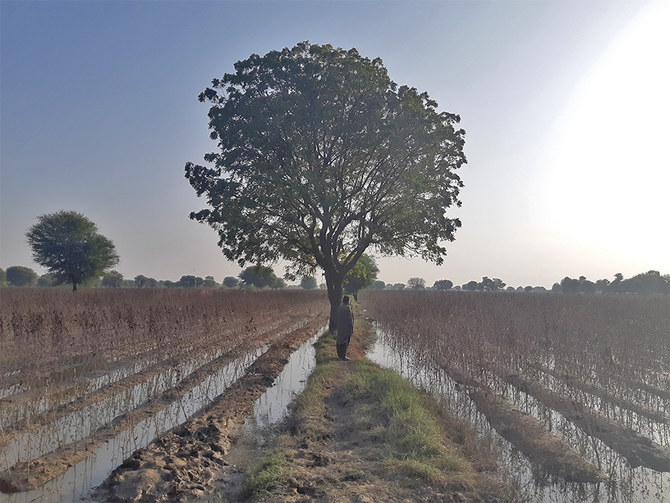
This picture shows an agricultural land which is still submerged by flood water in Umerkot, Pakistan, on November 17, 2022. (AN photo by Zulfiqar Kunbhar)
Official estimates suggest the catastrophic floods in Pakistan inflicted more than $30 billion in economic losses while the agricultural sector suffered $3.7 billion in damages. Sindh was the worst-hit province, where a large number of farmers lost both crops and livestock.
Sodho said that he shifted to the new production method two years ago when he decided to employ it over 11 out of his 55 acres of land. The year 2022 was the best for him in terms of cotton, sugarcane, and vegetable crops even amid the unprecedented floods, he said.
Farmers in Umerkot mostly complain of water shortages and Sodho’s decision to switch to the new farming technique was also prompted by the same reason since the innovative method could help him grow the crops by using much less water than was otherwise required for conventional farming.
Speaking to Arab News, Sharif, the 71-year-old founder of the system, said PQNK was a “low-cost, sustainable agricultural technique.”
“This is a self-funded initiative and there is no commercial angle involved in it,” Sharif, who is also the founding chairman and chief executive of Pedaver Private Limited, said over the telephone.
He said his method did not employ agrochemicals “which are poisonous for the microbes in the soil.” With an emphasis on organic food production, a farmer’s yield can also be sold at much higher rates in the international market. Apart from that, the new method “helps reduce the seed and water requirements by about 80 percent each.”
He said local soil had developed hardpan layers of chemical pesticide and fertilizer deposits of seven to 19 inches since the green revolution in the 1960s in conventional agriculture farming. Hardpan, he said, was largely impervious to water and restricted the growth of plant roots which lowered crop productivity and decreased the nutrition level.
“PQNK is a permanent low-cost solution for water scarcity and flooding,” he said.
“Breaking hardpan means increasing the capacity of the soil to absorb water. The recent floods caused massive devastation which could have been avoided if there had been a breaking of the hardpan on a larger scale. This also becomes clear when we see Bhom Singh Sodho’s farms since he applied the same method.”
Pakistan’s planning commission, the apex policymaking body, endorsed the new agricultural mechanism in 2021, rebranding it as Regenerative Agricultural Production System (RAPS).
According to Dr. Hamid Jalil, who works with the commission as a member of food security and climate change, “RAPS is a climate-smart agricultural production system.”
“We are scaling up RAPS in the country and introducing it in all public sector research centers and universities for authentication trials,” he told Arab News.
“We have already had success in getting international recognition for it when the World Bank evaluated RAPS in April this year and included it in the upcoming agricultural projects in Pakistan.”
However, Jalil said the biggest challenge in adopting the farming mechanism on a mass level was the provision of seed-sowing planter machines.
“With the assistance of Pro Nature Alliance, the planning commission manufactured four planter machines recently on an experimental basis whose testing was successful,” he added. “Pakistan needs 20,000 planter machines across the country to adopt RAPS. We have made PC-1 [or project feasibility report] that after approval will allow starting local production of planter machines. We can make the required number of machines in five years.”
Sharif added that the farming system could help Pakistan “generate an estimated $20 billion exportable food surplus in just a few years, provided that the country takes well-planned initiatives.
“At present, I have millions of followers across the world who are learning PQNK techniques online,” he said. “In Pakistan, there are about 100,000 farmers who are linked with PQNK and their number is increasing.”