

Pakistan summons Tehran envoy as four soldiers killed in attack from ‘Iranian soil’

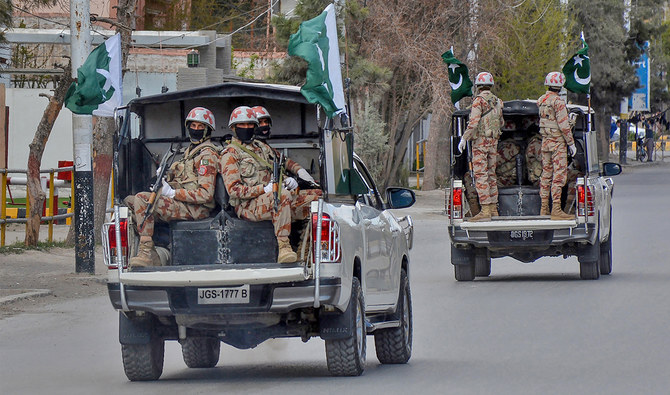
Security personnel patrol with vehicles on a street in Quetta, Balochistan, on March 25, 2020. (AFP/File)
Short Url
Updated 20 January 2023
Follow

Pakistan summons Tehran envoy as four soldiers killed in attack from ‘Iranian soil’

  • Pakistan says militants launched attack from across the border on soldiers in Balochistan’s Panjgur district
  • The foreign office reported summoned the Iranian envoy, asked to ‘prevent recurrence of such incidents’

ISLAMABAD: Pakistan on Thursday called on Iranian authorities to hold accountable “responsible elements” behind an attack a day earlier in which four security personnel were killed in a region bordering Iran, with the foreign office reportedly summoning Tehran’s envoy in Islamabad to express concern on the matter. 

The Pakistan army said on Wednesday “Iranian soil” had been used to launch an attack on soldiers on patrol duty in Balochistan’s Panjgur district.

Iran and Pakistan have for years accused each other of not doing enough to stamp out militants allegedly sheltering across their lengthy, shared border, which has long been plagued by unrest from both drug smuggling gangs and separatist and religious militants.

“Pakistan strongly condemns the terrorist attack from across the Iran border,” Pakistani foreign office spokesperson Mumtaz Zahra Baloch told reporters at a media briefing. “Terrorists used the territory of Iran and we hope that Iran will act against the responsible elements.”

Baloch said Pakistan had never allowed its territory to be used against Iran.

“Iran also should not allow its territory to be used for terrorism against Pakistan,” the spokesperson added.

Pakistan also reportedly summoned the Iranian ambassador to express “grave concern over the terrorist attack.” The ambassador was said to have been asked to bring the perpetrators to justice and “prevent recurrence of such incidents.”

In a press statement, the Iranian embassy in Islamabad condemned Wednesday’s attack and sent condolences to the families of the deceased.

“Terrorism is the common pain of Iran,” the statement said, “and Pakistan and both countries have fallen victim to this nefarious trend.”

In 2019, Iran and Pakistan said they would form a joint quick reaction force to combat militant activity on their shared border, but little has been reported since on the force’s work.

Pakistan has seen a spike in militant attacks in recent weeks, with most linked to the outlawed Tehreek-e-Taliban Pakistan group, or TTP, that unilaterally ended a cease-fire with the Pakistani government last November. The Pak Institute for Peace Studies, an Islamabad-based think tank, said Pakistan was hit by 254 militant attacks in 2022.


No casualties as blast derails Jaffar Express train in Pakistan’s south

Updated 26 January 2026
Follow

No casualties as blast derails Jaffar Express train in Pakistan’s south

  • Passengers were stranded and railway staffers were clearing the track after blast, official says
  • In March 2025, separatist militants hijacked the same train with hundreds of passengers aboard

QUETTA: A blast hit Jaffar Express and derailed four carriages of the passenger train in Pakistan’s southern Sindh province on Monday, officials said, with no casualties reported.

The blast occurred at the Abad railway station when the Peshawar-bound train was on its way to Sindh’s Sukkur city from Quetta, according to Pakistan Railways’ Quetta Division controller Muhammad Kashif.

No group immediately claimed responsibility for the bomb attack, but passenger trains have often been targeted by Baloch separatist outfits in the restive Balochistan province that borders Sindh.

“Four bogies of the train were derailed due to the intensity of the explosion,” Kashif told Arab News. “No casualty was reported in the latest attack on passenger train.”

The Jaffar Express stands derailed near Abad Railway Station in Jacobabad following a blast on January 26, 2026. (AN Photo/Saadullah Akhtar)

Another railway employee, who was aboard the train and requested anonymity, said the train was heading toward Sukkur from Jacobabad when they heard the powerful explosion, which derailed power van among four bogies.

“A small piece of the railway track has been destroyed,” he said, adding that passengers were now standing outside the train and railway staffers were busy clearing the track.

In March last year, fighters belonging to the Balochistan Liberation Army (BLA) separatist group had stormed Jaffar Express with hundreds of passengers on board and took them hostage. The military had rescued them after an hours-long operation that left 33 militants, 23 soldiers, three railway staff and five passengers dead.

The passenger train, which runs between Balochistan’s provincial capital of Quetta and Peshawar in the country’s northwest, had been targeted in at least four bomb attacks last year since the March hijacking, according to an Arab News tally.

The Jaffar Express stands derailed near Abad Railway Station in Jacobabad following a blast on January 26, 2026. (AN Photo/Saadullah Akhtar)

Pakistan Railways says it has beefed up security arrangements for passenger trains in the province and increased the number of paramilitary troops on Jaffar Express since the hijacking in March, but militants have continued to target them in the restive region.

Balochistan, Pakistan’s southwestern province that borders Iran and Afghanistan, is the site of a decades-long insurgency waged by Baloch separatist groups who often attack security forces and foreigners, and kidnap government officials.

The separatists accuse the central government of stealing the region’s resources to fund development elsewhere in the country. The Pakistani government denies the allegations and says it is working for the uplift of local communities in Balochistan.