

Russian president says Pakistan ‘important partner’ in South Asia, Islamic world

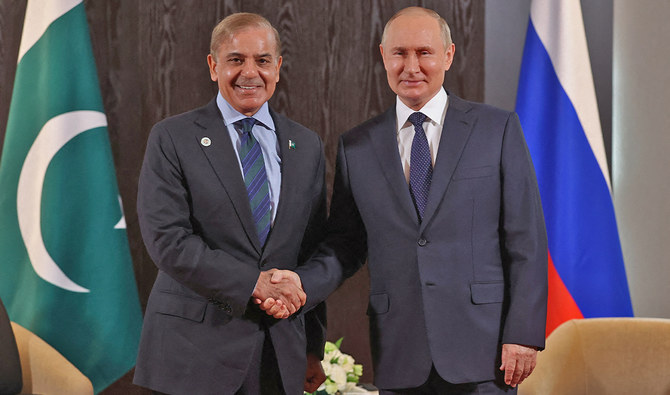
Russian President Vladimir Putin meets with Prime Minister of Pakistan Shehbaz Sharif on the sidelines of the Shanghai Cooperation Organisation (SCO) leaders' summit in Samarkand on September 15, 2022. (AFP/File)
Short Url
Updated 20 January 2023
Follow

Russian president says Pakistan ‘important partner’ in South Asia, Islamic world

  • President Putin shows interest in strengthening bilateral relations in a message to Prime Minister Shehbaz Sharif
  • A Russian delegation is already visiting Islamabad to discuss oil and gas supply to Pakistan on discounted rates

ISLAMABAD: Russian President Vladimir Putin described Pakistan as an “important partner in South Asia and the Islamic world” in a message to Prime Minister Shehbaz Sharif on Thursday, said an official statement circulated in Islamabad after a visiting delegation from Moscow met the Pakistani premier in Lahore.

Led by Russian energy minister Nikolay Shulginov, the 80-member delegation arrived in Pakistan’s federal capital earlier this week to discuss a range of issues, including an oil and gas deal on discounted rates, during high-level consultations between the two sides.

The prime minister welcomed the Russian official and said that Pakistan attributed tremendous significance to its relations with the Russian Federation.

“The Russian Energy Minister reciprocated Prime Minister’s sentiments and delivered a special message of Russian President Vladimir Putin to the Prime Minister,” said the statement issued by the PM Office. “In his message, President Putin referring to Pakistan as Russia’s important partner in South Asia and the Islamic World reiterated Russia’s strong interest to deepen the bilateral relationship.”

Sharif met the Russian president in September last year on the sidelines of the Shanghai Cooperation Organization summit in Samarkand. During their conversation, the two leaders decided to broaden and deepen the bilateral ties by focusing on energy supplies along with enhance trade and investment.

Pakistan’s energy procurements from international markets constitute the largest portion of its import bill, putting immense pressure on the rapidly depleting forex reserves with its central bank that have plummeted to $4.6 billion.

Officials in Islamabad hope to save a significant amount while meeting the country’s burgeoning energy needs by securing a favorable procurement deal for oil and gas from Moscow.

“Both sides agreed on the importance of energy sector for the development of bilateral economic and trade relations,” the official statement said after Thursday’s meeting. “In this regard, views were exchanged on supplying oil and gas from Russia to Pakistan on a long-term basis. Matters related to gas pipelines were also reviewed.”

Pakistan and Russia agreed to build a 1,100-kilometer pipeline in 2015 to deliver imported liquefied natural gas (LNG) from Karachi on the Arabian Sea coast to power plants in the northeastern province of Punjab.

The prime minister also shared his vision for the eighth round of Pakistan-Russia Inter-Governmental Commission meeting is taking place in Islamabad on Friday.


Pakistan, China to sign multiple MoUs at major agriculture investment conference today

Updated 11 sec ago
Follow

Pakistan, China to sign multiple MoUs at major agriculture investment conference today

  • Hundreds of Chinese and Pakistani firms to attend Islamabad event
  • Conference seen as part of expanding CPEC ties into agriculture, trade

KARACHI: Islamabad and Beijing are set to sign multiple memorandums of understanding (MoUs) to boost agricultural investment and cooperation at a major conference taking place in the capital tomorrow, Monday, with hundreds of Chinese and Pakistani companies expected to participate.

The conference is being billed by Pakistan’s Ministry of National Food Security and Research as a platform for deepening bilateral agricultural ties and supporting broader economic engagement between the two countries.

“Multiple memorandums of understanding will be signed at the Pakistan–China Agricultural Conference,” the Ministry of National Food Security said in a statement. “115 Chinese and 165 Pakistani companies will participate.”

The conference reflects a growing emphasis on expanding Pakistan-China economic cooperation beyond the transport and energy foundations of the flagship China-Pakistan Economic Corridor (CPEC) into agriculture, industry and technology.

Under its first phase launched in 2015, CPEC, a core component of China’s Belt and Road Initiative, focused primarily on transportation infrastructure, energy generation and connectivity projects linking western China to the Arabian Sea via Pakistan. That phase included motorways, power plants and the development of the Gwadar Port in the country's southwest, aimed at helping Pakistan address chronic power shortages and enhance transport connectivity.

In recent years, both governments have formally moved toward a “CPEC 2.0” phase aimed at diversifying the corridor’s impact into areas such as special economic zones, innovation, digital cooperation and agriculture. Second-phase discussions have highlighted Pakistan’s goal of modernizing its agricultural sector, attracting Chinese technology and investment, and boosting export potential, with high-level talks taking place between planning officials and investors in Beijing.

Agri-sector cooperation has also seen practical collaboration, with joint initiatives examining technology transfer, export protocols and value-chain development, including partnerships in livestock, mechanization and horticulture.

Organizers say the Islamabad conference will bring together government policymakers, private sector investors, industry associations and multinational agribusiness firms from both nations. Discussions will center on investment opportunities, technology adoption, export expansion and building linkages with global buyers within the framework of Pakistan-China economic cooperation.