

EU assembly wants Iran’s Revolutionary Guard on terror list

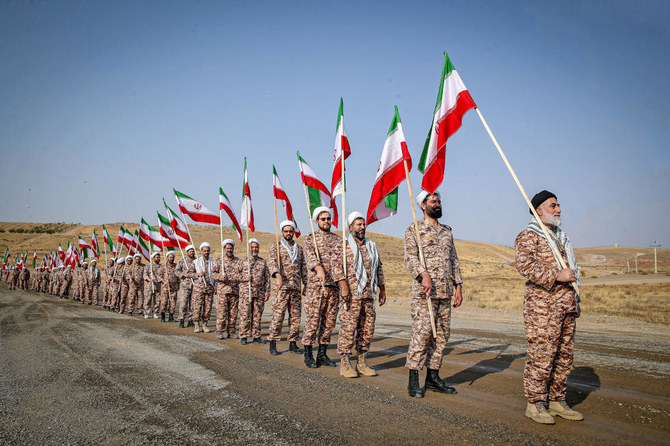
European Parliament votes in favor for classifying Iran’s Revolutionary Guards as a terrorist organization. (FILE/AFP)
Short Url
Updated 19 January 2023
Follow

EU assembly wants Iran’s Revolutionary Guard on terror list

  • Iran warned the EU against listing the Revolutionary Guard as a terrorist entity

BRUSSELS: The European Parliament on Thursday called for Iran’s Revolutionary Guard to be put on the European Union’s terrorist list and insisted that sanctions targeting Tehran had to be expanded after the violent suppression of protests.
In a nonbinding resolution, the legislature mustered a large majority to call on the EU’s 27 member states for such punitive action to counter what it sees as a swift backsliding of human rights in Iran.
Beyond the call to put the organization on its terrorist blacklist, the European Parliament also wants the EU to ban any economic or financial activity that can linked to the Revolutionary Guard Corps. The United States has already designated the corps as a “foreign terrorist organization,” and subjected it to unprecedented sanctions.

Iran warned on Thursday that the European Union would “shoot itself in the foot” if it designated the Revolutionary Guard Corps as a terrorist entity.
“We have repeatedly said the Revolutionary Guards are a formal and sovereign organization whose role is central for guaranteeing Iran’s security,” Iran’s foreign minister Hossein Amirabdollahian said during a phone call to the EU’s High Representative for Foreign Affairs, Josep Borrell.
“Steps taken by the European Parliament to list the organization as terrorist are in a way a shot in the foot of Europe itself.”
The European Parliament action came before Monday’s meeting of EU foreign ministers where more sanctions against Tehran are expected to be approved.
Thursday’s resolution came after four months of anti-government protests in Iran sparked by the death of Mahsa Amini, a 22-year-old woman who was being held by the morality police for allegedly violating the country’s strict Islamic dress code.
The protests quickly escalated into calls for the overthrow of the theocracy and mark one of the biggest challenges it has faced in more than four decades.
Iran has blamed the unrest on the US and other foreign powers, without providing evidence. The protesters say they are fed up with social and political repression, corruption and an economy weighed down by Western sanctions and mismanagement.
The EU steadfastly condemned the violence used during the demonstrations.


WHO says Dubai global emergency logistics hub ‘resuming operations’

Updated 5 sec ago
Follow

WHO says Dubai global emergency logistics hub ‘resuming operations’

  • Hanan Balkhy, WHO’s Eastern Mediterranean regional chief, says more than 50 emergency supply requests across 25 countries are affected by the pause
  • The hub stopped work this week after Iran launched waves of missile and drone attacks across the Gulf
GENEVA: The World Health Organization said its global health emergencies logistics hub in Dubai was resuming operations on Friday after a pause caused by the war in the Middle East.
“One of our most immediate concerns is the disruption of humanitarian health supply chains,” Hanan Balkhy, the UN health agency’s Eastern Mediterranean regional chief, told a press conference in Geneva.
“After a temporary pause, WHO’s Hub for Global Health Emergencies Logistics is today resuming operations,” she said, speaking from Cairo.
She said the UAE, in coordination with the UN’s World Food Programme, had confirmed that it stood ready to facilitate urgent humanitarian shipments.
“More than 50 emergency supply requests across 25 countries are currently affected,” said Balkhy.
“These pending requests — which will benefit more than 1.5 million people — include WHO supplies for Lebanon, Gaza, Yemen, and Somalia, as well as polio laboratory supplies for global detection and eradication activities across a number of countries.”
She said the WHO would be working in the coming days to process urgent new shipments and clear priority backlogs.
Balkhy noted that even before the escalation of hostilities in the Middle East, health systems in many countries were already operating at full capacity.
“WHO has pre-positioned trauma supplies and essential medicines at our warehouse in Tehran and is closely monitoring the situation — including potential mass casualty needs, disruptions to essential health services, and possible displacement,” she said.