

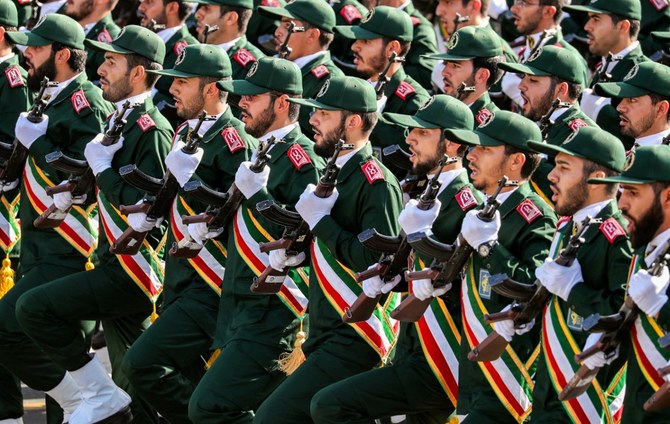
Iran’s Revolutionary Guards allocated $3bn amid crippled economy

The IRGC also receives revenue from illegal oil sales and is known to fund terrorist groups throughout the region. (File/AFP)
Short Url
Updated 16 January 2023
Follow

Iran’s Revolutionary Guards allocated $3bn amid crippled economy

  • Budget for state militia increased by 28 percent
  • More than half of the population now living below poverty line due to soaring inflation

LONDON: Iran’s regime is to plough billions of dollars into the Islamic Revolutionary Guards Corps as the regime bolsters its security apparatus amid protests, soaring inflation and a collapsing economy.

The militia was allocated $3 billion in the national budget, representing a 28 percent increase on last year, The Times reported. However, some experts estimate its actual income could be as high as $17 billion.

The IRGC, which has played a role in the violent crackdown of nationwide protests, also receives revenue from illegal oil sales and is known to fund terrorist groups throughout the region, including Hezbollah in Lebanon and the Houthis in Yemen.

Iran’s regular army had its budget increased by 36 percent to around $1.22 billion, and the police budget will increase by 44 percent to $1.55 billion. 

The intelligence ministry has received a 52 percent increase, approximately $500 million, while prison funding has increased by 55 percent, or $230 million. 

Iranian journalist Kourosh Ziabari said the “militarisation of the budget” was contrary to the needs of the Iranian people.

According to the Statistical Centre of Iran, inflation has reached more than 50 percent, the highest level in recent history. More than half of the population are now living below the poverty line. 

Iranian economic expert Mardo Soghom told The Times that crippling western sanctions were forcing the government to sell cut-price oil, with China buying at $37 a barrel — around half of the current global price and leaving only $7 profit for Iran on each barrel. 

Despite having the world’s second largest gas reserves after Qatar, the country lacks the technology to maximize its vast wealth. In the dead of winter, Iranians are being advised to turn down their heating.

“They need bigger platforms and huge pumps in order to extract the gas,” Soghom said.  

“Even their distribution network is a source of waste, around 40 percent of energy getting lost, including electricity. 

“They have had to shut down factories in order to get heat to households and last month, the government cut gas to 800 government entities to divert energy to homes because there was a snow storm.

“To improve production, the government needs about $40 billion in investments and western technology.

“This kind of technology is only available to western firms like Total and Exxon. China and Russia don’t even have this. Russia relies on BP for this kind of stuff, so with this foreign policy they [Iran] have, stuck in their animosity with the West, they have neither the money nor technology to improve like Qatar does.”


Delivery drivers dodge debris to keep Gulf fed under Iranian attacks

Updated 7 sec ago
Follow

Delivery drivers dodge debris to keep Gulf fed under Iranian attacks

  • Thousands of couriers on motorcycles have been working full throttle to ensure food, home supplies and whatever else a customer might need is available
  • UAE President Mohamed bin Zayed Al-Nahyan walked with his massive entourage through Dubai Mall pausing for an occasional selfie

DUBAI: As air raid sirens wail and explosions echo off glass skyscrapers, Gulf delivery drivers have emerged as unlikely heroes, providing a lifeline to frightened residents sheltering from Iranian attacks.
Airports, embassies, residential areas and military installations across the region have come under fire from daily salvos of Iranian missiles and drones since the war between the Islamic republic, Israel and the US broke out on Saturday.
While weaving through Gulf metropolizes’ traffic was never entirely safe, delivery drivers now face danger from the skies with the risk of falling debris from drones and interceptors.
Nonetheless, thousands of couriers on motorcycles have been working full throttle to ensure food, home supplies and whatever else a customer might need is available with the tap of an app.
During the war’s first hours, Agyemang Ata was in a mall in Dubai, waiting for an order when the first explosions rang out, but the 27-year-old has no plans to leave.
“My mom, sister and family have been calling me but I told them I am OK, they don’t need to worry about me,” Ata told AFP.
“I will stay here and work. Dubai is a safe place for me.”
To most residents, drivers like Ata were just an anonymous army keeping the hassles of daily life at bay — and to some, another traffic hazard on already busy streets.
Now, however, people are heralding their vital role, with many on social media describing them as “heroes” risking their lives to keep the Gulf running.
Further north in Kuwait, driver Walid Rabie said the fear was constant.
“We carry our lives along with the orders,” he told AFP
At least seven civilians have been killed in the Gulf since Iran began its attacks — many of them foreign laborers, who make up a large part of the region’s workforce.
Washington said six US service members have also been killed, four of them in Kuwait.

‘I have struggled’

The UAE has seen a disproportionate number of attacks, with the Ministry of Defense saying authorities have worked to intercept more than 900 drones and about 200 missiles fired at their territory.
“I’m afraid, I won’t lie,” said Franklin, a delivery driver in Dubai.
The need to earn a living outweighs other anxieties over the war, but maintaining his regular pace has been difficult under the new circumstances, and the number of orders has dropped.
“Before, I used to complete between 10 and 15 orders a day,” he explained. “But since this started, I have struggled to get even eight.”
The life of the drivers cuts a stark contrast to the region’s numerous influencers on social media, who have continued to party during the war, or to the city’s well-heeled expats, some of whom have dropped six figures on chartered flights out of neighboring countries to escape.
In Bahrain, where the sounds of explosions have continued for a sixth day, a foreign worker at a food delivery company said the situation was worrying at first but he has begun to get used to it — especially since he needs the job.
“I go out to work almost every day. I follow the news and hope the crisis will end,” said Ajit Arun, 32.
“We take precautions while driving, especially when the sirens sound.”
Across the Gulf, governments have implored their citizens and residents to avoid posting misinformation about the war and rely on official channels for news.
Others have sought to present an image of normality.
UAE President Mohamed bin Zayed Al-Nahyan walked with his massive entourage through Dubai Mall pausing for an occasional selfie.
But on the city’s streets, the reality of war weighed heavily, casting questions for some over future plans to stay in the Gulf.
“If things continue like this, I cannot risk my life,” said Franklin. “It would be better for me to return to my country.”