

Britain is actively considering proscribing Iran’s Revolutionary Guard, says minister

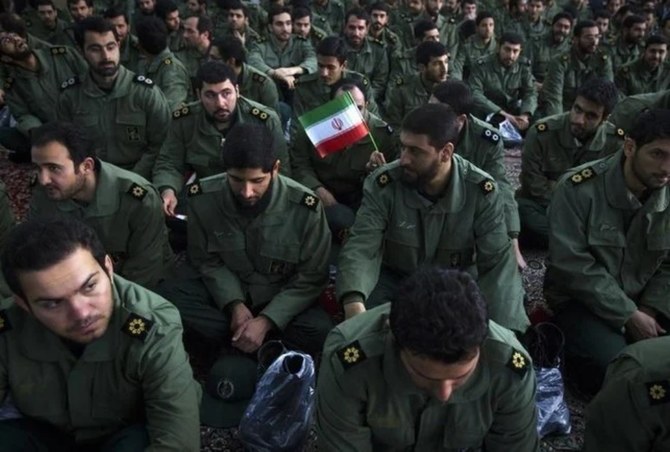
Britain is considering proscribing Iran's Revolutionary Guard as a terrorist organisation but has not reached a final decision on the matter. (Reuters/File)
Short Url
Updated 12 January 2023
Follow

Britain is actively considering proscribing Iran’s Revolutionary Guard, says minister

  • Action would mean it would become a criminal offense to belong to the group
  • Growing international threat against IRGC makes it more difficult for it to violently suppress protests, Iranian-Irish protester Amir Seifi says

LONDON: UK Foreign Office Minister Leo Docherty told parliament on Thursday that Britain is actively considering formally declaring that Iran’s Revolutionary Guard is a terrorist organization, but that no final decision has been made.

“It would be wrong of me to speculate... about the outcome of the government’s current consideration of this issue, which is active,” Docherty said during a debate on the situation in Iran, during which some lawmakers had called for proscription.

“But I can say that I think the calls right across the house, and the unity with which these calls are being made on all sides, will be noted by the government, and this is something that we regard as extremely serious.”

Proscribing Iran’s Revolutionary Guard as a terrorist group would mean that it would become a criminal offense in Britain to belong to the group, attend its meetings, and carry its logo in public.

Iranian-Irish national Amir Seifi, a supporter of the National Council of Resistance of Iran, was among those who demonstrated outside the UK parliament on Thursday.

Seifi told Arab News: “It is important to show them that the Iranian people support what they are doing and that they are also standing in solidarity with people in Iran.”

The 42-year-old said that the IRGC, from both an economic and military point of view, is the main force of the regime and its violence against protesters, and that imposing sanctions on it would effectively “cripple” the system.

“This is a regime that has been trying to instill fear in the hearts of the protesters and the Iranian people,” Seifi said. 

He added that the organization is aware of the growing international threat against it, making it more difficult for it to violently suppress protests while also gaining access to arms and equipment from the international community.

“The matter of proscribing the IRGC is something our resistance has been calling for so many years, but today the cross parties had massive support for it,” Seifi said. 

He added: “There was also condemnation for the behavior of the regime against the protesters, the brutal suppression, as well as against its meddling in the affairs of other countries and export of terrorism to other countries, especially in the Middle East.

“There were calls from many MPs to shut down the embassy of the regime and expel its diplomats. 

“At the end, there was a motion that was introduced that passed unanimously, which was unreservedly condemning the actions of the regime, the brutal suppression of protesters, and supporting the right of the Iranian protesters.”

The IRGC is already subject to British sanctions.


Hundreds mourn in Syria’s Homs after deadly mosque bombing

Updated 4 sec ago
Follow

Hundreds mourn in Syria’s Homs after deadly mosque bombing

HOMS: Hundreds of mourners gathered Saturday despite rain and cold outside of a mosque in the Syrian city of Homs where a bombing the day before killed eight people and wounded 18.
The crowd gathered next to the Imam Ali ibn Abi Talib Mosque in the Wadi Al-Dhahab neighborhood, where the population is predominantly from the Alawite minority, before driving in convoys to bury the victims.
Officials have said the preliminary investigations indicate explosive devices were planted inside the mosque but have not yet publicly identified a suspect.
A little-known group calling itself Saraya Ansar Al-Sunna claimed responsibility for the attack in a statement posted on its Telegram channel, in which it indicated that the attack intended to target members of the Alawite sect, an offshoot of Shia Islam whom hard-line Islamists consider to be apostates.
The same group had previously claimed a suicide attack in June in which a gunman opened fire and then detonated an explosive vest inside a Greek Orthodox church in Dweil’a, on the outskirts of Damascus, killing 25 people as worshippers prayed on a Sunday.
A neighbor of the mosque, who asked to be identified only by the honorific Abu Ahmad (“father of Ahmad“) out of security concerns, said he was at home when he heard the sound of a “very very strong explosion.”
He and other neighbors went to the mosque and saw terrified people running out of it, he said. They entered and began trying to help the wounded, amid blood and scattered body parts on the floor.
While the neighborhood is primarily Alawite, he said the mosque had always been open to members of all sects to pray.
“It’s the house of God,” he said. “The mosque’s door is open to everyone. No one ever asked questions. Whoever wants to enter can enter.”
Mourners were unable to enter the mosque to pray Saturday because the crime scene remained cordoned off, so they prayed outside.
Some then marched through the streets chanting “Ya Ali,” in reference to the Prophet Muhammad’s cousin and son-in-law whom Shiite Muslims consider to be his rightful successor.