

UAE likely to include hydrogen in revised energy strategy

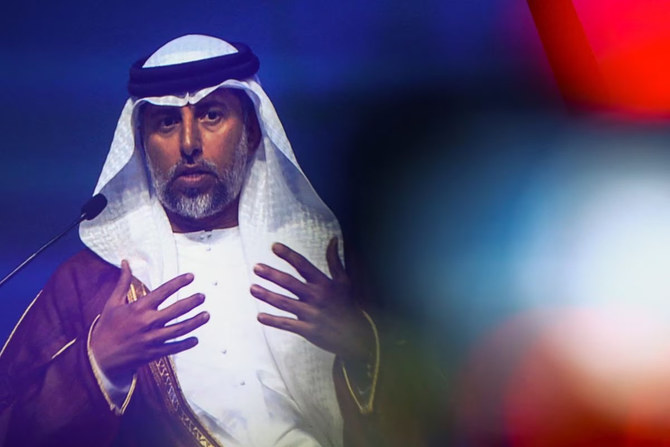
United Arab Emirates Oil Minister Suhail Al-Mazrouei speaks during the Abu Dhabi International Petroleum Exhibition and Conference (ADIPEC) in Abu Dhabi, United Arab Emirates. (Reuters/File)
Short Url
Updated 18 January 2023
Follow

UAE likely to include hydrogen in revised energy strategy

ABU DHABI: The UAE’s energy minister expects hydrogen to be included in a revised energy strategy, to be launched this year, as part of the Gulf state’s ambitions to become a top hydrogen exporter and advance its clean energy development projects.

It launched its energy strategy plan for 2050 in 2017 but is preparing to update it to align with its goal of achieving climate neutrality by 2050.

“My expectation is that it (the revised strategy) is going to put hydrogen as one element in the target of the strategy of energy by 2050,” Suhail Al-Mazrouei said at a hydrogen summit during Abu Dhabi Sustainability Week.

“That would require us to go and significantly increase the installed capacity of solar in order for us to produce enough hydrogen to use it as a fuel.”

In October, Al-Mazrouei said the UAE aimed to reach a 25 percent share of the hydrogen export market and that Japan, South Korea and Germany would be top destinations for it.

The UAE, one of the world’s top oil exporters, is preparing to host the UN’s climate conference COP28 toward the end of this year amid questions from some activists about fossil fuel interests dominating the debate.

Al-Mazrouei said the UAE hoped to demonstrate its ability to “walk the talk” by implementing projects and meeting clean energy targets.

The UAE launched 11 environmentally friendly energy projects worth AED 159 billion ($43.2 billion) in 2022, the energy minister recently revealed. Al-Mazrouei said that the country’s clean energy production in 2021 totaled 7,035.75 MW.

He said the UAE has adopted the latest innovations that drive the path of sustainable development and was among the first countries to ratify the Paris Agreement.


Aramco’s 13% rally helps Saudi stocks post second weekly gain

Updated 12 March 2026
Follow

Aramco’s 13% rally helps Saudi stocks post second weekly gain

RIYADH: Saudi Aramco extended its year-to-date rally to nearly 13 percent on Thursday, helping the Kingdom’s benchmark stock index secure a second straight weekly gain despite a weaker final trading session.  

Saudi Aramco shares, which carry the heaviest weighting on the Saudi Exchange, closed at SR26.86 ($7.16), leaving the stock 12.72 percent higher since the start of 2026. The stock also remained 3.09 percent above last week’s close, even after falling 1.1 percent in Thursday’s session.

The rise in energy shares came as escalating tensions in the Middle East pushed oil prices above $100 a barrel, after attacks on tankers in the Gulf and the Strait of Hormuz heightened concerns over supply disruptions.

The Tadawul All Share Index maintained its weekly uptrend, rising nearly 1.07 percent week on week to close at 10,778.32, despite falling 0.45 percent in Thursday’s session. Compared with the first trading day of the year, the index has gained 4.01 percent.

Total trading turnover on the benchmark index reached SR5.05 billion at Thursday’s close, with 88 stocks advancing and 176 declining.

Aramco’s performance continued to anchor sentiment after the company reported adjusted net income of $104.7 billion for 2025 earlier this week, while net profit fell 12.1 percent year on year to $93.39 billion, compared with $106.25 billion in 2024, as lower crude prices weighed on earnings despite higher sales volumes across oil, gas and refined products.

On a March 10 earnings call, Aramco CEO Amin Nasser warned that prolonged disruption in the Strait of Hormuz could have severe implications for global energy markets. Roughly 20 percent of the world’s oil normally passes through the waterway each day, but shipments have been largely blocked.

“There would be catastrophic consequences for the world’s oil markets and the longer the disruption goes on ... the more drastic the consequences for the global economy,” he said.

“While we have faced disruptions in the past, this one by far is the biggest crisis the region’s oil and gas industry has faced.”

Saudi equities showed mixed performance in Thursday’s session. The MSCI Tadawul Index fell 5.99 points, or 0.40 percent, to close at 1,476.76.

The Kingdom’s parallel market Nomu gained 132.47 points, or 0.6 percent, to close at 22,370.4, with 38 stocks advancing and 34 declining.

On March 11, the International Energy Agency announced the release of 400 million barrels of oil from its reserves, the largest such move in its history. As part of that, the US said it would release 172 million barrels starting next week.