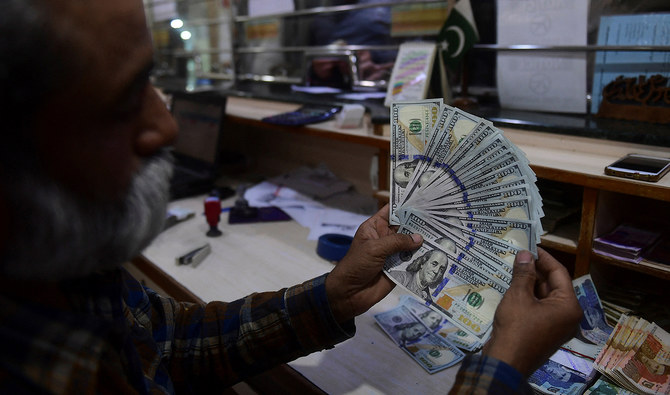

ISLAMABAD: The governor of Pakistan’s central bank said on Wednesday the country expected to receive dollar inflows in the coming week, as the South Asian nation faces a severe forex crisis, with State Bank reserves falling to a critical level of $4.3 billion.
As the specter of default looms large, Prime Minister Shehbaz Sharif’s administration has been desperately seeking external financing, particularly a loan tranche from the International Monetary Fund (IMF) which has been pending since September last year.
“We are expecting dollar inflows into the country from next week, after which our foreign exchange reserves will start increasing,” governor of the State Bank of Pakistan (SBP), Jameel Ahmad, said on Wednesday, speaking to a group of businesspeople at the Federation of Pakistan Chambers of Commerce and Industry (FPCCI) in Karachi.
He did not disclose the exact amount of the inflows or where they would come from.
Ahmad said the government was aware of the “difficulties” the business community was facing because of the country’s inability to resume imports but added that the situation would improve in the coming week.
“The incoming dollars will allow us to remove the restrictions on imports,” he added.
“We have chalked out a plan to facilitate the business community but import decisions have to be made keeping in view the dollars we have in reserves,” Ahmad said.
Last year, the cash-strapped country imposed a ban on the import of luxury goods to avoid a balance of payment crisis but lifted some of the restrictions after pressure from the industrial sector.
Experts warn that a dire dollar crunch in Pakistan may further hurt the import of essential items in the coming months and lead to a shortage of several food items.
The fast-depleting forex stockpile has currently left banks refusing to issue new letters of credit (LCs) for importers, hitting an economy already squeezed by soaring inflation and lackluster growth. The central bank has also restricted overseas payments and halved the amount of foreign currency that a person can carry overseas to $5,000.
On Monday, finance minister Ishaq Dar assured the export industry of relief in the future.
“Five (previously) Zero Rated Export Oriented Sectors & all other Exporters will be given complete facilitation for import of Raw Material, Parts and Accessories to meet their Export requirements,” he said, without specifying what measures would be taken.
According to a statement released by the FPCCI, the central bank governor announced to form a joint committee with the chamber for the resolution of the huge backlog in LCs.
FPCCI president Irfan Iqbal Sheikh maintained that all import consignments not involving dollar outflows should be cleared with immediate effect. He also said the SBP should “come up with crystal clear plan on the importers can order from international suppliers to enable the business community to keep the trust of suppliers.”
The IMF approved the seventh and eighth reviews of Pakistan’s bailout program, agreed in 2019, together in August to allow the release of more than $1.1 billion. Pakistan secured a $6 billion bailout in 2019, that was topped up with another $1 billion earlier this year.
With its dwindling reserves, the IMF program is critical for Pakistan, which urgently need external financing to support an economy that was badly battered by devastating floods in the last monsoon season.
More than $9 billion in pledges were made by the international community for the flood recovery at a climate conference in Geneva last week.
Long-time ally Saudi Arabia said recently it was considering investing $10 billion in the South Asian nation of 220 million and increasing its deposits in the country’s central bank from $3 billion to $5 billion. Earlier this month, PM Shehbaz Sharif said the United Arab Emirates had also agreed to extend a $2 billion loan to his country and provide an additional $1 billion.