

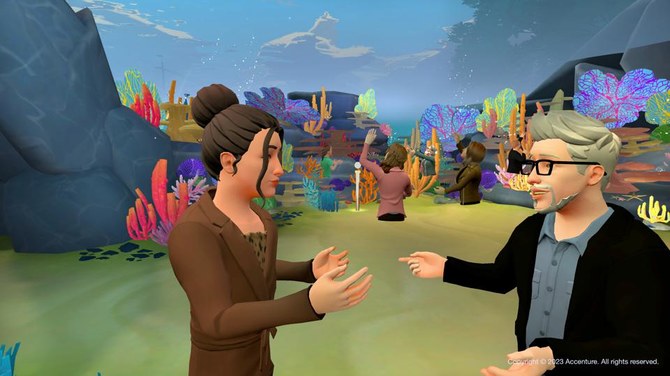
WEF launches ‘virtual global village’ in the metaverse

More than 80 organizations and founding partners are backing the project, which seeks to bridge the physical and digital worlds, and establish new types of work collaboration. (WEF/File)
Short Url
Updated 17 January 2023
Follow

WEF launches ‘virtual global village’ in the metaverse

  • Virtual space will promote ‘more diverse global collaboration and large-scale action’
  • Founding partners include Saudi government, Aramco, Dubai Future Foundation

LONDON: The World Economic Forum in collaboration with Microsoft and Accenture on Tuesday announced the launch of the Global Collaboration Village, a metaverse project to help tackle some of the world’s most pressing challenges.

The virtual village will “bolster more diverse global collaboration and large-scale action,” the WEF believes.

“We are creating the first public purpose-oriented application of the metaverse technology, building a true global village in the virtual space,” said Klaus Schwab, WEF founder and executive chairman. 

The village, supported by both private and public partners, will “use the frontier capabilities of the metaverse to find solutions for addressing the big issues of our time in a more open, inclusive and sustained way,” he said.

More than 80 organizations and founding partners are backing the project, which seeks to bridge the physical and digital worlds, and establish new types of work collaboration.

Companies and public institutions, including IBM and Meta, as well as the Saudi government and UN, will meet in the first-ever interactive, multilateral session in the metaverse.

“We believe the metaverse has the potential to fundamentally change the way we communicate and collaborate, overcoming limitations of the physical world to deliver enhanced connections for everyone,” said Brad Smith, vice-chair and president of Microsoft.

The village is “a prime example of how we can use metaverse technology to bring people and communities together in new ways,” he said.

It will feature a town hall, which serves as the forum’s “virtual congress center,” and several virtual collaboration spaces.

Stakeholder campuses will allow partners to shape their presence and the village’s development.

Based on the forum’s guiding principles, the project hopes to further bolster learning, collaboration and partnership, and strengthen and re-energize international cooperation.


‘No Other Land’ director’s home, family attacked by Israeli soldiers in West Bank

Updated 18 February 2026
Follow

‘No Other Land’ director’s home, family attacked by Israeli soldiers in West Bank

  • Hamdan Ballal’s brother held ‘round his neck,’ filmmaker says
  • Other relatives handcuffed, blindfolded, detained, reports say

DUBAI: Hamdan Ballal, one of the four directors of the Oscar-winning documentary “No Other Land,” said that his home was attacked by Israeli soldiers and that several members of his family were injured and detained, according to media reports.

Settler attacks on Masafer Yatta, a cluster of villages in the southern West Bank, had intensified, the filmmaker said.

Ballal said he called the police on Sunday to enforce a ruling that prohibited non-residents from entering the area around his home in the village of Susya, but was instead visited by soldiers and a local settler leader.

The director, who was not at home at the time, said the soldiers raided his property and attacked everyone inside, including his brother, Mohammed Ballal, who was held “round his neck,” which caused him to turn blue and left him struggling to breathe.

Several other family members, including two brothers, a nephew and a cousin, were stopped by soldiers while traveling from a nearby village. They were handcuffed, blindfolded and detained for three hours at an army base, before being released later the same night, Ballal said.

A spokesperson for the army said that “a number of Palestinians adjacent to the area of Susya” were detained for refusing to identify themselves to soldiers but emphasized that “IDF soldiers did not assault them and did not raid their home.”

Ballal said that he was attacked last year by the same Israeli settler who attacked his family on Sunday. He said he was released the following day with injuries to his head and stomach.

“Two weeks ago we managed to get a decision from the Israeli court that the area around my home is closed to non-residents, but the settlers break that order and still come with their flocks almost every day,” the filmmaker said in a statement.

The ruling “was supposed to make things a bit quieter for us,” but the “opposite has been true,” as settlers have “ramped up their harassment and the Israeli authorities have done nothing to enforce the decision and today they joined the settlers in the attack,” he said.

In recent days, Israel has introduced a set of measures aimed at deepening its control over the West Bank.

On Sunday, the government approved a plan that allows Israelis to register land in the West Bank for the first time since the registration process was frozen following the 1967 war, when Israel captured the territory from Jordan.

The move has been widely condemned by humanitarian and advocacy groups.

UN Secretary-General Antonio Guterres called on Israel to reverse its decision, which he said could “lead to the dispossession of Palestinians of their property and risks expanding unlawful Israeli control over land in the area.”

In a joint statement on Tuesday, more than 80 UN member states said they strongly condemned “unilateral Israeli decisions and measures aimed at expanding Israel’s unlawful presence in the West Bank.”

“Such decisions are contrary to Israel’s obligations under international law and must be immediately reversed,” it said.

Legal advocacy group Adalah said it had sent an urgent letter to Israeli ministers demanding the “immediate cancellation” of the land registry decision.

Adalah’s legal director Dr. Suhad Bishara said that Israel’s decision “deepens the gravest violations of international law, including the continued commission of war crimes (settlements), crimes against humanity (apartheid) and the crime of aggression (de facto and de jure annexation).”