RAMALLAH: Palestinian human rights organizations have accused the Israeli army of modifying firing orders against Palestinians resulting in an unprecedented number of killings since December.
The move has followed the formulation of a far-right Israeli government under Prime Minister Benjamin Netanyahu.
The shooting victims had posed no threat to the lives of Israeli soldiers, the rights groups claimed.
Fifteen Palestinians have been killed in the West Bank since the beginning of the year. The latest was 40-year-old Palestinian policeman Hamdi Abu Dayyeh, who was shot dead on Tuesday by Israeli soldiers in the town of Halhul, north of Hebron, in the southern West Bank.
Ahmed Kahla, 45, from Silwad, east of Ramallah, was killed by troops at the beginning of the week.
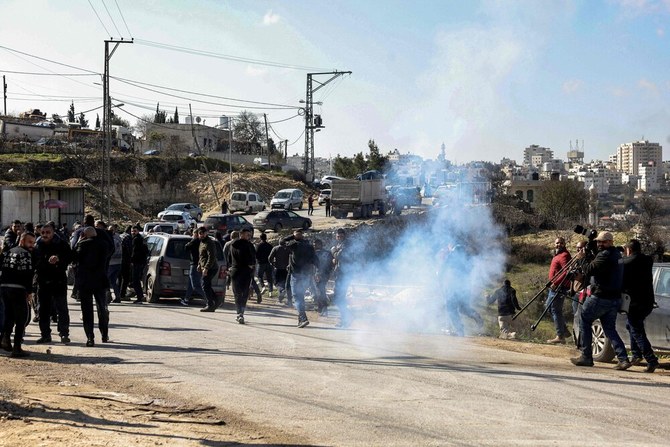
His eldest son, Qusai Kahla, who was with him when the soldiers opened fire, said they were on their way to work in the morning when their car was stopped at an Israeli checkpoint. The soldiers fired a stun grenade that hit the roof of the vehicle and then they used pepper spray against them.
Video footage showed a fistfight taking place between Kahla’s father and some Israeli soldiers, one of which shot him at point-blank range.
Similarly, in late December, the Israeli army shot Ammar Mufleh, 23, at close quarters in Hawara near Nablus.
Ammar Dweik, director of the Palestinian Independent Commission for Human Rights, told Arab News: “New amendments are constantly being made to these instructions to facilitate shooting at Palestinians, and the aim is to give legal protection to Israeli soldiers and cover up their crimes in the field against the Palestinians.”
The last amendment to the shooting instructions was given in December, he said, “and since then we have witnessed an escalation in killings and field executions.”
Israeli Minister of National Security Itamar Ben-Gvir recently praised a soldier who killed a Palestinian in the town of Al-Dhahiriya, south of Hebron.
“We see incitement by Israeli politicians to kill Palestinians. The essence of the new instructions is that the soldier can shoot and use lethal force when he feels the slightest suspicion,” Dweik added.
The victims of Israeli shooting policy are not compensated even if shot by mistake, unless they are American. Because of US pressure, the Israeli army compensated the family of an American victim in the fall of last year.
Palestinian rights groups hope to influence international public opinion to pressure Israel to stop the violations through their documentation and publication of the killings.
Dweik said: “We, as human rights institutions, are constantly following up on this matter, and the Palestinian Foreign Ministry has submitted a file to the International Criminal Court on the issue of field executions. It shows that what is happening is a policy of extrajudicial killings under flimsy pretexts and not isolated incidents.”
According to the Palestinian Ministry of Health, the Israeli army killed 170 Palestinians in the West Bank, and six in Israel, during 2022.
A senior Israeli security official told Arab News that the firing orders were the same as previous ones, but what differed was their application.
He pointed out that the orders stipulated that if a soldier feared a threat to their life, they were allowed to shoot toward the source of danger gradually — first in the air, then toward the legs, then the abdomen.
“This is possible when there is a distance between them and the attacker and sufficient time, but if they are surprised by an attack, they can only shoot to neutralize the attacker, and that may mean killing them,” the official said, adding that it was forbidden to continue shooting after neutralizing the danger.
He said that in the event of armed clashes between Israeli soldiers and Palestinians, “the best-armed, the most trained, and the most efficient in using weapons prevail. Therefore, you see that the dead are always on the side of the Palestinian armed men, not the soldiers. Therefore, the picture appears incomplete, as if they were killed suddenly, while the truth is that they were killed in an armed clash.”
He added that the orders dictated that if an army force came under fire, it must keep responding to the fire source until it was silenced.
“Every night, we carry out a campaign of arrests in the camps, cities, and villages of the West Bank, and in most of the arrest operations, we are exposed to shooting by the Palestinians. Naturally, our trained snipers target the untrained gunmen who shoot at our forces,” he said.
Another Israeli military expert told Arab News that the Israel Defense Forces’ shooting rules and orders were kept in the highest secrecy and were not even revealed to the Americans.
Separately, Jordan summoned the Israeli ambassador to the Foreign Ministry’s headquarters in Amman after Israeli authorities prevented the Jordanian ambassador to Palestine, Ghassan Al-Majali, from entering Al-Aqsa Mosque in Jerusalem.
Israeli police at the Lions Gate demanded that Al-Majali obtain prior permission to visit, which he refused to do.
A ministry spokesman said the Israeli envoy had been given a strongly worded letter of protest to be conveyed immediately to his government.


![]()

Rights groups slam rise in Palestinian shooting deaths, protection for Israeli soldiers
Short Url
https://arab.news/4ftqf
Rights groups slam rise in Palestinian shooting deaths, protection for Israeli soldiers
- The move has followed the formulation of a far-right Israeli government under Prime Minister Benjamin Netanyahu
- The shooting victims had posed no threat to the lives of Israeli soldiers, the rights groups claimed

Latest updates


© 2026 SAUDI RESEARCH & PUBLISHING COMPANY, All Rights Reserved And subject to Terms of Use Agreement.