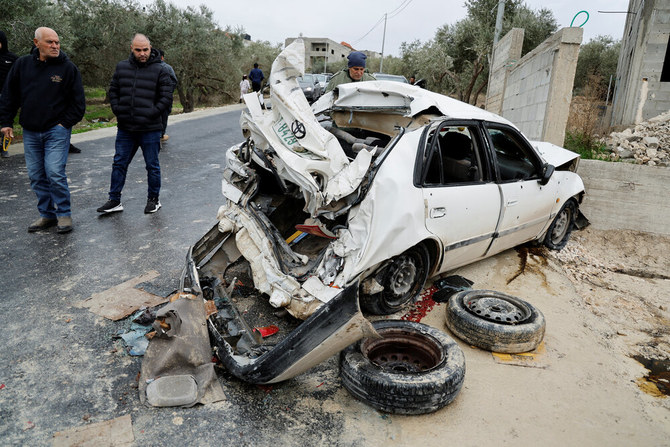
RAMALLAH: Israeli troops shot and killed two Palestinian men during a raid in the occupied West Bank early on Saturday, while a third Palestinian died of wounds sustained in a separate Israeli operation two weeks earlier, Palestinian medical officials said.
The two victims were in a vehicle when they were targeted. The deaths bring to 12, including three children, the number of Palestinians killed by Israeli forces so far this year.
The Jenin Brigade said in a statement that the killing of the three young men will not go unpunished.
Mohammad Shtayyeh, Palestinian prime minister, called for international protection from Israeli forces’ “oppression.”
Gaza ruling party Hamas urged Palestinians “to continue resisting the Israeli occupation with all means possible.”
In a statement, it said: “We emphasize that the continued aggressive policy adopted by the fascist Israeli occupation government against the Palestinian people and their lands and holy sites will not grant it a sense of purported security.”
Such a policy, it added, would not succeed in undermining the steadfastness and resilience of Palestinians.
Rawhi Fattouh, president of the Palestinian National Council, said in a statement: “The pace of fascist terrorism in Israel is escalating through the execution and murder policies of the new extremist government.
“The fascist occupation is trying, through its bloody terror, daily executions, continuous aggression on the Palestinian lands, and public threats against our prisoners, to export its internal crises.”
The Palestinian Foreign Ministry said that the Israeli “occupation practices extrajudicial killings, field executions, and fires live bullets at Palestinian citizens,” with instructions to “kill and degrade the lives of citizens coming from the political and military echelons of the occupying state.”
It called on the international community and the US administration to exert real pressure on Israel to “stop its bloody escalation against our people.”
The ministry urged the International Criminal Court to quickly complete its investigations, and hold Israel and the perpetrators to account.
An increase in the number of killings indicates that the current year will be worse than 2022, which was considered bloodier than 2021.
Mustafa Al-Barghouti, secretary-general of the Palestinian National Initiative Movement, denounced the “criminality of the Israeli occupation army, which deliberately executes the Palestinian people in cold blood every day” during its incursions into cities, camps and villages in the West Bank.
However, he said that these daily killings, carried out at the behest of Itamar Ben-Gvir, Israel’s new security minister, and other extremists in the Israeli government, will not slow the pace of resistance.
Meanwhile, dozens of Palestinians protesting against the seizing of Palestinian lands in Zuwaidin, Masafer Yatta, south of Hebron, by settlers were halted by Israeli troops, who fired stun grenades and tear gas to break up the demonstration.
Israeli forces set up checkpoints in the area and also detained Mashhour Al-Wahwah, a photographer with the Palestinian Wafa news agency, for several hours.
The latest killings by the Israeli army coincided with a violent escalation of settler attacks on Palestinians.
On Friday afternoon, young settlers attacked a group of Palestinians, accompanied by American, French and Italian activists, who were taking part in a march near Jericho. Some sustained moderate injuries and were treated in hospital.
Palestinians living inside Israel accuse the new Israeli government of seeking to seize Negev (southern Israel) through racist laws, policies and measures aimed at more than 300,000 Bedouin citizens living there.
In 2013, 697 homes were demolished in the Negev, with the number rising to 1,073 in 2014, 982 in 2015, 1,158 in 2016, and 3,000 in 2021.
Palestinian citizens say that Israel considers their presence in the Negev dangerous.
They believe that the escalation of the right-wing Israeli government’s policies will force them into clashes, as happened a year ago.
Yousef Jabarin, a former Knesset member and university law professor, told Arab News that current right-wing ministers in the Israeli government began to incite and intimidate Palestinians in the Negev even before taking office.
He said that Israel has so far refused to recognize more than 40 Palestinian villages and towns there, some of which were built and established before the state of Israel came into being, and refuses to provide them with essential services.
“There is fear that this government will adopt a policy of displacement against the Palestinian residents of the Negev, and the Negev will be a hot spot of friction if the extremists in this government try to implement their plans against the Palestinians in the Negev,” Jabarin said.

Three more Palestinians killed by Israeli forces
Short Url
https://arab.news/9hbjf
Three more Palestinians killed by Israeli forces
- Negev residents accuse government of trying to force them off their land
- Gaza ruling party Hamas urged Palestinians “to continue resisting the Israeli occupation with all means possible”
A look at Ramadan and how Muslims observe the holy month
- Ramadan is the ninth month of the Islamic lunar calendar; the month cycles through the seasons
- Ramadan is followed by the Islamic holiday of Eid Al-Fitr
CAIRO: Observant Muslims the world over will soon be united in a ritual of daily fasting from dawn to sunset as the Islamic holy month of Ramadan starts. For Muslims, it’s a time for increased worship, religious reflection and charity. Socially, it often brings families and friends together in festive gatherings around meals to break their fast.
Ramadan is followed by the Islamic holiday of Eid Al-Fitr.
First day of Ramadan expected around Feb. 18-19
Ramadan is the ninth month of the Islamic lunar calendar; the month cycles through the seasons.
The start of the month traditionally depends on the sighting of the crescent moon. This year, the first day of Ramadan is expected to be on or around Feb. 18 or 19. The actual start date may vary among countries and Muslim communities due to declarations by multiple Islamic authorities around the globe on whether the crescent had been sighted or different methodologies used to determine the beginning of the month.
This year, the start of Ramadan is expected around the same time as Ash Wednesday, a solemn day of fasting and reflection that signals the start of Lent, the most penitential season of the church calendar for Catholics and many other Christians.
Fasting is one of the pillars of Islam
Fasting is one of the Five Pillars of Islam, along with the profession of faith, prayer, almsgiving and pilgrimage.
Muslims see various meanings and lessons in observing the fast.
It’s regarded as an act of worship to attain piety and one of submission to God. The devout see benefits, including practicing self-restraint, cultivating gratitude and empathizing with people who are poor and hungry.
The daily fast in Ramadan includes abstaining from all food and drink — not even a sip of water is allowed — from dawn to sunset, before breaking the fast in a meal known as “iftar” in Arabic.
Muslims typically stream into mosques for congregational prayers and dedicate more time to religious contemplation and the reading of the Qur’an, the Muslim holy book.
Charity is a hallmark of Ramadan. Among other ways of giving, many seek to provide iftar for those in need, distributing Ramadan boxes filled with pantry staples, handing out warm meals alongside such things as dates and juice or helping hold free communal meals.
Muslims eat a predawn meal, called “suhoor,” to hydrate and nurture their bodies ahead of the daily fast.
Exemptions from fasting
There are certain exemptions, such as for those who are unable to because of illness or travel. Those unable to fast due to being temporarily ill or traveling need to make up for the missed days of fasting later.
Cultural and social traditions associated with Ramadan
Muslims are ethnically and racially diverse and not all Ramadan traditions are rooted in religion. Some customs may transcend borders, while others can differ across cultures.
Many social rituals center on gathering and socializing after the daily fast. Some Muslims decorate their homes, put out Ramadan-themed tableware and centerpieces or throng to markets and Ramadan bazaars.
In Egypt, Ramadan is typically a festive time. Colorful lanterns, in different shapes and sizes, dangle from children’s hands and adorn homes. Ramadan songs may be played to welcome the month.
Ramadan’s soundscape in Egypt has traditionally included the predawn banging on drums by a “mesaharati” who roams neighborhoods, calling out to the faithful, sometimes by name, to wake them up for the suhoor meal.
New TV shows and communal meals
A lineup of new television series is another social fixture of the month in some countries, and advertisers compete for viewers’ attention.
In various regions, some Muslims worry that the month is getting commercialized, and say an emphasis on decorations, TV shows, outings or lavish iftar banquets can detract from Ramadan’s religious essence. Others say that a balance can be struck and that, in moderation, such rituals are part of the month’s festive spirit.
In Indonesia, Ramadan rituals vary across regions, reflecting the diversity of cultures. In deeply conservative Aceh province, animals are slaughtered during Meugang festivities, the meat cooked and shared with family, friends, poor people and orphans.
Hundreds of residents in Tangerang, a city outside the capital, Jakarta, flock to the Cisadane River to wash their hair with rice straw shampoo and welcome the fasting month with a symbolic spiritual cleansing.
Across the island of Sumatra, after evening prayers, many boys and girls parade through the streets, carrying torches and playing Islamic songs.
In the United States, where Muslims make up a racially and ethnically diverse minority, gathering at mosques and Islamic centers when possible for iftar meals and prayers provides many Muslim families with a sense of community. Some Muslims also organize or attend interfaith iftar meals.
Ramadan is followed by the Islamic holiday of Eid Al-Fitr.
First day of Ramadan expected around Feb. 18-19
Ramadan is the ninth month of the Islamic lunar calendar; the month cycles through the seasons.
The start of the month traditionally depends on the sighting of the crescent moon. This year, the first day of Ramadan is expected to be on or around Feb. 18 or 19. The actual start date may vary among countries and Muslim communities due to declarations by multiple Islamic authorities around the globe on whether the crescent had been sighted or different methodologies used to determine the beginning of the month.
This year, the start of Ramadan is expected around the same time as Ash Wednesday, a solemn day of fasting and reflection that signals the start of Lent, the most penitential season of the church calendar for Catholics and many other Christians.
Fasting is one of the pillars of Islam
Fasting is one of the Five Pillars of Islam, along with the profession of faith, prayer, almsgiving and pilgrimage.
Muslims see various meanings and lessons in observing the fast.
It’s regarded as an act of worship to attain piety and one of submission to God. The devout see benefits, including practicing self-restraint, cultivating gratitude and empathizing with people who are poor and hungry.
The daily fast in Ramadan includes abstaining from all food and drink — not even a sip of water is allowed — from dawn to sunset, before breaking the fast in a meal known as “iftar” in Arabic.
Muslims typically stream into mosques for congregational prayers and dedicate more time to religious contemplation and the reading of the Qur’an, the Muslim holy book.
Charity is a hallmark of Ramadan. Among other ways of giving, many seek to provide iftar for those in need, distributing Ramadan boxes filled with pantry staples, handing out warm meals alongside such things as dates and juice or helping hold free communal meals.
Muslims eat a predawn meal, called “suhoor,” to hydrate and nurture their bodies ahead of the daily fast.
Exemptions from fasting
There are certain exemptions, such as for those who are unable to because of illness or travel. Those unable to fast due to being temporarily ill or traveling need to make up for the missed days of fasting later.
Cultural and social traditions associated with Ramadan
Muslims are ethnically and racially diverse and not all Ramadan traditions are rooted in religion. Some customs may transcend borders, while others can differ across cultures.
Many social rituals center on gathering and socializing after the daily fast. Some Muslims decorate their homes, put out Ramadan-themed tableware and centerpieces or throng to markets and Ramadan bazaars.
In Egypt, Ramadan is typically a festive time. Colorful lanterns, in different shapes and sizes, dangle from children’s hands and adorn homes. Ramadan songs may be played to welcome the month.
Ramadan’s soundscape in Egypt has traditionally included the predawn banging on drums by a “mesaharati” who roams neighborhoods, calling out to the faithful, sometimes by name, to wake them up for the suhoor meal.
New TV shows and communal meals
A lineup of new television series is another social fixture of the month in some countries, and advertisers compete for viewers’ attention.
In various regions, some Muslims worry that the month is getting commercialized, and say an emphasis on decorations, TV shows, outings or lavish iftar banquets can detract from Ramadan’s religious essence. Others say that a balance can be struck and that, in moderation, such rituals are part of the month’s festive spirit.
In Indonesia, Ramadan rituals vary across regions, reflecting the diversity of cultures. In deeply conservative Aceh province, animals are slaughtered during Meugang festivities, the meat cooked and shared with family, friends, poor people and orphans.
Hundreds of residents in Tangerang, a city outside the capital, Jakarta, flock to the Cisadane River to wash their hair with rice straw shampoo and welcome the fasting month with a symbolic spiritual cleansing.
Across the island of Sumatra, after evening prayers, many boys and girls parade through the streets, carrying torches and playing Islamic songs.
In the United States, where Muslims make up a racially and ethnically diverse minority, gathering at mosques and Islamic centers when possible for iftar meals and prayers provides many Muslim families with a sense of community. Some Muslims also organize or attend interfaith iftar meals.
© 2026 SAUDI RESEARCH & PUBLISHING COMPANY, All Rights Reserved And subject to Terms of Use Agreement.