BERLIN: German Chancellor Olaf Scholz said Tuesday he will appoint a regional official as the new defense minister following the resignation of the much-criticized Christine Lambrecht.
The defense minister-designate, Boris Pistorius, is a member of Scholz’s Social Democratic Party and has served as interior minister of Lower Saxony state since 2013.
“I am very pleased to have won Boris Pistorius, an outstanding politician from our country, for the post of defense minister,” Scholz said in a written statement.
“Pistorius is an extremely experienced politician who has administrative experience, has been involved in security policy for years and, with his competence, assertiveness and big heart, is exactly the right person to lead the Bundeswehr through this change of era,” the chancellor added.
Pistorius, 62, is scheduled to receive his certificate of appointment from German President Frank-Walter Steinmeier and take his oath of office in parliament on Thursday, government spokesman Steffen Hebestreit said.
Following Lambrecht’s resignation, the chancellor consulted closely with the members of his party and parliamentary group leaders and decided on Pistorius as the new defense minister, Hebestreit said in a written statement.
“I’m convinced this is someone who will get along with the troops and whom the servicemen and women will like very much,” Scholz told reporters later on Tuesday.
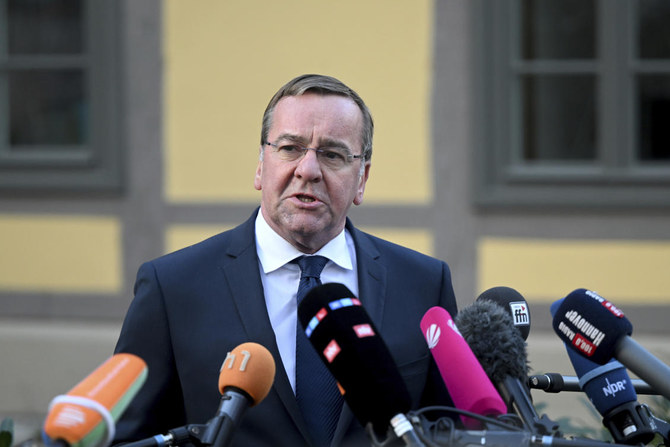
The designated defense minister thanked the chancellor for his nomination and said it is “truly an extraordinary honor for me to take on this office.”
“I know the importance of the task in these times,” Pistorius told reporters. “The tasks that lie ahead of the troops are enormous ... I want to make the Bundeswehr strong for the times that lie ahead.”
Lambrecht announced her resignation on Monday.
Pistorius is inheriting the job of steering Germany’s military modernization project and overseeing expanding weapons deliveries to Ukraine amid Russia’s war.
He also is getting quickly thrown into the deep end of his new position. US Defense Secretary Lloyd Austin is scheduled to visit Berlin this week and then host a meeting of allies at Ramstein Air Base in western Germany. On Sunday, the German and French governments are expected to hold bilateral talks that include a meeting of the countries’ joint security council.
Pistorius completed his military service from 1980 to 1981, then studied law in the western German towns of Osnabrueck and Muenster.
Before being appointed interior minister of Lower Saxony, he served as mayor of Osnabrueck from 2006 to 2013, Germany news agency dpa reported.
Lambrecht had been defense minister since Scholz became chancellor in December 2021. Critics had long portrayed her as being out of her depth.
The German government has faced mounting pressure to make another significant step forward in German military aid to Ukraine by agreeing to deliver Leopard 2 battle tanks. Earlier this month, the government agreed to provide 40 Marder armored personnel carriers and a Patriot air defense missile battery to Kyiv.
Germany has given Ukraine substantial support in recent months, including howitzers, Gepard self-propelled anti-aircraft guns and the first of four IRIS-T surface-to-air missile systems. But critics, some inside Germany’s governing coalition, have long complained of Scholz’s perceived hesitancy to step up aid.
Vice-Chancellor Robert Habeck, a member of Germany’s Greens party, welcomed Scholz’ choice of Pistorius. He pointed out that the job comes with a lot of responsibility, especially after Russia’s attack on Ukraine almost a year ago.
“Germany, as part of the European Union and NATO, must be ready to defend itself and strengthen its defense capability, in close cooperation with its partners,” he said.
“There are also important decisions to be made in the short term, in particular the pressing question of how we continue to support Ukraine in its right to self-defense,” Habeck added.


![]()

Germany to appoint regional official as defense minister
Short Url
https://arab.news/4rxn8
Germany to appoint regional official as defense minister
- The defense minister-designate, Boris Pistorius, is a member of Scholz’s Social Democratic Party
- “I am very pleased to have won Boris Pistorius, an outstanding politician from our country, for the post of defense minister," said Scholz


Latest updates


© 2026 SAUDI RESEARCH & PUBLISHING COMPANY, All Rights Reserved And subject to Terms of Use Agreement.