

Pakistan joins 40 UN member states urging Israel to lift ‘punitive’ sanctions on Palestinians

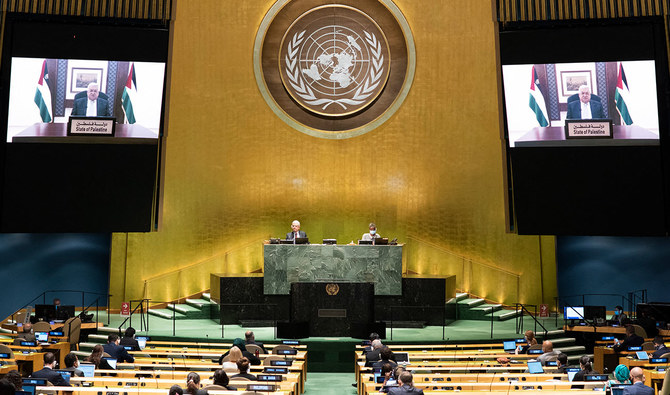
This UN handout photo shows Mahmoud Abbas, President of the State of Palestine, as he virtually addresses the general debate of the 75th session of the United Nations General Assembly, on September 25, 2020, in New York. (AFP PHOTO / UNITED NATIONS / EVAN SCHNEIDER)
Short Url
Updated 17 January 2023
Follow

Pakistan joins 40 UN member states urging Israel to lift ‘punitive’ sanctions on Palestinians

  • On December 30, UN General Assembly passed a resolution requesting an opinion from International Court of Justice on Israeli occupation
  • In retaliation, Israel announced a series of sanctions, including financial ones, on January 6 against the Palestinian Authority

UNITED NATIONS: Some 40 countries on Monday called on Israel to lift sanctions it imposed on the Palestinian Authority earlier this month over its push to get the UN’s top court to issue an advisory opinion on the Israeli occupation.

On December 30, the UN General Assembly passed a resolution requesting an opinion from the International Court of Justice on the issue of the Israeli occupation of Palestinian territories.

In retaliation, Israel announced a series of sanctions, including financial ones, on January 6 against the Palestinian Authority to make it “pay the price” for pushing for the resolution.

In a statement to journalists Monday, some 40 United Nations member states, reaffirming their “unwavering support” for the ICJ and international law, expressed “deep concern regarding the Israeli government’s decision to impose punitive measures against the Palestinian people, leadership and civil society following the request by the General Assembly” to the court.

“Regardless of each country’s position on the resolution, we reject punitive measures in response to a request for an advisory opinion by the International Court of Justice, and more broadly in response to a General Assembly resolution, and call for their immediate reversal,” the members said.

The statement is signed by countries that voted for this resolution (Algeria, Argentina, Belgium, Ireland, Pakistan and South Africa, among others) but also by some that abstained — Japan, France and South Korea — and others that voted against, like Germany and Estonia.

“This is significant as it shows that regardless of how countries have voted, they are united in rejecting these punitive measures,” the Palestinian ambassador to the UN, Riyad Mansour, said in a statement.

Asked about the members’ statement, a spokeswoman for the UN secretary-general reiterated Antonio Guterres’s “deep concern” about “recent Israeli measures against the Palestinian Authority,” stressing that “there should be no retaliation” in connection with the ICJ.

A UN Security Council meeting on the Palestinian issue is scheduled for Wednesday.

A previous meeting this month, after the visit of an Israeli minister to the Al-Aqsa Mosque, known in Judaism as the Temple Mount, led to a tense verbal exchange between Israeli and Palestinian diplomats.


Pakistan urges pilgrims to complete Saudi biometrics as Hajj preparations gain pace

Updated 30 January 2026
Follow

Pakistan urges pilgrims to complete Saudi biometrics as Hajj preparations gain pace

  • Government warns pilgrims biometric verification is required for Hajj visas
  • Step follows tighter oversight after last year’s Hajj travel disruptions

ISLAMABAD: Pakistan’s government on Friday urged aspiring pilgrims to complete mandatory Saudi biometric verification for Hajj visas, as preparations for the 2026 pilgrimage gather pace following stricter oversight of the Hajj process.

The announcement comes only a day after Pakistan’s Religious Affairs Minister Sardar Muhammad Yousuf said regulations for private Hajj operators had been tightened, reducing their quota following widespread complaints last year, when tens of thousands of pilgrims were unable to travel under the private Hajj scheme.

“Saudi biometric verification is mandatory for the issuance of Hajj visas,” the Ministry of Religious Affairs said in a statement, urging pilgrims to complete the process promptly to avoid delays.

“Hajj pilgrims should complete their biometric verification at home using the ‘Saudi Visa Bio’ app as soon as possible,” it added.

The statement said the pilgrims who were unable to complete biometric verification through the mobile application should visit designated Saudi Tasheer centers before Feb. 8, adding that details of the centers were available on Pakistan’s official Hajj mobile application.

Pakistan has been steadily implementing digital and procedural requirements for pilgrims ahead of Hajj 2026, including mandatory training sessions, biometric checks and greater use of mobile applications, as part of efforts to reduce mismanagement.

Saudi Arabia has allocated Pakistan a quota of 179,210 pilgrims for Hajj 2026, with the majority of seats reserved under the government scheme and the remainder allocated to private tour operators.