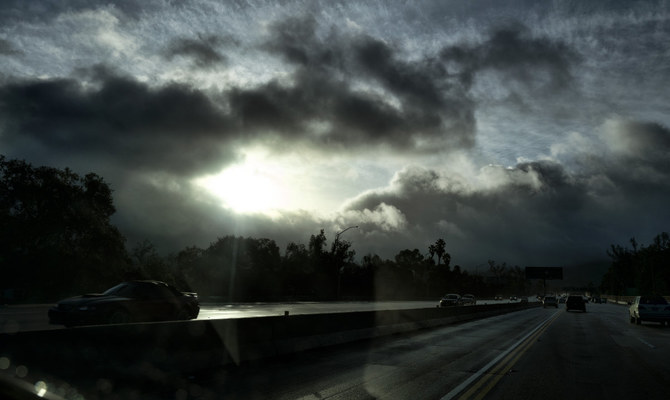
LOS ANGELES: The ninth atmospheric river in a three-week series of major winter storms was churning through California on Monday, leaving mountain driving dangerous and the flooding risk high near swollen rivers even as the sun came out in some areas.
Heavy snow fell across the Sierra Nevada and the National Weather Service discouraged travel. Interstate 80, a key highway from the San Francisco Bay Area to Lake Tahoe ski resorts, reopened with chain requirements after periodic weekend closures because of whiteout conditions.
“If you must travel, be prepared for dangerous travel conditions, significant travel delays and road closures,” the weather service office in Sacramento said on Twitter.
The University of California Berkeley Central Sierra Snow Lab tweeted Monday morning that it had recorded 49.6 inches (126 cm) of new snow since Friday.
A backcountry avalanche warning was issued for the central Sierra, including the greater Tahoe area.
A barrage of atmospheric river storms has dumped rain and snow on California since late December, cutting power to thousands, swamping roads, toppling trees, unleashing debris flows and triggering landslides. Monday’s system was relatively weak compared with earlier storms, but flooding and mudslide risks remained because the state was so saturated, forecasters said.
Mostly dry days were in the week’s forecast, though some parts of Northern California could see more rain at midweek.
The sun came out Monday in San Francisco, where 20.3 inches (51.5 cm) of rain has fallen at the city’s airport since Oct. 1, when California typically begins recording rainfall for the year. The average for the “water year” is 19.6 inches (49.8 cm), “so we’ve surpassed the yearly total with 8 more months to go,” the San Francisco weather service office tweeted.
Across the bay in Berkeley, 10 homes were evacuated Monday when a sodden hillside collapsed, sending mud onto properties. No injuries were reported.
Up to 2 more inches (5 cm) of rain fell Sunday in the soaked Sacramento Valley, where residents of Wilton and surrounding communities were warned to prepare to leave if the Cosumnes River rose further.
In Monterey County, the swollen Salinas River swamped farmland over the weekend and officials said Monday that it was still rising. To the east, flood warnings were still in effect for Merced County in the agricultural Central Valley, where Gov. Gavin Newsom visited Saturday.
Newsom on Monday signed an executive order to further bolster the state’s emergency storm response and help communities that suffered damage. President Joe Biden declared a major disaster in the state and ordered federal aid to supplement local recovery efforts.
In Southern California, the sun shone in Los Angeles, but winter storm warnings and adviseries were still in place for mountain areas, where many roads remained impassable because of mud and rock slides. Two northbound lanes of Interstate 5 near Castaic in northern LA County were closed indefinitely after a hillside collapsed.
Downtown Los Angeles set a rainfall record Saturday with 1.82 inches (4.6 cm), the weather service said.
At least 20 storm-related deaths have occurred, and a 5-year-old boy remained missing after being swept out of his mother’s car by floodwaters in San Luis Obispo County.
Forecasters were keeping their eyes on a storm forming in the Pacific to see if it gains enough strength to become the state’s 10th atmospheric river of the season. Either way it is likely to only bring light rain and will be confined mostly to Northern California when it makes landfall Wednesday, state climatologist Dr. Mike Anderson said Monday during a state weather briefing.


![]()
![]()

More rain, snow in California from ninth in series of storms

Short Url
https://arab.news/yxqg3
More rain, snow in California from ninth in series of storms
- A barrage of atmospheric river storms has dumped rain and snow on California since late December, cutting power to thousands, swamping roads, toppling trees, unleashing debris flows and triggering landslides


Latest updates


© 2026 SAUDI RESEARCH & PUBLISHING COMPANY, All Rights Reserved And subject to Terms of Use Agreement.