

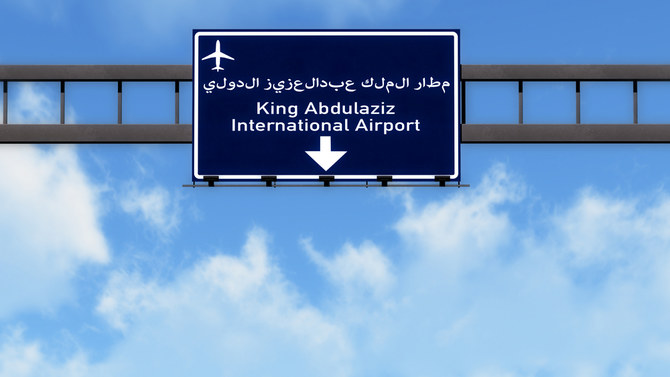
King Abdulaziz International tops airport performance in December as travel sector revives: GACA data

King Abdulaziz Airport, also known as Jeddah International Airport, topped the list where the number of passengers exceeded 15 million annually. (Shutterstock)
Short Url
Updated 16 January 2023
Follow

King Abdulaziz International tops airport performance in December as travel sector revives: GACA data

RIYADH: The King Abdulaziz International airport in Jeddah ranked top among international airports in Saudi Arabia for overall performance in December, as the Kingdom’s travel sector shows strong signs of rebounding, according to the latest report by the General Authority for Civil Aviation.

GACA monthly report evaluates the country’s airports’ commitment to implementing improvements in passenger experience and services based on fourteen performance criteria including time spent in travel procedures, passports, customs areas and disability services.

With a commitment rate of 82 percent in December, up from 64 percent in November, King Abdulaziz Airport, also known as Jeddah International Airport, topped the list where the number of passengers exceeded 15 million annually.

In the same list, King Khalid International Airport in Riyadh came second with a commitment rate of 64 percent, down from 73 percent in November 2022.

GACA has followed the principle of transparency when evaluating the airports’ performance, which was divided into five categories based on the number of passengers traveling annually and the type of airports.

According to the report, King Fahd International Airport maintained the first spot in the second category, where the number of passengers ranges between 5 to 15 million annually, with a commitment rate of 91 percent.

Prince Mohammad bin Abdulaziz International Airport also had a commitment rate of 91 percent in the second category in December, up from 82 percent in November 2022.

As for the third category of international airports, where the number of passengers ranges between 2 and 5 million annually, Abha International Airport and King Abdullah bin Abdulaziz Airport in Jazan maintained a 100 percent commitment rate in December 2022.

Meanwhile, Al-Jouf Airport ranked first in the fourth category of international airports that receive less than two million passengers annually, with a 100 percent commitment rate in December, the same as the rate recorded in November.

The fifth category is a ranking for domestic airports, in which Bisha Airport came first, achieving a score of 100 percent.

The National Aviation Strategy is one of the key elements in Saudi Arabia’s Vision 2030 as the Kingdom aims to diversify its revenue sources by elevating its travel and tourism sector.

According to the National Aviation Strategy, Saudi Arabia is aiming to increase air connectivity to 250 destinations, reaching 330 million passengers, and double air cargo capacity to 4.5 million tons by 2030.


Saudi Arabia launches skills framework to support mining, industrial growth 

Updated 6 sec ago
Follow

Saudi Arabia launches skills framework to support mining, industrial growth 

JEDDAH: Saudi Arabia has launched a new skills framework for the mining and industrial sectors to standardize job roles and support workforce development. 

The initiative was unveiled by Minister of Industry and Mineral Resources Bandar Alkhorayef on the sidelines of the Global Labor Market Conference 2026, according to Al-Eqtisadiah. 

The framework is intended to help employers, job seekers and training providers better navigate labor demand in mining and industry, as Saudi Arabia accelerates investment in manufacturing, minerals processing and related value chains under Vision 2030. 

“This is, in fact, a tool which ensures clear definitions of occupations and their required skills. It will cover more than 500 job roles, detailing the necessary skills, responsibilities, and titles,” Alkhorayef said during a discussion panel at the event. 

The Ministry of Industry and Mineral Resources said the initiative — known as the Industry & Mining Occupations & Skills Framework — will serve as a national reference for occupations and skills in mining and industry. 

The framework is designed to achieve a set of strategic objectives that support human capital development in the industrial and mining sectors. It aims to strengthen workforce planning, training programs, and career pathways, while supporting informed decision-making. 

Covering more than 500 industrial occupations, over 300 professional specialties, 600 skills, and 900 professional certifications, the framework sets standardized job titles, descriptions, and skill requirements to support recruitment, performance, and competitiveness. 

For each occupation, a profile is developed, outlining the code, job titles, and descriptions, as well as other information such as key tasks, educational qualifications, and required skills.

These profiles give employees clarity on roles, career pathways, and accredited credentials, while helping job seekers match their qualifications with suitable roles and focus on targeted skill development. 

The framework, published by the ministry, runs to nearly 3,200 pages and was developed through collaboration with the General Authority for Statistics, alongside government bodies, private sector organizations and academic institutions. 

The launch comes as Saudi Arabia’s mining push gains momentum after new surveys of the Arabian Shield showed the Kingdom’s mineral resources are larger than previously estimated. 

Official estimates have jumped by about 90 percent to roughly SR9.37 trillion ($2.5 trillion), up from around SR5 trillion in 2016, strengthening the case for further mining investment and skills development.