

Abu Dhabi’s Masdar signs memorandum with Dutch companies to develop green hydrogen supply chain

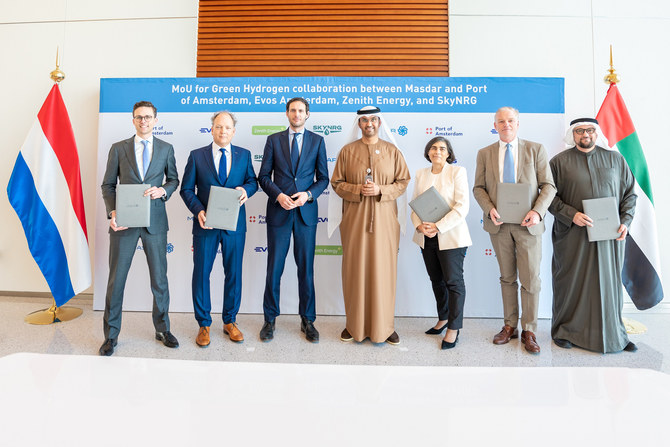
Renewable energy firm Masdar signed a MoU with the Port of Amsterdam, SkyNRG, Evos, and Zenith Energy. (WAM)
Short Url
Updated 15 January 2023
Follow

Abu Dhabi’s Masdar signs memorandum with Dutch companies to develop green hydrogen supply chain

  • Product will be directed to key European sectors via continent’s fourth-largest port
  • Agreement reflects countries’ commitment to exploring energy solutions, says UAE minister

ABU DHABI: Renewable energy firm Masdar of Abu Dhabi has signed a memorandum of understanding with the Port of Amsterdam, SkyNRG, Evos, and Zenith Energy that aims to develop a green hydrogen supply chain between the UAE and the capital of the Netherlands, the Emirates News Agency reported on Sunday.

The parties are to work together to establish the chain, with production in Abu Dhabi and exports via the Port of Amsterdam, which is Europe’s fourth largest.

The exported green hydrogen will be directed to key European sectors such as sustainable aviation fuel, steelmaking, and shipping.

The parties will also examine various hydrogen transportation methods, with a particular emphasis on liquid organic carriers and liquid hydrogen. 

The agreement was signed by Masdar CEO Mohamed Jameel Al Ramahi; Port of Amsterdam Managing Director Gert-Jan Nieuwenhuizen; SkyNRG Chief Development Officer Maarten van Dijk; Evos Business Development Manager Bart van der Meer; and Zenith Energy Managing Director Ellen Ruhotas.

This deal was completed in the presence of UAE Minister of Industry and Advanced Technology Sultan bin Ahmed Al-Jaber, and Dutch Minister of Foreign Affairs Wopke Hoekstra.

Al-Jaber said: “This agreement builds upon the existing relationship between the UAE and the Netherlands, and demonstrates our mutual commitment to exploring low and zero-carbon energy solutions.

“The UAE aims to play a central role in the emerging green hydrogen economy, and this partnership with the Port of Amsterdam and associated players in the green hydrogen space would help position Abu Dhabi as a key hub.”

Al Ramahi said: “Masdar believes green hydrogen to be a promising energy source for ‘hard-to-abate’ sectors in support of global decarbonisation, which is why we launched our dedicated green hydrogen business last month.

“We are pleased to partner with Port of Amsterdam, SkyNRG, Evos Amsterdam, and Zenith Energy to leverage our synergies in the fuel and logistics sectors to see how green hydrogen can help us achieve our shared goals for decarbonisation and sustainable economic growth.”

Green hydrogen is produced by splitting water by electrolysis, producing oxygen and hydrogen.

Hydrogen will be an essential component of a net-zero energy system and will play an important role in decarbonizing sectors that are difficult to electrify, such as heavy industry and long-distance transportation, according to the International Renewable Energy Agency.  

The global green hydrogen market is expected to reach $72 billion by 2030, while PricewaterhouseCoopers has estimated that hydrogen demand is expected to range between 150 million and 500 million tons per year by 2050. 

Masdar announced its new shareholding structure and green hydrogen business unit in December, with the goal of achieving production of 1 million tons annually by 2030.

It signed several agreements in the same month with leading Egyptian state-backed organizations to cooperate in the development of green hydrogen production plants in the country, targeting an annual output of up to 480,000 tons. 


Industry leaders highlight Riyadh’s Metro, infrastructure as investment catalysts

Updated 29 December 2025
Follow

Industry leaders highlight Riyadh’s Metro, infrastructure as investment catalysts

RIYADH: Saudi Arabia’s capital, Riyadh, is experiencing a transformative phase in its real estate sector, with the construction market projected to reach approximately $100 billion in 2025, accompanied by an anticipated annual growth rate of 5.4 percent through 2029.

The Kingdom is simultaneously advancing its data center capacity at an accelerated pace, with an impressive 2.7 GW currently in the pipeline. This expansion underscores the critical role of strategic land and power planning in establishing national infrastructure as a cornerstone of economic growth.

These insights were shared by leading industry experts during JLL’s recent client event in Riyadh, which focused on the city’s macroeconomic landscape and emerging trends across office, residential, retail, hospitality, and pioneering sectors, including AI infrastructure and Transit-Oriented Development.

Saud Al-Sulaimani, Country Lead and Head of Capital Markets at JLL Saudi Arabia, commented: “Riyadh is positioned at the forefront of Saudi Arabia’s Vision 2030, offering unparalleled opportunities for both investors and developers. National priorities are continuously recalibrated to ensure strategic alignment of projects and foster deeper collaboration with the private sector.”

He added: “Recent regulatory developments, including the introduction of the White Land Tax and the rent freeze, are designed to stabilize the market and are expected to drive renewed focus on delivering premium-quality assets. This dynamic environment, coupled with evolving construction cost considerations in select segments, is fundamentally reshaping the market landscape while accelerating progress toward our national objectives.”

The event further underscored the transformative impact of infrastructure initiatives. Mireille Azzam Vidjen, Head of Consulting for the Middle East and Africa at JLL, highlighted Riyadh’s transit revolution. She detailed the Riyadh Metro, a $22.5 billion investment encompassing 176 kilometers, six lines, and 84 stations, providing extensive geographic coverage, with a depth of 9.8 km per 100 sq. km. This strategic development generates significant TOD opportunities, with properties in proximity potentially commanding a 20-30 percent premium. JLL emphasized the importance of implementing climate-responsive last-mile solutions to enhance mobility and accessibility, particularly given Riyadh’s extreme temperatures.

Gaurav Mathur, Head of Data Centers at JLL, emphasized the rapid expansion of the Kingdom’s AI infrastructure, signaling a critical area for technological investment and innovation.

Focusing on the construction sector, Maroun Deeb, Head of Projects and Development Services, KSA at JLL, explained that the industry is actively navigating complexities such as skilled labor availability, material costs, and supply chain dynamics.

He highlighted the adoption of Building Information Modeling as a key driver for enhancing operational efficiency and project delivery.