Pakistan says ‘just’ resolution of Kashmir dispute only way to achieve South Asia peace

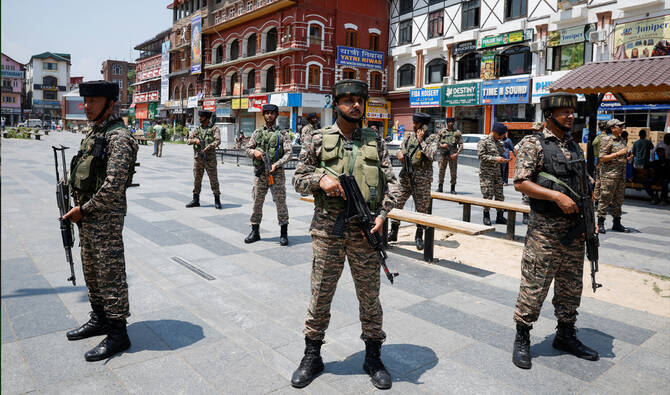
Indian security personnel stand guard on a street during the sixth anniversary of the revocation of Jammu and Kashmir’s partial autonomy, splitting the state into the two federally administered territories of Jammu and Kashmir and Ladakh, in Srinagar, Indian-administered Kashmir on August 5, 2025. (REUTERS/File)
Short Url
Updated 05 January 2026
Follow

Pakistan says ‘just’ resolution of Kashmir dispute only way to achieve South Asia peace

  • Pakistan marks ‘Right of Self-Determination Day’ on Jan. 5 to commemorate UN Security Council passing a resolution for plebiscite in Kashmir
  • Prime Minister Shehbaz Sharif urges international community to rein in India from its alleged widespread human rights violations in the area 

ISLAMABAD: Prime Minister Shehbaz Sharif stressed on Monday that the only path to durable peace in South Asia was through a just resolution of the Kashmir dispute, urging the international community to take steps to rein in New Delhi from alleged rights violations in the territory. 

The message came from Sharif’s office on the occasion of the ‘Right to Self-Determination Day,’ which Pakistan marks every year on Jan. 5 to pay tribute to the people of Indian-administered Kashmir. It commemorates the day when the United Nations Security Council passed a resolution in 1949, supporting the right of the people of Jammu and Kashmir to decide their future through a free and fair plebiscite under UN supervision. 

The Muslim-majority Himalayan region of Kashmir has been divided between Pakistan and India since their independence from British rule in 1947. Both countries govern parts of the territory but claim it in full, having fought two of their three wars over the disputed region.

“The world must also recognize that a just resolution of the Jammu and Kashmir dispute is the only way to achieve durable peace in South Asia,” Sharif said, according to a statement from the Prime Minister’s Office (PMO). 

“We urge the international community to urgently call upon India to halt its widespread human rights violations in IIOJK [Illegally Occupied Jammu and Kashmir], reverse its unilateral and illegal actions of 5 August 2019, repeal the draconian laws and give the right to self-determination to the Kashmiri people, as enshrined in the United Nations Security Council resolutions.”

The Pakistani prime minister was referring to India’s decision of Aug. 5, 2019, in which it repealed Article 370 of its constitution that granted special autonomous status to the part of Kashmir New Delhi administers. The move infuriated Pakistan, with Islamabad describing it as a “unilateral” step.

Pakistan accuses the Indian government of using oppressive tactics to suppress the people of Kashmir. It alleges New Delhi imprisons Kashmir leaders and activists without any charge and muzzles free speech in the territory. 

India denies the charges and accuses Pakistan of supporting militant outfits in the region, allegations that Islamabad denies. 

“All Indian coercive measures have failed to subjugate the will of the people of IIOJK or suppress their quest for the right to self-determination,” Sharif said. “The people of Pakistan salute their indomitable courage, commitment and resilience, in the face of Indian atrocities.”

The Pakistani prime minister’s message comes as tensions persist between the nuclear-armed nations. India and Pakistan engaged in the worst fighting since 1999 in May 2025 when the two countries pounded each other with missiles, drone strikes, fighter jets and traded artillery fire for four days before Washington brokered a ceasefire on May 10. 

Tensions surged after India blamed Pakistan for supporting a militant attack in Indian-administered Kashmir on Apr. 22 that killed over 20 people, mostly Hindu tourists. Pakistan denied involvement and called for a credible investigation to probe the incident. 


Karachi port sees rise in transshipment activity as Middle East tensions reshape shipping routes

Updated 4 sec ago
Follow

Karachi port sees rise in transshipment activity as Middle East tensions reshape shipping routes

  • Two vessels dock simultaneously at Karachi terminals as regional cargo redistribution grows
  • New feeder service has been launched to link Karachi with UAE hubs Fujairah and Khor Fakkan

KARACHI: Karachi Port is seeing increased transshipment activity and new feeder links to Gulf logistics hubs as shipping lines adjust regional routes amid tensions linked to the war involving Iran, port authorities said on Thursday.

Two vessels carrying transshipment cargo docked simultaneously at the port, according to a statement, highlighting its growing role in redistributing containers across Middle Eastern shipping routes.

The development comes as the conflict in the Middle East raises concerns about disruptions to critical energy and trade corridors.

The war has already pushed up oil and gas prices and heightened risks for shipping across Gulf waters, prompting logistics companies to reassess routes and rely more heavily on regional hubs outside potential conflict zones.

“The simultaneous handling of transshipment containers at Karachi Port highlights the port’s strong operational capacity, efficient port infrastructure, and strategic geographic advantage in supporting regional maritime logistics, container shipping operations, and uninterrupted international trade during ongoing disruptions in global shipping routes,” the official statement said.

“As transshipment cargo volumes continue to increase, Karachi Port is steadily strengthening its reputation as a key maritime logistics hub in South Asia and the Middle East regions, further reinforcing Pakistan’s role in international shipping and maritime connectivity,” it added.

FEEDER SERVICE

Separately, Karachi Gateway Terminal (Private) Limited (KGTL) said a dedicated feeder service linking Karachi with the UAE ports of Fujairah and Khor Fakkan has begun operations, strengthening connectivity between Pakistan and key Gulf transshipment hubs.

The inaugural voyage of the service arrived at the terminal on the evening of March 11, marking the start of regular operations aimed at maintaining reliable links between Pakistani exporters and global shipping networks.

“The commencement of this feeder service reflects KGTL’s continued commitment to strengthening Pakistan’s maritime connectivity and supporting the country’s trading community,” Khurram Aziz Khan, KGTL chief executive officer, said in a statement.

“By linking Karachi directly with major UAE transshipment hubs, this service provides importers and exporters with reliable access to global shipping networks while reinforcing the role of Karachi Gateway Terminal as a key gateway for international trade,” he added.

Chairman of the Karachi Port Trust Rear Admiral (r) Shahid Ahmed said stronger links with regional hubs would help facilitate smoother cargo movement.

“The introduction of this feeder service further enhances Karachi Port’s connectivity with key regional hubs and supports Pakistan’s growing trade requirements,” he said.

“Strengthening maritime links with the UAE will help facilitate smoother cargo movement while providing greater flexibility for the country’s trading community.”