

Bomb kills 10 at DR Congo church, Islamists suspected

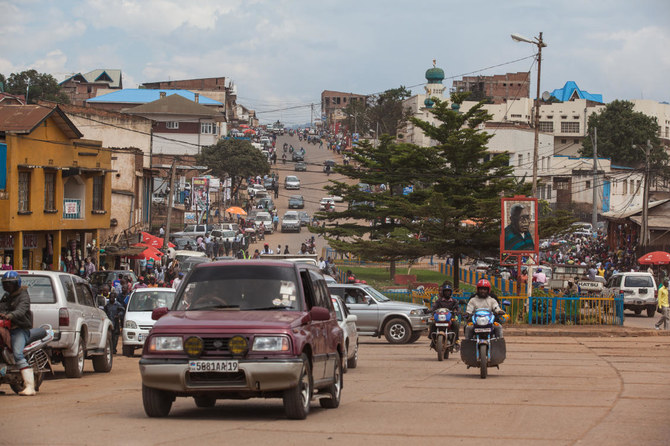
A suspected militant bomb attack took place at a Protestant church in the eastern Congolese city of Kasindi on the border with Uganda. (File/Shutterstock)
Short Url
Updated 16 January 2023
Follow

Bomb kills 10 at DR Congo church, Islamists suspected

BENI, DR Congo: A bomb killed at least 10 people and wounded 39 others as it ripped through a church in eastern Democratic Republic of Congo on Sunday, in an attack blamed on suspected Islamists.
A Congolese military spokesman, Antony Mualushayi, said the “terrorist act” happened in a Pentecostal church in North Kivu province’s Kasindi, a town on the border with Uganda.
The explosion killed at least 10 people and wounded 39, he added, revising up an initial death toll of five. Both tolls were provisional, the spokesman said.
But the spokesman for Uganda’s military operation in the DRC, Bilal Katamba, said on Sunday evening that 16 people had been killed in the blast, and 20 wounded.
“The attackers used an IED to carry out the attack and we suspect ADF is behind the attack,” he added.
AFP was unable to independently confirm the death toll.
The DRC’s communications ministry said on social media that the attack was apparently carried out by the Allied Democratic Forces (ADF) --- which the Daesh group claims as its affiliate in central Africa.
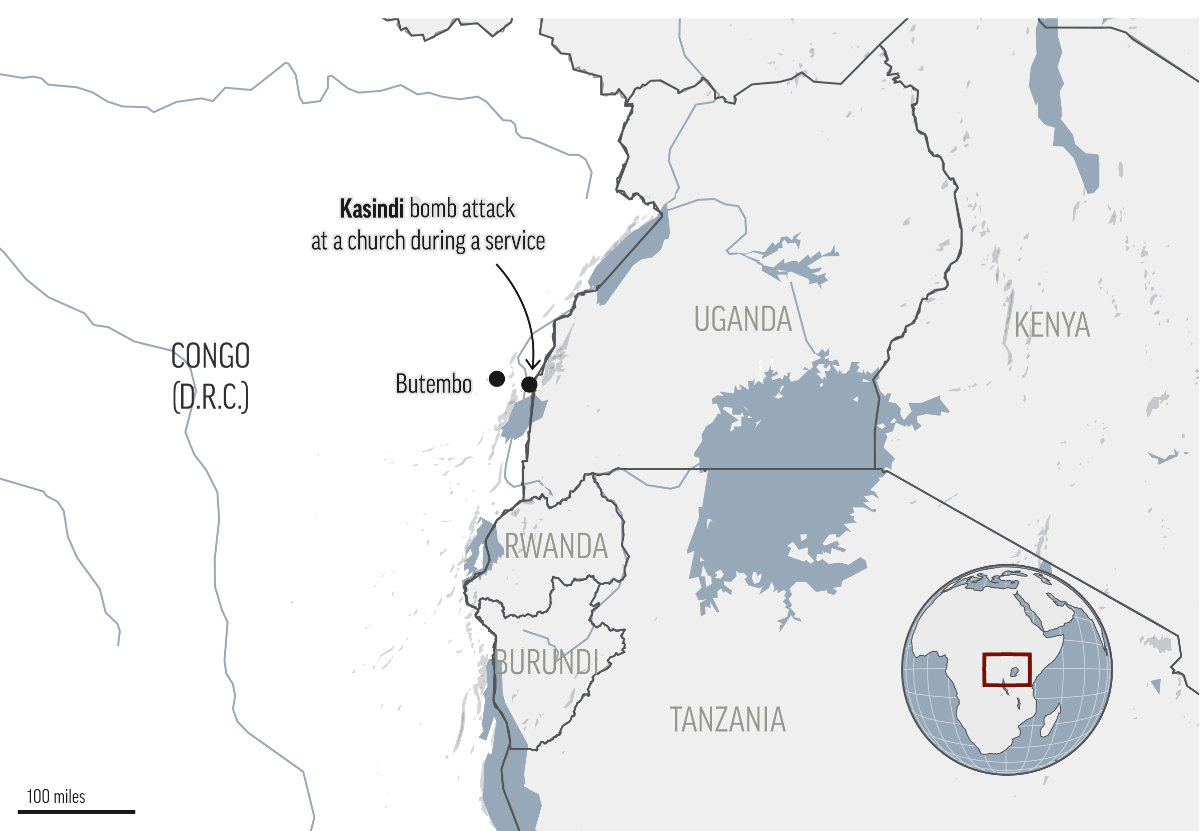


A suspected extremist attack at a church in eastern Congo killed at least 10 people and wounded more than three dozen, according to the country.s army. (AP)

The ADF is one of the deadliest of the more than 120 armed groups in eastern DRC, many of them the legacy of regional wars that flared at the turn of the century.
It has been accused of slaughtering thousands of Congolese civilians and carrying out bomb attacks in Uganda. ADF operatives have also planted bombs in towns in North Kivu in the past.
On Sunday evening, the Daesh group claimed responsibility for the attack and said that “nearly 20” people had been killed, according to the specialized monitoring group Site intelligence group.
Army spokesman Mualushayi said a Kenyan suspect was arrested in the wake of the attack.

Baptism ceremony

A deacon at the evangelical church in Kasindi, Esdras Kambale Mupanya, said that worshippers had gathered for a baptism ceremony before the bomb detonated.
“Several among us died on the spot, others had their feet cut in two,” the 42-year-old told AFP. “God saved me and I came out in good health with my choir members. Today was not the day I should die.”
Fellow survivor, Jean-Paul Syauswa, said the explosion happened just after a group of people had been baptised, while a blind pastor was commenting on Bible verses.
“The bomb threw me at least 100 meters (yards) away,” he said.
Kiza Kivua, a 50-year-old farmer who lost his brother in the attack, said he was having trouble coming to terms with the loss of a “loved one who went to church to pray.”
He added that he thought the government was neglecting its citizens.
“How can such a situation happen when Kasindi is full of soldiers?,” Kivua said.

Terrorist organization
In 2021, the United States labelled the ADF a “foreign terrorist organization” with links to the Daesh group. The militia is active mainly in North Kivu and neighboring Ituri province.
The same year, a joint Congolese-Ugandan military operation began targeting the ADF inside the DRC.
But the attacks have continued.
A report by independent experts for the UN Security Council, released in December, said the ADF had “continued its geographic expansion” despite the Congolese-Ugandan military operation, killing at least 370 civilians since April 2022.
It also warned that the ADF was changing tactics: opting for “more visible and more lethal” bomb attacks in urban areas.
In April last year, for example, a woman detonated a suicide vest in a bar in North Kivu’s capital Goma, according to the independent UN experts. Six people died in the attack and 16 more were wounded.
Congolese President Felix Tshisekedi placed North Kivu and Ituri under a so-called state of siege in 2021 in a bid to stem the violence, with military officials replacing civilian administrators.
The measure has also largely failed to stop attacks against civilians.
The DRC’s presidency condemned Sunday’s attack, as did the United Nations peacekeeping mission in the impoverished nation of over 90 million people.


North Korean leader Kim inspects new warship, claims progress toward nuclear-armed navy

Updated 9 sec ago
Follow

North Korean leader Kim inspects new warship, claims progress toward nuclear-armed navy

  • Kim has hailed the development of Choe Hyon as a significant advancement toward his goal of expanding the operational range and preemptive strike capabilities of his nuclear-armed military

SEOUL, South Korea: North Korean leader Kim Jong Un inspected his new destroyer for two straight days ahead of its commissioning and observed a test of cruise missiles fired from the warship, vowing to accelerate the nuclear-armament of his navy, state media said Thursday.
The North’s official Korean Central News Agency said Kim, during his visits to the western shipyard of Nampo on Tuesday and Wednesday, also inspected the construction of a third destroyer of the same class as his 5,000-ton warship, the Choe Hyon, first unveiled in April 2025.
Kim has hailed the development of Choe Hyon as a significant advancement toward his goal of expanding the operational range and preemptive strike capabilities of his nuclear-armed military. State media says the ship is designed to handle various weapons systems, including antiair and anti-naval weapons, as well as nuclear-capable ballistic and cruise missiles. South Korean military officials and experts say Choe Hyon was likely built with Russian assistance amid deepening military ties, but some have raised doubts about whether it’s ready for active service.
North Korea unveiled a second destroyer of the same class in May last year, but it was damaged during a botched launching ceremony at the northeastern port of Chongjin, triggering a furious reaction from Kim, who called the failure “criminal.” North Korea has said the new destroyer, named Kang Kon, was relaunched in June after repair, but outside experts have questioned whether the ship is fully operational.
After observing Choe Hyon’s sea trials on Tuesday, Kim said the ship met operational requirements and called it a symbol of the country’s expanding naval capabilities. He called for building two warships a year over the next five years of the same or higher class as the Choe Hyon.
Kim came back Wednesday to observe a test launch of cruise missiles from the Choe Hyon. State media published photos of him watching from shore as several projectiles rose from the vessel in plumes of white smoke and described the weapons as “strategic,” a term used for nuclear-capable systems.
After years of spurring ballistic missile development, Kim has shifted his focus more toward naval capabilities, including an ongoing construction of a nuclear-powered submarine. KCNA said the third destroyer under construction at the Nampo shipyard is expected to be completed by the ruling Workers’ Party’s founding anniversary in October.
Naval capabilities were also a key focus when Kim outlined his five-year military goals at last month’s Workers’ Party congress, which included calls for intercontinental ballistic missiles capable of being launched from underwater.
Kim on Tuesday claimed that his efforts to arm his navy with nuclear weapons were “making satisfactory” progress. He said those purported advancements would “constitute a radical change in defending our maritime sovereignty, something that we have not achieved for half a century.”
KCNA did not elaborate on what Kim meant. Some analysts say North Korea may be preparing to formally declare a maritime boundary that could encroach on waters controlled by rival South Korea.
As inter-Korean tensions worsen, Kim has repeatedly said he does not recognize the Northern Limit Line, drawn by the US-led UN Command at the end of the 1950-53 Korean War. The poorly drawn western sea boundary has been the site of several deadly naval clashes in past years.
At the party congress, Kim doubled down on plans to expand North Korea’s nuclear arsenal, which already is equipped with various weapons systems threatening the United States and US allies in Asia, and confirmed his hard-line view of rival South Korea.
But he left the door open for dialogue with the Trump administration, reiterating Pyongyang’s demand that Washington drop its insistence on denuclearization as a precondition for resuming long-stalled talks.