

Iranian foreign minister praises dialogue between Syria, Turkiye

1 / 2
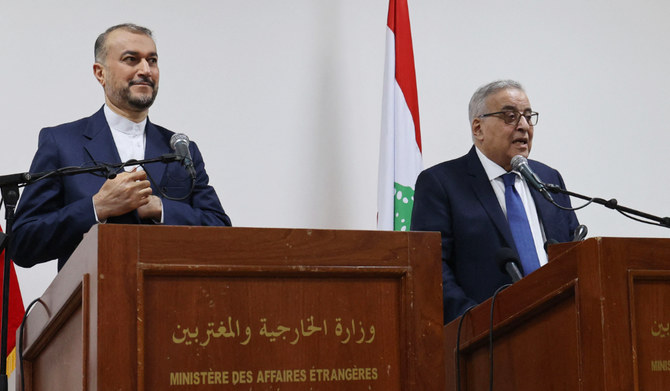
Lebanon's Foreign Minister Abdallah Bou Habib (R) and his Iranian counterpart Hossein Amir-Abdollahian hold a joint press conference at the Foreign Ministry in the Lebanese capital Beirut, on January 13, 2023. (AFP)
2 / 2
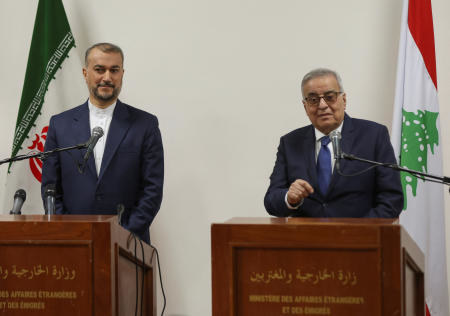
Lebanon's caretaker Foreign Minister Abdallah Bou Habib and Iranian foreign minister Hossein Amirabdollahian attend a news conference at the Ministry of Foreign Affairs, in Beirut (Reuters)
Short Url
Updated 13 January 2023
Follow

Iranian foreign minister praises dialogue between Syria, Turkiye

  • Hossein Amir-Abdollahian speaks after meeting top officials in Beirut
  • Iran ‘a faithful friend of Lebanon,’ he says

BEIRUT: Iranian Foreign Minister Hossein Amir-Abdollahian has praised the dialogue taking place between Syria and Turkiye, and the meetings of the two nations’ leaders.

“We believe that it will reflect positively on the interests of both countries and it is the best way to find a solution for the Syrian-Turkish relations issue,” he said.

“The matter can be pursued within the framework of the Astana talks, while giving the Syrian presence a role in this dialogue.”

Amir-Abdollahian was speaking in Beirut after talks with Lebanon’s Caretaker Prime Minister Najib Mikati, Parliament Speaker Nabih Berri and his Lebanese counterpart Abdullah Bou Habib.

Iran “will always remain a faithful friend of Lebanon,” he added.

BACKGROUND

Iranian Foreign Minister Amir-Abdollahian held talks in Beirut with Lebanon’s Caretaker Prime Minister Najib Mikati, Parliament Speaker Nabih Berri and his Lebanese counterpart Abdullah Bou Habib.

On whether Hezbollah can facilitate the presidential election process, Amir-Abdollahian said: “We do not interfere, in any way, in internal Lebanese affairs.

“We are certain that the Lebanese political parties have the awareness, foresight and expertise to end the presidential vacuum and elect a new president as soon as possible.”

He said positive steps were being taken to activate bilateral relations with Lebanon, and reiterated Iran’s offer “to rebuild and rehabilitate Lebanon’s power plants, as well as build new ones, based on an agreement that can be reached with the Lebanese government.”

Amir-Abdollahian added: “Iran explicitly supports the Lebanese resistance and the Palestinian resistance against any Israeli attacks targeting these two countries.”

According to his press office, Mikati said during his meeting with the Iranian minister that “the circumstances in Lebanon are difficult, but we are working on managing the situation and we have the confidence and the will to overcome this ordeal.”

On Iran’s offer to donate fuel to Lebanon, Bou Habib said that “we are facing many obstacles, a political disagreement in Lebanon and external pressure, but we are still trying to get the donation, and we agreed with our Iranian brothers to keep pursuing this attempt.”

He said he told his Iranian counterpart that Lebanon was keen to preserve Iran’s stability and was fundamentally opposed to any country interfering in the affairs of another.

Amir-Abdollahian also met with Hezbollah Secretary-General Hassan Nasrallah.

In a statement, Hezbollah said that “the meeting discussed political developments in Lebanon, Palestine and the region, especially the options and threats stemming from the formation of a corrupt and extremist Israeli government, and the status of the resistance movements and axis in the face of the regional and international developments and events.”

Also on Friday, the Lebanese army said its troops shot at an Israeli drone that crossed into Lebanon’s airspace on the outskirts of the southern town of Houla and Wadi Hounin, south of the Litani River.

The army urged political forces “to assume their responsibilities to achieve national interest, accelerate the process of electing a president and carry out all relevant constitutional duties in order to meet the Lebanese people’s aspirations, achieve political stability and carry out the economic reforms needed to overcome the significant difficulties facing Lebanon in recent years.”

Meanwhile, Maronite Patriarch Bechara Al-Rahi continued his visit to the UK, where earlier this week he visited the House of Commons and took part in a panel discussion on Lebanon’s political situation and difficult social conditions.

At a press conference he stressed the need to “shield Lebanon from regional and international conflicts, while preserving its friendly relations with Arab and foreign countries.”

He also called for the speedy election of a new president and appealed to nations, including the UK, “to play the required role through their commitment to support Lebanon before the international community and the United Nations.”


Gaza’s living conditions worsen as strong winds and hypothermia kill 5

Updated 14 January 2026
Follow

Gaza’s living conditions worsen as strong winds and hypothermia kill 5

  • Hundreds of tents and makeshift shelters were blown away or heavily damaged, the UN humanitarian office reported

DEIR AL-BALAH, Gaza Strip: Strong winter winds collapsed walls onto flimsy tents for Palestinians displaced by war in Gaza, killing at least four people, hospital authorities said Tuesday.
Dangerous living conditions persist in Gaza after more than two years of devastating Israeli bombardment and aid shortfalls. A ceasefire has been in effect since Oct. 10. But aid groups say that Palestinians broadly lack the shelter necessary to withstand frequent winter storms.
The dead include two women, a girl and a man, according to Shifa Hospital, Gaza City’s largest, which received the bodies.
The Gaza Health Ministry said Tuesday a 1-year-old boy died of hypothermia overnight, while the spokesman for the UN’s children agency said over 100 children and teenagers have been killed by “military means” since the ceasefire began.
Meanwhile, Israel’s military said it exchanged fire Tuesday with six people spotted near its troops deployed in southern Gaza, killing at least two of them in western Rafah.
Family mourns relatives killed by wall collapse
Three members of the same family — 72-year-old Mohamed Hamouda, his 15-year-old granddaughter and his daughter-in-law — were killed when an 8-meter (26-foot) high wall collapsed onto their tent in a coastal area along the Mediterranean shore of Gaza City, Shifa Hospital said. At least five others were injured.
Their relatives on Tuesday began removing the rubble that had buried their loved ones and rebuilding the tent shelters for survivors.
“The world has allowed us to witness death in all its forms,” Bassel Hamouda said after the funeral. “It’s true the bombing may have temporarily stopped, but we have witnessed every conceivable cause of death in the world in the Gaza Strip.”
A second woman was killed when a wall fell on her tent in the western part of the city, Shifa Hospital said.
Hundreds of tents and makeshift shelters were blown away or heavily damaged, the UN humanitarian office reported.
The UN and its humanitarian partners were distributing tents, tarps, blankets and clothes as well as nutrition and hygiene items across Gaza, said the UN Office for the Coordination of Humanitarian Affairs.
The majority of Palestinians live in makeshift tents since their homes were reduced to rubble during the war. When storms strike the territory, Palestinian rescue workers warn people against seeking shelter inside damaged buildings for fears of collapse. Aid groups say not enough shelter materials are entering Gaza during the truce.
In the central town of Zawaida, Associated Press footage showed inundated tents Tuesday morning, with people trying to rebuild their shelters.
Yasmin Shalha, a displaced woman from the northern town of Beit Lahiya, stood against winds that lifted the tarps of tents around her as she stitched hers back together with needle and thread. She said it had fallen on top of her family the night before, as they slept.
“The winds were very, very strong. The tent collapsed over us,” the mother of five told AP. “As you can see, our situation is dire.”
On the shore in southern Gaza, tents were swept into the Mediterranean. Families pulled what was left from the sea, while some built sand barriers to hold back rising water.
“The sea took our mattresses, our tents, our food and everything we owned,” Shaban Abu Ishaq said, as he dragged part of his tent out of the sea in the Muwasi area of Khan Younis.
Mohamed Al-Sawalha, a 72-year-old man from the northern refugee camp of Jabaliya, said the conditions most Palestinians in Gaza endure are barely livable.
“It doesn’t work neither in summer nor in winter,” he said of the tent. “We left behind houses and buildings (with) doors that could be opened and closed. Now we live in a tent. Even sheep don’t live like we do.”
Residents aren’t able to return to their homes in Israeli-controlled areas of the Gaza Strip.
Child death toll in Gaza rises
Gaza’s Health Ministry said the 1-year-old in the central town of Deir Al-Balah was the seventh fatality due to the cold conditions since winter started. Others included a baby just seven days old and a 4-year-old girl, whose deaths were announced Monday.
The ministry, part of the Hamas-run government, says more than 440 people were killed by Israeli fire and their bodies brought to hospitals since the ceasefire went into effect. The ministry maintains detailed casualty records that are seen as generally reliable by UN agencies and independent experts.
UNICEF spokesman James Elder said Tuesday at least 100 children under the age of 18 — 60 boys and 40 girls — have been killed since the truce began due to military operations, including drone strikes, airstrikes, tank shelling and use of live ammunition. Those figures, he said, reflect incidents where enough details have been compiled to warrant recording, but the total toll is expected to be higher. He said hundreds of children have been wounded.
While “bombings and shootings have slowed” during the ceasefire, they have not stopped, Elder told reporters at a UN briefing in Geneva by video from Gaza City. “So what the world now calls calm would be considered a crisis anywhere else,” he said.
Gaza’s population of more than 2 million people has been struggling to keep the cold weather and storms at bay while facing shortages of humanitarian aid and a lack of more substantial temporary housing, which is badly needed during the winter months. It’s the third winter since the war between Israel and Hamas started on Oct. 7, 2023, when militants stormed into southern Israel and killed around 1,200 people and abducted 251 others into Gaza.
Gaza’s Health Ministry says more than 71,400 Palestinians have been killed in Israel’s retaliatory offensive.