

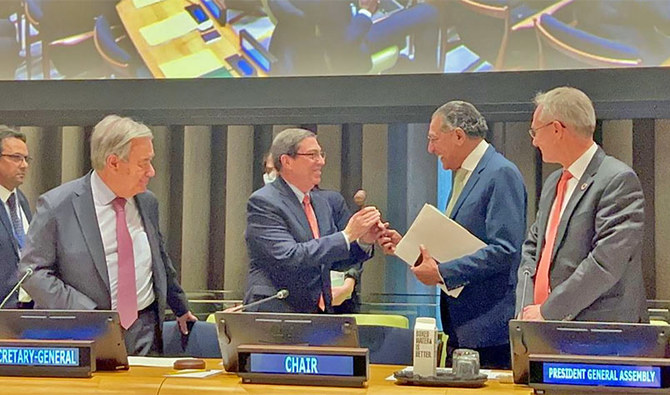
After Pakistan, Cuba takes over reins of ‘Group of 77 and China’

Pakistan's permanent representative to the United Nations (UN), Ambassador Munir Akram, hands over the gavel to the representative of Cuba at the UN, in New York, US, on January 12, 2022. (Photo courtesy: @PakistanPR_UN/Twitter)
Short Url
Updated 13 January 2023
Follow

After Pakistan, Cuba takes over reins of ‘Group of 77 and China’

  • ‘Group of 77 and China’ advocates for developing countries’ interests at the UN
  • The group now counts 134 countries as members, but has retained its initial name

UNITED NATIONS: Cuba on Thursday took over the rotating presidency of the Group of 77 and China, which advocates for developing countries’ interests at the United Nations.

Cuban Foreign Minister Bruno Rodriguez took over leadership from last year’s chair Pakistan.

UN Secretary-General Antonio Guterres said at the handover ceremony that in many ways, the Group of 77 and China reflects the goal of the United Nations itself.

“Year in and year out, you stand together to discuss, debate and amplify global solutions to realize the better, fairer and more sustainable future every country deserves,” he said.

He also highlighted the challenges facing the world: growing poverty and inequalities, pandemics, recession, unemployment, climate change and the rights of women and girls being disrespected.

“While each challenge is different, they are all felt most keenly in the countries you represent,” he added.

The group now counts 134 countries as members but has retained its initial name.


IMF Executive Board to review $1.2 billion loan disbursement for Pakistan today

Updated 4 sec ago
Follow

IMF Executive Board to review $1.2 billion loan disbursement for Pakistan today

  • Pakistan, IMF reached a Staff-Level Agreement in October for second review of $7 billion Extended Fund, climate fund program
  • Economists view IMF bailout packages as essential for cash-strapped Pakistan grappling with a prolonged macroeconomic crisis

ISLAMABAD: The Executive Board of the International Monetary Fund (IMF) is set to meet in Washington today to review a $1.2 billion loan disbursement for Pakistan, state media reported on Monday.

Pakistan and the IMF reached a Staff-Level Agreement (SLA) in October for the second review of a $7 billion Extended Fund Facility (EFF) and the first review of its $1.4 billion Resilience and Sustainability Facility (RSF). 

The agreement between the two sides took place after an IMF mission, led by the international lender’s representative Iva Petrova, held discussions with Pakistani authorities during a Sept. 24–Oct. 8 visit to Karachi, Islamabad and Washington D.C.

“The International Monetary Fund’s (IMF) Executive Board is set to meet in Washington today to review and approve $1.2 billion in loan for Pakistan,” state broadcaster Pakistan TV reported. 

Pakistan has been grappling with a prolonged macroeconomic crisis that has drained its financial resources and triggered a balance of payments crisis for the past couple of years. Islamabad, however, has reported some financial gains since 2022, which include recording a surplus in its current account and bringing inflation down considerably.

Economists view the IMF’s bailout packages as crucial for cash-strapped Pakistan, which has relied heavily on financing from bilateral partners such as Saudi Arabia, China and the United Arab Emirates, as well as multilateral lenders including the IMF, World Bank, Asian Development Bank and Islamic Development Bank. 

Speaking to Arab News last month, Pakistan’s former finance adviser Khaqan Najeeb said the $1.2 billion disbursement will further stabilize Pakistan’s near-term external position and unlock additional official inflows.

“Continued engagement also reinforces macro stability, as reflected in recent improvements in inflation, the current account, and reserve buffers,” Najeeb said.

Pakistan came close to sovereign default in mid-2023, when foreign exchange reserves fell below three weeks of import cover, inflation surged to a record 38% in May, and the country struggled to secure external financing after delays in its IMF program. Fuel shortages, import restrictions, and a rapidly depreciating rupee added to the pressure, while ratings agencies downgraded Pakistan’s debt and warned of heightened default risk.

The crisis eased only after Pakistan reached a last-minute Stand-By Arrangement with the IMF in June 2023, unlocking emergency support and preventing an immediate default.