

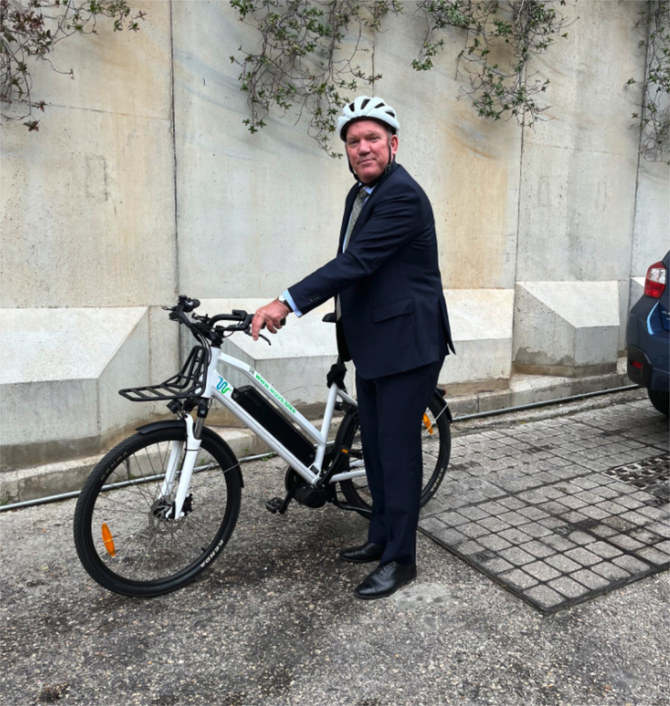
Beat the traffic: While Beirut politicians cling to motorcades, a European diplomat opts for a bike

Short Url
Updated 13 January 2023
Follow

Beat the traffic: While Beirut politicians cling to motorcades, a European diplomat opts for a bike

  • Hans Peter van der Woude, the Dutch ambassador to Lebanon, was praised for setting an example in a country facing a growing traffic crisis
  • He posted a photo on Twitter of himself and his bicycle, sparking an online debate and criticism of the government for failing to tackle transport problems

LONDON: While Lebanese politicians typically travel in multi-car motorcades, at least one European diplomat is beating the heavy Beirut traffic by getting on a bike.

In a message posted on Twitter on Thursday, Hans Peter van der Woude, the Dutch ambassador to Lebanon, posted a photo of himself wearing a helmet and standing next to an e-bike as he prepared to set off for a meeting.

The photo sparked an online debate about the country’s traffic problems, with many people praising him as an “example” for everyone to follow.

“Setting a great example. Drive safely,” one user wrote.

Another asked the envoy whether he feels safe cycling around the busy streets of the capital.

“I felt really comfortable on a bicycle in traffic,” van der Woude replied. “Just because drivers are not used to cyclists, they are more careful. One has to be vigilant though, like everyone in Lebanese traffic.”

He added that he completes his journeys really quickly compared with people in cars, who often get stuck in traffic jams.

Nasser Yassin, Lebanon’s environment minister, retweeted the envoy’s photo, thanked him and said the government backs the use of non-motorized transport options, also known as “soft mobility.”

“We are supporting initiatives that will promote soft mobility in Beirut and other cities; but we need to work more with municipalities and others to create the right environment for soft mobility in our cities,” he wrote.

However, the minister faced criticism from people who accused him of hypocrisy, given the lack of a government strategy to tackle Lebanon’s traffic problems.

One person wrote: “Mr. Nasser Yassin, in your government’s ministerial statement, you announced ‘the pursuit of a comprehensive transport plan and the adoption of a partnership mechanism between the public and private sectors.’ And you, with this tweet, are encouraging support for soft mobility initiatives. Can you tell us how and what you have accomplished or what you intend to accomplish … apart from tweeting on Twitter?”

In recent years, traffic congestion in Lebanon has increased as a result of the poor state of roads, the growing number of vehicles using them, and a flawed public-transport system. According to World Bank-affiliated Urban Transport Development Project, people in Lebanon spend an estimated average of 720 hours in vehicles each year.

Officials have promised to find solutions to the over-reliance on private vehicles in the country but have been accused of hypocrisy on the issue. In 2017, for example, the Lebanese government was criticized for purchasing, or receiving as grants and donations, an “excessively large number of vehicles” for use by ministries, departments, public institutions and municipalities.

The government was also accused of breaking laws and regulations by using money from the public purse to pay for maintenance, insurance, fuel and other expenses arising from the use of an estimated 12,000 government-owned vehicles.


Cambodia takes back looted historic artifacts handled by British art dealer

Updated 28 February 2026
Follow

Cambodia takes back looted historic artifacts handled by British art dealer

  • The objects were returned under a 2020 agreement between the Ministry of Culture and Fine Arts and the family of the late Douglas Latchford, a British art collector and dealer who allegedly had the items smuggled out of Cambodia

PHNOM PENH, Cambodia: Cambodian officials on Friday received more than six dozen historic artifacts described as part of the country’s cultural heritage that had been looted during decades of war and instability.
At a ceremony attended by Deputy Prime Minister Hun Many, the 74 items were unveiled at the National Museum in Phnom Penh after their repatriation from the United Kingdom.
The objects were returned under a 2020 agreement between the Ministry of Culture and Fine Arts and the family of the late Douglas Latchford, a British art collector and dealer who allegedly had the items smuggled out of Cambodia.
“This substantial restitution represents one of the most important returns of Khmer cultural heritage in recent years, following major repatriations in 2021 and 2023 from the same collection,” the Culture Ministry said in a statement. “It marks a significant step forward in Cambodia’s continued efforts to recover, preserve, and restore its ancestral legacy for future generations.”
The artifacts were described as dating from the pre-Angkorian period through the height of the Angkor Empire, including “monumental sandstone sculptures, refined bronze works, and significant ritual objects.” The Angkor Empire, which extended from the ninth to the 15th century, is best known for the Angkor Wat archaeological site, the nation’s biggest tourist attraction.
Latchford was a prominent antiquities dealer who allegedly orchestrated an operation to sell looted Cambodian sculptures on the international market.
From 1970 to the 1980s, during Cambodia’s civil wars and the communist Khmer Rouge ‘s brutal reign, organized looting networks sent artifacts to Latchford, who then sold them to Western collectors, dealers, and institutions. These pieces were often physically damaged, having been pried off temple walls or other structures by the looters.
Latchford was indicted in a New York federal court in 2019 on charges including wire fraud and conspiracy. He died in 2020, aged 88, before he could be extradited to face charges.
Cambodia, like neighboring Thailand, has benefited from a trend in recent decades involving the repatriation of art and archaeological treasures. These include ancient Asian artworks as well as pieces lost or stolen during turmoil in places such as Syria, Iraq and Nazi-occupied Europe. New York’s Metropolitan Museum of Art is one of the prominent institutions that has been returning illegally smuggled art, including to Cambodia.
“The ancient artifacts created and preserved by our ancestors are now being returned to Cambodia, bringing warmth and joy, following the country’s return to peace,” said Hun Many, who is the younger brother of Prime Minister Hun Manet.