

Private sector appetite shows opportunities in growing Saudi mining industry: NIDLP CEO

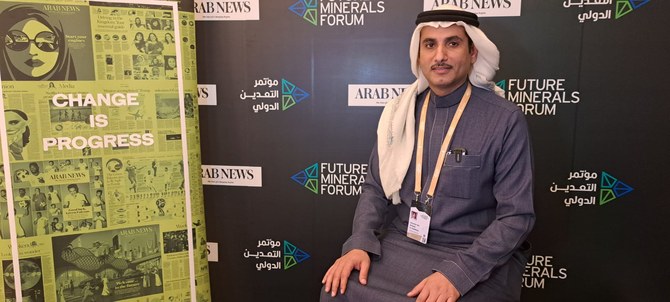
Suliman Al-Mazroua, CEO of Saudi Arabia’s National Industrial Development and Logistics Program. (AN Photo)
Short Url
Updated 15 January 2023
Follow

Private sector appetite shows opportunities in growing Saudi mining industry: NIDLP CEO

RIYADH: Saudi Arabia is witnessing a spur in private sector companies entering the Kingdom’s mining sector, indicating strong growth in the mineral exploration industry, according to a top official. 

In an exclusive interview with Arab News on the sidelines of the Future Minerals Forum in Riyadh, on Jan. 12, Suliman Al-Mazroua, CEO of Saudi Arabia’s National Industrial Development and Logistics Program, said that the long-term strategic plans of the Kingdom in the mining sector have started showing positive results. 

“More importantly, the appetite of the private sector to join the mining industry — that is what matters to us. We see a lot of newcomers joining the mining sector. It shows the appetite and the real opportunity they are seeing in this sector. Mining has never been as popular as it is now,” said Al-Mazroua. 

He added: “For us to achieve our goals, we must have long-term plans. And this is definitely what Vision 2030 has done for us. With long-term plans, we are achieving our targets.” 

The CEO pointed out that events like Future Minerals Forum are reshaping the mining sector in Saudi Arabia, as “it helps attract more private companies to enter the Kingdom and operate in the mineral exploration industry.” 

Expressing his excitement about the development of the forum from its first version last year, Al-Mazroua said the event is seeing almost double on everything. "Double on number of deals around the private sector, and double the number of attendees. More than 130 countries contributed to this forum, more than 200 speakers, and more than 13,000 attendees,” he said. 

Al-Mazroua further pointed out that 27 memorandums of understanding had been signed so far during the forum, adding: “This number could be even more upon the completion of the event.”  

He went on and said that NIDLP has launched more than 50 initiatives just for mining, while the total number of combined initiatives in mining, industry, logistics, and energy stands at 300. 

“We are just at the beginning of mining potential in Saudi Arabia, and we will be seeing more to come. We have started seeing the results already; the best two years. We are seeing the number of licenses compared to the full ten years is almost the same. So, what we have done in two years is equal to ten years of historical data,” he added. 

Al-Mazroua noted that the Kingdom’s Mining Partnership Council will help the government to get feedback from mining companies, and it will help achieve the highest potential results from the private sector. 

“Vision 2030 is all about continuous feedback and continuous enhancement. Having this council with the private sector is to ensure that we have a feedback process to the government to keep improving the process, improving the ease of doing the mining in Saudi, improving how to integrate mining with the logistic industry and energy, and making sure that we achieve the highest potential possible,” he noted. 

Al-Mazroua added: “We will be inviting members from the private sector on a monthly basis to review with them what we are doing and how we can improve our performance.” 

On the third and final day of the event, during a panel discussion, Al-Mazroua said that bringing different sectors under one umbrella is crucial for the development of the mining industry in Saudi Arabia. 

“Integration is the key to the development of the mining sector. We have a program in NIDLP, where the main job is to integrate the four sectors; mining, industry, logistics and energy,” said Al-Mazroua. 


Future Minerals Forum launches global index to track critical mineral supply chains 

Updated 29 sec ago
Follow

Future Minerals Forum launches global index to track critical mineral supply chains 

RIYADH: The Future Minerals Forum on Jan. 12 launched the “Future Minerals Index Report,” a first-of-its-kind global tool designed to measure and track progress in developing critical mineral value chains across producing, exporting, and consuming countries.  

The initiative aims to support the creation of more resilient and responsible supply chains and promote sustainable development worldwide.  

Khalid Al-Mudaifer, vice minister of industry and mineral resources for mining affairs, stated: “The Future Minerals Index Report is an unprecedented and essential document; it is an intellectual tool that highlights key trends in the mining and minerals sector, particularly in terms of insights and directions from sector stakeholders, including government leaders, global mining executives, experts, and interested parties.”   

He pointed out that the report is distinguished by its tracking of developments in mineral supplies and its provision of actionable recommendations to ensure the sustainable development of critical mineral value chains. 

Al-Mudaifer described the report as a new international benchmark that establishes a comprehensive baseline to measure the progress of governments, companies, and investors in enhancing more resilient and responsible mineral supply chains.   

He said it provides a clear picture of how global critical mineral markets are shaped by capital, risk, and trust dynamics. “It shows where investment is growing or shrinking and identifies the widening gap between resource availability and capital allocation. Based on this baseline, the report will monitor changes in risk perceptions, investment flows, and progress toward more resilient mineral value chains.”  

Ali Al-Mutairi, general supervisor of the Future Minerals Forum, emphasized the report’s importance and the attention it received at the forum due to its role in highlighting global trends in the mining sector.   

He explained that the report was prepared in partnership with McKinsey & Co. and in collaboration with other sector experts, including S&P Global Market Intelligence, Global AI, and GlobeScan.  

“It integrates stakeholder trends, data, market insights, and intelligence into a single reference that supports global mining and mineral sector decision-making,” he said.  

Jeffrey Lorsch, partner at McKinsey & Co., commented: “The Future Minerals Index Report, by integrating market data, stakeholder perspectives, and value chain standards, provides a strategic roadmap to help companies navigate volatility and unlock long-term growth opportunities.”  

The report is based on the “Future Minerals Framework,” developed with contributions from 47 experts across multilateral organizations, non-profits, and private companies. It was first introduced at the 2025 International Ministerial Meeting.   

The framework outlines key enablers for end-to-end value chains, including supportive policies and regulations, innovative financing solutions to secure and manage investments, multimodal infrastructure such as roads, railways, and ports to reduce costs and increase viability, and sustainability through strong environmental and social governance frameworks.   

It also includes talent development through education, training, R&D, technological modernization via updated geological data systems and global expertise partnerships, and geology through reliable, accessible geological data in producing, exporting, and consuming countries as a critical factor in attracting investment.  

The report highlighted the world’s urgent need to sustain mineral supplies, featuring contributions from leading industry figures.  

Robert Friedland, founder of Ivanhoe Mines, Ivanhoe Electric, and I-Pulse, stated that the electrification of energy systems, digitalization of the economy, and the rapid growth of artificial intelligence are converging toward a future that increasingly depends on minerals.   

He stressed: “You can’t reduce emissions, build computing systems, or transport energy without mining.”  

Bob Wilt, CEO of Ma’aden, said in the report: “We are not fully prepared to deliver the minerals the world needs. Our biggest challenges are not equipment, capital, or technology — but people.”  

Duncan Wanblad, CEO of Anglo American, noted that global copper demand is expected to grow by 75 percent to reach 56 million tonnes annually by 2050. To meet this demand and offset declines from aging mines, the sector will need to open approximately 60 new mines the size of Quellaveco within the next decade alone.  

Gustavo Pimenta, CEO of Vale, said in his contribution: “I can’t imagine a future without mining — at least not a sustainable one that balances economic development with environmental protection and social responsibility. Mining has become essential to everything.”  

The release of the Future Minerals Index Report coincides with the upcoming fifth edition of the Future Minerals Forum, being held from Jan. 13 to 15, 2026, in Riyadh under the patronage of the Custodian of the Two Holy Mosques, King Salman bin Abdulaziz Al Saud. The event is held under the theme “Minerals: Facing the Challenges of a New Era of Development.”  

The forum will host a wide range of ministers and CEOs from leading global mining companies, reflecting its stature as a global platform in the mining sector and a key event showcasing Saudi Arabia’s leadership in shaping the future of minerals regionally and internationally.