Iraqi conjoined twins Ali and Omar separated in 11-hour surgery in Saudi Arabia

1 / 3
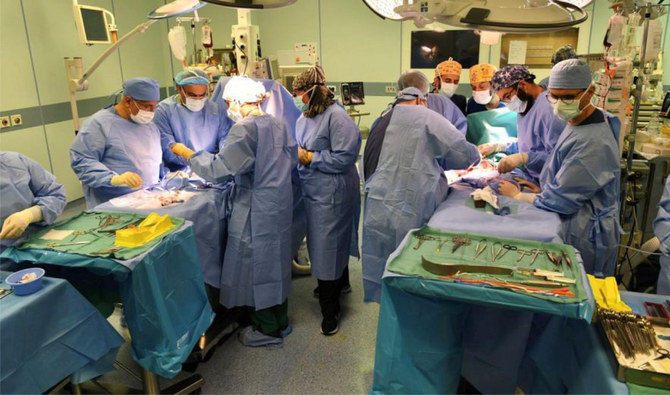
The surgery was performed at King Abdullah Specialized Children’s Hospital. (SPA)
2 / 3
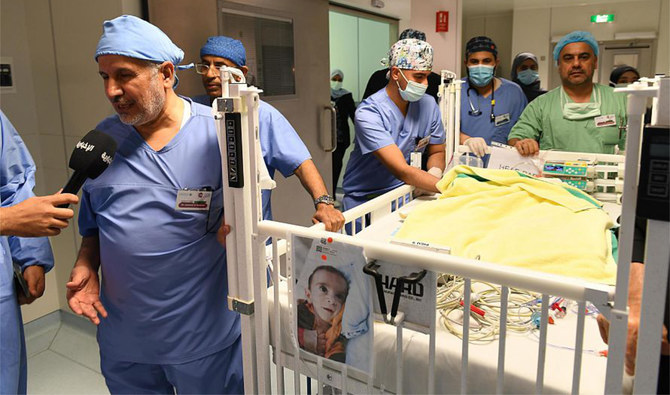
(SPA)
3 / 3
(SPA)
Short Url
Updated 13 January 2023
Follow

Iraqi conjoined twins Ali and Omar separated in 11-hour surgery in Saudi Arabia

  • 27 doctors, specialists and nursing staff were involved in the separation operation
  • They were conjoined at the lower chest and abdomen, and shared a liver, bile ducts, and intestines

RIYADH: A specialist team of surgeons completed surgery to separate Iraqi conjoined twins Ali and Omar in Riyadh on Thursday, the Saudi Press Agency reported.

The operation, which took 11 hours and consisted of six phases, was completed by a 27-member team of consultants, specialists, nursing and technical staff, and based on directives from King Salman and Crown Prince Mohammed bin Salman.

The team separated the twins, who were conjoined at the lower chest and abdomen, and shared a liver, bile ducts, and intestines.

Dr. Abdullah Al-Rabeeah, adviser at the Royal Court and supervisor general of the King Salman Humanitarian Aid and Relief Center, said that “this operation comes in implementation of the generous directives of the Saudi leadership,” making it the 54th such procedure of the Saudi Conjoined Twins Program.


Al-Rabeeah, who is also head of the medical team, added that the Saudi program had been able to operate on 127 conjoined twins from 23 countries during the past 32 years, and stressed the Kingdom’s pioneering role in humanitarian work in general and medical work in particular.

He thanked the medical team who performed the surgery for their efforts, and added that the achievement reflected the leadership’s willingness to help people.

He added that it was also an indication of Saudi medical excellence, and was in line with the goals of the Kingdom’s Vision 2030 to develop the country’s health sector and advance its quality and efficiency.

Abdul-Sattar Hadi Al-Janabi, Iraqi ambassador to the Kingdom, said he appreciated the unlimited humanitarian support and efforts provided by the Saudi government, and praised the efforts of the medical team led by Al-Rabeeah.

He also expressed his joy at the twins’ successful separation surgery.

Ali and Omar’s parents extended their thanks and gratitude to the king and crown prince for the surgery, and for providing their children with all necessary treatment.

Last week, the surgical team has also successfully separated Saudi conjoined twins who were attached at the hip and shared a spinal cord in an operation that lasted seven hours over seven stages.

The surgery, which was carried out under directives from King Salman and Crown Prince Mohammed bin Salman, required 28 consultants, specialists and nursing and technical personnel.

Earlier last month, Nigerian conjoined twins Hassana and Hussaina arrive in Saudi Arabia for a “delicate” separation procedure being carried out free of charge on the directives of King Salman.

Yahaya Lawal, Nigeria’s envoy to the Kingdom, said the monarch had sent a flying ambulance to transport the twins and their parents to Riyadh, where the surgery would take place.

The twins, born in hospital to a Nigerian couple, shared vital organs, including a liver.


Experimental farm in Al-Lith looks into future of Saudi Arabian agriculture

Updated 21 min 35 sec ago
Follow

Experimental farm in Al-Lith looks into future of Saudi Arabian agriculture

  • Research initiative reflects strategic transformation

JEDDAH: An experimental farm in Saudi Arabia’s Al-Lith Governorate is one of the research initiatives reflecting the strategic transformation taking place in the Kingdom’s agricultural sector.

The farm uses highly efficient, sustainable production models that combine scientific research with commercial application, contributing to strengthening the country’s food security system and the sustainability of water resources.

Located in the Ghumaiqa Center on an area of about 10 hectares, the cutting-edge farm is a testing platform for modern agricultural technologies that tackle the challenge of water scarcity.

The farm includes developed open fields and modern greenhouses, supported by smart irrigation encompassing drip and sprinkler irrigation alongside surface and subsurface technologies.

All the systems operate via smart controls that enable the monitoring of water consumption and ensure improved efficiency, thereby achieving a balance between agricultural production and water conservation.

The farm also uses treated and diluted low-salinity seawater.

It aims to diversify agricultural water sources, reduce reliance on freshwater, and open new horizons for agriculture in coastal and semi-arid environments.

A view of the experimental farm in Al-Lith. (SPA)

The project represents a promising investment opportunity in the field of smart agriculture, enabling the development of commercially scalable production models, particularly for high-value vegetables and fruits, while reducing operational costs associated with water and energy, enhancing the economic feasibility of future agricultural projects.

In addition, the project contributes to transferring and localizing agricultural expertise, supporting local food supply chains, and creating an attractive environment for agricultural investment.

This aligns with Sustainable Development Goals and enhances the efficiency of the private sector in adopting innovative agricultural solutions.

Yahya bin Abdulrahman Al-Mahabi, the director of the Ministry of Environment, Water and Agriculture office in Al-Lith Governorate, told the Saudi Press Agency that the project represented the future of agriculture in the Kingdom.

He explained that the vision was based on investing in technology, enhancing the return on water per unit, and integrating scientific research with investment opportunities.

Al-Mahabi spoke of the experimental farm as a modern, scalable and replicable model applicable in several regions of the Kingdom, particularly in coastal environments.

Al-Mahabi highlighted the Ministry of Environment, Water and Agriculture’s commitment to supporting distinctive projects that contributed to achieving food security while developing rural areas and enhancing agricultural production efficiency, in line with the objectives of the Kingdom’s Vision 2030.