

Punjab chief minister signs summary to dissolve provincial legislature

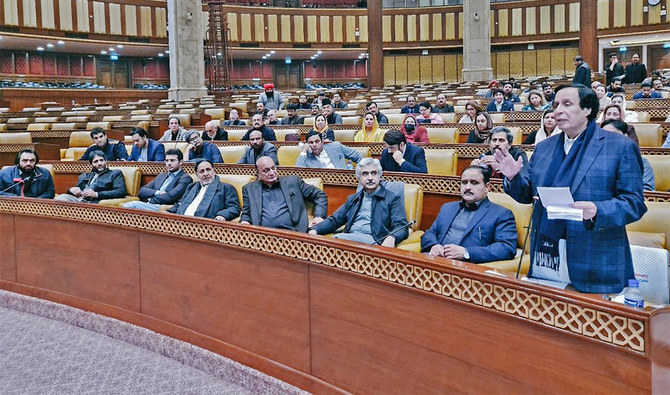
Punjab Chief Minister Chaudhry Parvez Elahi (standing) addresses the provincial lawmakers after retaining his seat in a vote of confidence in the Punjab Assembly in Lahore, Pakistan, on January 11, 2022. (@ChParvezElahi/Twitter)
Short Url
Updated 12 January 2023
Follow

Punjab chief minister signs summary to dissolve provincial legislature

  • Ex-PM Khan’s party says Khyber Pakhtunkhwa Assembly will also be dissolved ‘day after tomorrow’
  • Analysts maintain the former prime minister is up for the ‘final battle’ against his political rivals

ISLAMABAD: Punjab Chief Minister Chaudhry Parvez Elahi signed a summary for the dissolution of the provincial assembly on Thursday, said a senior official of former prime minister Imran Khan’s Pakistan Tehreek-e-Insaf (PTI) party, adding that Khyber Pakhtunkhwa’s legislature would also be dissolved on Saturday.

The development took place only a few hours after the chief minister got vote of confidence from the 371-member house and Punjab Governor Baligh-ur-Rehman withdrew his de-notification order concerning Elahi and his cabinet.

“The chief minister has signed the summary and sent the advice to the Punjab governor [to dissolve the assembly],” said PTI senior vice president Chaudhry Fawad Hussain while talking to the media in Lahore. “If the governor doesn’t accept the advice, the assembly will automatically stand dissolved after 48 hours.”

Pakistan’s constitution says the governor “shall dissolve the Provincial Assembly if so advised by the Chief Minister; and the Provincial Assembly shall, unless sooner dissolved, stand dissolved at the expiration of forty-eight hours after the Chief Minister has so advised.”

Hussain also announced the KP assembly, where the PTI was in power, would also be dissolved “day after tomorrow,” hoping that the dissolution of the two assemblies would pave the way for early national elections.

Since his ouster from power in a parliamentary no-confidence vote last April, ex-PM Khan has been pushing the federal government, led by Prime Minister Shehbaz Sharif, to hold snap polls in the country.

The Sharif administration has repeatedly declined his demand, saying the elections would be held on time. The national elections in Pakistan are scheduled to be held in October this year after the expiry of five-year term of all the assemblies.

Khan announced in November to dissolve the provincial legislatures of Punjab and Khyber Pakhtunkhwa where his party was in power to push the federal government for early elections.

“We have fulfilled our promise with the public that we will return to them [to seek a fresh mandate]. Imran Khan has fulfilled that promise,” Hussain said.

He informed the process to install an interim administration in Punjab would be initiated with a letter to the opposition leader in the assembly, adding the elections would be held within 90 days in the two provinces.

The PTI leader said the elections would be held on nearly 60 percent of the seats in the country and “we still feel the federal government should abandon its stubbornness, agree an electoral framework and move ahead for national elections.”

“Pakistani economy cannot prosper unless we bring stability through elections,” he maintained while urging the National Assembly speaker to accept 121 resignations of PTI lawmakers to hold elections of the national and provincial assembly seats at the same time.

Political analysts said former prime minister Khan was trying to “politically blackmail” the federal government and the newly appointed security establishment of the country by forcing them to agree to snap polls through the dissolution of assemblies.

“Khan is playing a trump card by dissolving the Punjab and KP assemblies and trying to create a political chaos to compel his political rivals to step down,” Owais Tohid, a senior political analyst, told Arab News.

He doubted the federal government led by Prime Minister Sharif would be willing to hold early general elections since its officials feel “they have already paid a heavy political cost by jacking up prices of utilities and taxes to fix the economy.”

“Mr. Khan is up for the final battle against his political rivals as he believes he could spring back to power by riding on his public popularity in the elections,” he said.


Islamabad says surge in aircraft orders after India standoff could end IMF reliance

Updated 22 min 17 sec ago
Follow

Islamabad says surge in aircraft orders after India standoff could end IMF reliance

  • Pakistani jets came into the limelight after Islamabad claimed to have shot down six Indian aircraft during a standoff in May last year
  • Many countries have since stepped up engagement with Pakistan, while others have proposed learning from PAF’s multi-domain capabilities

ISLAMABAD: Defense Minister Khawaja Asif on Tuesday said Pakistan has witnessed a surge in aircraft orders after a four-day military standoff with India last year and, if materialized, they could end the country’s reliance on the International Monetary Fund (IMF).

The statement came hours after a high-level Bangladeshi defense delegation met Pakistan’s Air Chief Marshal Zaheer Ahmed Baber Sidhu to discuss a potential sale of JF-17 Thunder aircraft, a multi-role fighter jointly developed by China and Pakistan that has become the backbone of the Pakistan Air Force (PAF) over the past decade.

Fighter jets used by Pakistan came into the limelight after Islamabad claimed to have shot down six Indian aircraft, including French-made Rafale jets, during the military conflict with India in May last year. India acknowledged losses in the aerial combat but did not specify a number.

Many countries have since stepped up defense engagement with Pakistan, while delegations from multiple other nations have proposed learning from Pakistan Air Force’s multi-domain air warfare capabilities that successfully advanced Chinese military technology performs against Western hardware.

“Right now, the number of orders we are receiving after reaching this point is significant because our aircraft have been tested,” Defense Minister Asif told a Pakistan’s Geo News channel.

“We are receiving those orders, and it is possible that after six months we may not even need the IMF.”

Pakistan markets the Chinese co-developed JF-17 as a lower-cost multi-role fighter and has positioned itself as a supplier able to offer aircraft, training and maintenance outside Western supply chains.

“I am saying this to you with full confidence,” Asif continued. “If, after six months, all these orders materialize, we will not need the IMF.”

Pakistan has repeatedly turned to the IMF for financial assistance to stabilize its economy. These loans come with strict conditions including fiscal reforms, subsidy cuts and measures to increase revenue that Pakistan must implement to secure disbursements.

In Sept. 2024, the IMF approved a $7 billion bailout for Pakistan under its Extended Fund Facility (EFF) program and a separate $1.4 billion loan under its climate resilience fund in May 2025, aimed at strengthening the country’s economic and climate resilience.

Pakistan has long been striving to expand defense exports by leveraging its decades of counter-insurgency experience and a domestic industry that produces aircraft, armored vehicles, munitions and other equipment.

The South Asian country reached a deal worth over $4 billion to sell military equipment to the Libyan National Army, Reuters report last month, citing Pakistani officials. The deal, one of Pakistan’s largest-ever weapons sales, included the sale of 16 JF-17 fighter jets and 12 Super Mushak trainer aircraft for basic pilot training.