RIO DE JANEIRO: “No amnesty! No amnesty! No amnesty!”
The chant reverberated off the walls of the jam-packed hall at the University of Sao Paulo’s law college on Monday afternoon. Within hours, it was the rallying cry for thousands of Brazilians who streamed into the streets of Rio de Janeiro and Sao Paulo, penned on protest posters and banners.
The words are a demand for retribution against the supporters of former President Jair Bolsonaro who stormed Brazil’s capital Sunday, and those who enabled the rampage.
“These people need to be punished, the people who ordered it need to be punished, those who gave money for it need to be punished,” Bety Amin, a 61-year-old therapist, said on Sao Paulo’s main boulevard. The word “DEMOCRACY” stretched across the back of her shirt. “They don’t represent Brazil. We represent Brazil.”
Protesters’ push for accountability evokes memories of an amnesty law that for decades has protected military members accused of abuse and murder during the country’s 1964-85 dictatorship. A 2014 truth commission report sparked debate over how Brazil has grappled with the regime’s legacy.
Declining to mete out punishment “can avoid tensions at the moment, but perpetuates instability,” Luis Felipe Miguel, a professor of political science at the University of Brasilia, wrote in a column entitled “No Amnesty” published Monday evening. “That is the lesson we should have learned from the end of the military dictatorship, when Brazil opted not to punish the regime’s killers and torturers.”
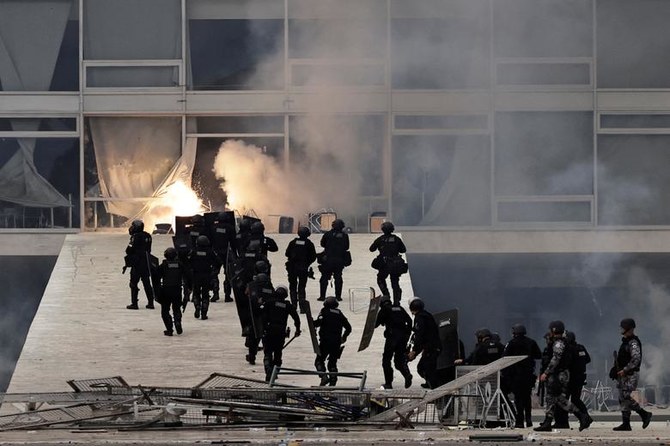
Brazilian police on Monday had already rounded up roughly 1,500 rioters. Some were caught in the act of trashing Brazil’s Congress, the Supreme Court and the presidential palace. Most were detained the following morning at an encampment in Brasilia. Many were held in a gymnasium throughout the day, and video shared on pro-Bolsonaro social media channels showed some complaining about poor treatment in the crowded space.
Hundreds of elderly and sick detainees were released Tuesday after they were questioned and had their phones inspected, local media O Globo reported. The Federal Police’s press office told The Associated Press that the force plans to indict at least 1,000 people, and has begun transferring them to prison.
The administration of President Luiz Inácio Lula da Silva says jailing the rioters is only the start.
Justice minister Flávio Dino vowed to prosecute those who acted behind the scenes to summon supporters on social media and finance their transport on charges involving organized crime, staging a coup, and violent abolition of the democratic rule of law. Authorities also are investigating allegations that local security personnel allowed the destruction to proceed unabated.
“We cannot and will not compromise in fulfilling our legal duties,” Dino said. “This fulfillment is essential so such events do not repeat themselves.”
Lula signed a decree, now approved by both houses of Congress, ordering the federal government to assume control of security in the capital.
Far-right elements have refused to accept Bolsonaro’s electoral defeat. Since his Oct. 30 loss, they have camped outside military barracks in Brasilia, pleading for intervention to allow Bolsonaro to remain in power and oust Lula. When no coup materialized, they rose up themselves.
Decked out in the green and yellow of the national flag, they broke windows, toppled furniture and hurled computers and printers to the ground. They punched holes in a massive Emiliano Di Cavalcanti painting at the presidential palace and destroyed other works of art. They overturned the U-shaped table where Supreme Court justices convene, ripped a door off one justice’s office and vandalized a statue outside the court. Hours passed before police expelled the mob.
“It’s unacceptable what happened yesterday. It’s terrorism,” Marcelo Menezes, a 59-year-old police officer from northeastern Pernambuco state, said at a protest in Sao Paulo. “I’m here in defense of democracy, I’m here in defense of the people.”
Cries of “No amnesty!” were also heard during Lula’s Jan. 1 inaugural address, in response to the president detailing the neglect of the outgoing Bolsonaro administration.
Bolsonaro, a former army captain, has waxed nostalgic for the dictatorship era, praised a notorious torturer as a hero and said the regime should have gone further in executing communists. His government also commemorated the anniversary of Brazil’s 1964 coup.
Political analysts had repeatedly warned that Bolsonaro was laying the groundwork for an insurrection in the mold of that which unfolded in the US Capitol on Jan. 6, 2021. For months, he stoked belief among hardcore supporters that the nation’s electronic voting system was prone to fraud — though he never presented any evidence and independent experts disagreed.
Results from the election, the closest since Brazil’s return to democracy, were quickly recognized by politicians across the spectrum, including some Bolsonaro allies, as well as dozens of other governments. The outgoing president surprised nearly everyone by promptly fading from view, neither conceding defeat nor emphatically crying fraud. He and his party submitted a request to nullify millions of votes, which was swiftly dismissed by the electoral authority.
None of that dissuaded his die-hard backers from their conviction that Bolsonaro should still be in power.
In the immediate aftermath of the riot, Lula said that the so-called “fascist fanatics” and their financial backers must be held responsible. He also accused Bolsonaro of encouraging the uprising.
Bolsonaro denied the president’s accusation Sunday. Writing on Twitter, he said peaceful protest is part of democracy, but vandalism and invasion of public buildings cross the line.
Authorities are also investigating the role of the federal district’s police in either failing to halt protesters’ advance or standing aside to let them run amok. Prosecutors in the capital said local security forces were negligent at the very least. A supreme court justice temporarily suspended the regional governor, who oversees the force, for what he termed “willful omission.” Another justice blamed authorities across Brazil for not swiftly cracking down on “homegrown neofascism.”
The upheaval finally prompted municipal and state governments to disperse the pro-Bolsonaro encampments outside the military barracks. Their tents and tarps were taken down, and residents were sent packing.
Meanwhile, pro-democracy protesters want to ensure their message — “No amnesty!” — will be heeded by both the law enforcement authorities and any far-right elements who might dare defy democracy again.
“After what happened yesterday, we need to go to the street,” said Marcos Gama, a retiree protesting Monday night in Sao Paulo. “We need to react.”


![]()

‘No amnesty!’: Brazilian protests demand jail for rioters
Short Url
https://arab.news/jtzhe
‘No amnesty!’: Brazilian protests demand jail for rioters
- Administration of President Luiz Inácio Lula da Silva says jailing the rioters is only the start


Latest updates



© 2026 SAUDI RESEARCH & PUBLISHING COMPANY, All Rights Reserved And subject to Terms of Use Agreement.