

Recession a looming threat for global economy — World Bank

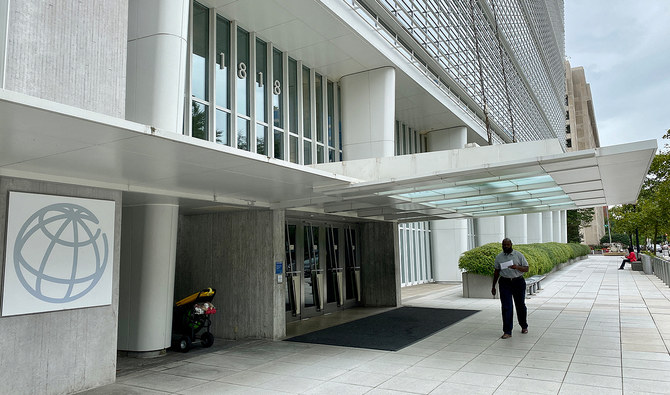
A man is walking in front of the World Bank Building in Washington DC on September 25, 2020. (Photo courtesy: AFP/File)
Short Url
Updated 10 January 2023
Follow

Recession a looming threat for global economy — World Bank

  • In annual report, the World Bank has slashed forecast for global growth this year by nearly half
  • If that forecast proves accurate, it would be the third-weakest annual expansion in three decades

WASHINGTON: The global economy will come “perilously close” to a recession this year, led by weaker growth in all the world’s top economies — the United States, Europe and China — the World Bank warned on Tuesday.

In an annual report, the World Bank, which lends money to poorer countries for development projects, said it had slashed its forecast for global growth this year by nearly half, to just 1.7 percent, from its previous projection of 3 percent. If that forecast proves accurate, it would be the third-weakest annual expansion in three decades, behind only the deep recessions that resulted from the 2008 global financial crisis and the coronavirus pandemic in 2020.

Though the United States might avoid a recession this year — the World Bank predicts the US economy will eke out growth of 0.5 percent — global weakness will likely pose another headwind for America’s businesses and consumers, on top of high prices and more expensive borrowing rates. The United States also remains vulnerable to further supply chain disruptions if COVID-19 keeps surging or Russia’s war in Ukraine worsens.

And Europe, long a major exporter to China, will likely suffer from a weaker Chinese economy.

The World Bank report also noted that rising interest rates in developed economies like the United States and Europe will attract investment capital from poorer countries, thereby depriving them of crucial domestic investment. At the same time, the report said, those high interest rates will slow growth in developed countries at a time when Russia’s invasion of Ukraine has kept world food prices high.

“Russia’s invasion of Ukraine has added major new costs,” World Bank President David Malpass said on a call with reporters. “The outlook is particularly devastating for many of the poorest economies where poverty reduction is already ground to a halt and access to electricity, fertilizer, food and capital is likely to remain limited for a prolonged period.”

The impact of a global downturn would fall particularly hard on poorer countries in such areas as Saharan Africa, which is home to 60 percent of the world’s poor. The World Bank predicts per capita income will grow just 1.2 percent in 2023 and 2024, which is such a tepid pace that poverty rates could rise.

“Weakness in growth and business investment will compound the already devastating reversals in education, health, poverty and infrastructure and the increasing demands from climate change,” Malpass said. “Addressing the scale of these challenges will require significantly more resources for development and global public goods.”

Along with seeking new financing so it can lend more to poorer countries, Malpass said, the World Bank is, among other things, seeking to improve its lending terms that would increase debt transparency, “especially for the rising share of poor countries that are at high risk of debt distress.”

The report follows a similarly gloomy forecast a week earlier from Kristina Georgieva, the head of the International Monetary Fund, the global lending agency. Georgieva estimated on CBS’ “Face the Nation” that one-third of the world will fall into recession this year.

“For most of the world economy, this is going to be a tough year, tougher than the year we leave behind,” Georgieva said. “Why? Because the three big economies — US, EU, China — are all slowing down simultaneously.”

The World Bank projects that the European Union’s economy won’t grow at all next year after having expanded 3.3 percent in 2022. It foresees China growing 4.3 percent, nearly a percentage point lower than it had previously forecast and about half the pace that Beijing posted in 2021.

The bank expects developing countries to fare better, growing 3.4 percent this year, the same as in 2022, though still only about half the pace of 2021. It forecasts Brazil’s growth slowing to 0.8 percent in 2023, down from 3 percent last year. In Pakistan, it expects the economy to expand just 2 percent this year, one-third of last year’s pace.

Other economists have also issued bleak outlooks, though most of them not quite as dire. Economists at JPMorgan are predicting slow growth this year for advanced economies and the world as a whole, but they don’t expect a global recession. Last month, the bank predicted that slowing inflation will bolster consumers’ ability to spend and power growth in the United States and elsewhere.

“The global expansion will turn into 2023 bent but not broken,” the JPMorgan report said.


Mystery of CIA’s lost nuclear device haunts Himalayan villagers 60 years on

Updated 20 December 2025
Follow

Mystery of CIA’s lost nuclear device haunts Himalayan villagers 60 years on

  • Plutonium-fueled spy system was meant to monitor China’s nuclear activity after 1964 atomic tests
  • Porter who took part in Nanda Devi mission warned family of ‘danger buried in snow’

NEW DELHI: Porters who helped American intelligence officers carry a nuclear spy system up the precarious slopes of Nanda Devi, India’s second-highest peak, returned home with stories that sent shockwaves through nearby villages, leaving many in fear that still holds six decades later.

A CIA team, working with India’s Intelligence Bureau, planned to install the device in the remote part of the Himalayas to monitor China, but a blizzard forced them to abandon the system before reaching the summit.

When they returned, the device was gone.

The spy system contained a large quantity of highly radioactive plutonium-238 — roughly a third of the amount used in the atomic bomb dropped by the US on the Japanese city of Nagasaki in the closing stages of the Second World War.

“The workers and porters who went with the CIA team in 1965 would tell the story of the nuclear device, and the villagers have been living in fear ever since,” said Narendra Rana from the Lata village near Nanda Devi’s peak.

His father, Dhan Singh Rana, was one of the porters who carried the device during the CIA’s mission in 1965.

“He told me there was a danger buried in the snow,” Rana said. “The villagers fear that as long as the device is buried in the snow, they are safe, but if it bursts, it will contaminate the air and water, and no one will be safe after that.”

During the Sino-Indian tensions in the 1960s, India cooperated with the US in surveillance after China conducted its first nuclear tests in 1964. The Nanda Devi mission was part of this cooperation and was classified for years. It only came under public scrutiny in 1978, when the story was broken by Outsider magazine.

The article caused an uproar in India, with lawmakers demanding the location of the nuclear device be revealed and calling for political accountability. The same year, then Prime Minister Morarji Desai set up a committee to assess whether nuclear material in the area near Nanda Devi could pollute the Ganges River, which originates there.

The Ganges is one of the world’s most crucial freshwater sources, with about 655 million people in India, Nepal, and Bangladesh depending on it for their essential needs.

The committee, chaired by prominent scientists, submitted its report a few months later, dismissing any cause for concerns, and establishing that even in the worst-case scenario of the device’s rupture, the river’s water would not be contaminated.

But for the villagers, the fear that the shell containing radioactive plutonium could break apart never goes away, and peace may only come once it is found.

Many believe the device, trapped within the glacier’s shifting ice, may have moved downhill over time.

Rana’s father told him that the device felt hot when it was carried, and he believed it might have melted its way into the glacier, remaining buried deep inside.

An imposing mass of rock and ice, Nanda Devi at 7,816 m is the second-highest mountain in India after Kangchenjunga. 

When a glacier near the mountain burst in 2021, claiming over 200 lives, scientists explained that the disaster was due to global warming, but in nearby villages the incident was initially blamed on a nuclear explosion.

“They feared the device had burst. Those rescuing people were afraid they might die from radiation,” Rana said. “If any noise is heard, if any smoke appears in the sky, we start fearing a leak from the nuclear device.”

The latent fear surfaces whenever natural disasters strike or media coverage puts the missing device back in the spotlight. Most recently, a New York Times article on the CIA mission’s 60th anniversary reignited the unease.

“The apprehensions are genuine. After 1965, Americans came twice to search for the device. The villagers accompanied them, but it could not be found, which remains a concern for the local community,” said Atul Soti, an environmentalist in Joshimath, Uttarakhand, about 50 km from Nanda Devi.

“People are worried. They have repeatedly sought answers from the government, but no clear response has been provided so far. Periodically, the villagers voice their concerns, and they need a definitive government statement on this issue.”

Despite repeated queries whenever media attention arises, Indian officials have not released detailed updates since the Desai-appointed committee submitted its findings.

“The government should issue a white paper to address people’s concerns. The white paper will make it clear about the status of the device, and whether leakage from the device could pollute the Ganges River,” Soti told Arab News.

“The government should be clear. If the government is not reacting, then it further reinforces the fear.”