

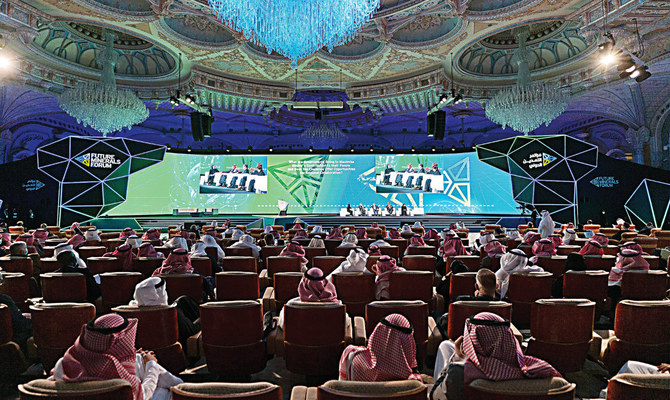

CAIRO: Saudi Arabia will host the second edition of the Future Minerals Forum from Jan. 10-12 to discuss the upcoming trends and challenges in the minerals industry.
Set to take place at the King Abdulaziz International Conference Center in Riyadh, the FMF will gather global mining leaders, including government officials and business executives.
With over 200 speakers and 13,000 attendees, the event will focus on creating responsible and resilient minerals and metals supply and value chains in Africa, Western and Central Asia.
The FMF is anticipated to tackle several topics, including sustainability, the future of mining, energy transition, the contribution of minerals to the development of societies, digital transformation and integrated value chains.
The forum will start with a ministerial roundtable on Jan. 10 to gather high-level government officials and nongovernmental organizations in the mining industry.
New frontiers
The two-day event will host leaders from over 100 countries to discuss five crucial topics: “The World Today,” “The Region,” “Decarbonizing Supply Chains,” “Digital and New Technology” and “Communities and Future Workforce.”
The “World of Today” is set to point out the region’s mineral development in a global context, the implications of war in Europe for future minerals supply and the economic, environmental and political development that will impact the region’s industry.
“The Region” will open room for a more in-depth discussion about the future of critical mineral supply and demand, exploring mineral hot spots and translating dialogue into actions.
Renewable energy, accountability, traceability and electrification of the supply chain are set to be the core of “Decarbonizing Supply Chains.”
“Digital and New Technology” will reimagine the mining sector through innovation and digitalization, while “Communities and Future Workforce” will explore the diversity, skill development and leadership in the industry.
On Jan. 11, the forum will host several fireside chats, live interviews, and panel discussions beginning with the subtheme “Lands of Opportunity: Enabling mineral development across Africa, Western and Central Asia.”
The event will then move to the second subtheme, “Reimaging minerals for the energy transition,” followed by the third and longest subtheme: “Toward creating regional centers of excellence Part 1.”
HIGHLIGHTS
• The two-day event will host leaders from over 100 countries to discuss five crucial topics: ‘The World Today,’ ‘The Region,’ ‘Decarbonizing Supply Chains,’ ‘Digital and New Technology’ and ‘Communities and Future Workforce.’
• Saudi Minister of Industry and Mineral Resources Bandar Alkhorayef will set the scene on Jan.11 with an opening presentation on the Ministerial Roundtable discussed topic and laying the groundwork for the 2023 forum.
• Saudi Energy Minister Prince Abdulaziz bin Salman will be the guest of a live interview on Saudi Arabia’s role as a global leader in renewable energy supply.
• On Jan. 12, the forum will host two workshops and panel discussions on the importance of education in the sector.
• The event will include a mining tech zone, marketplace, think tanks and a global connect program.
• The FMF 2023 has partnered with Development Partner Institute, Clareo, Center for Energy Studies at Rice University’s Baker Institute for Public Policy, and Payne Institute to deliver dynamic insights about the sector’s development.
Saudi Minister of Industry and Mineral Resources Bandar Alkhorayef will set the scene on Jan.11 with an opening presentation on the Ministerial Roundtable discussed topic and laying the groundwork for the 2023 forum.
Minister of Investment of Saudi Arabia Khalid Al-Falih and Minister of Finance Mohammed Al-Jadaan will be joined by Tarek El-Molla, Egypt’s minister of petroleum and mineral resources, Kairbek Uskenbayev, Kazakhstan’s minister of industry and infrastructure, Antoinnette N’Samba, Congo’s minister of mines and Grant Shapps, UK’s secretary of state for business, energy and industry, in a panel discussion on the role of governments in the mineral industry.
Sustainability leadership
In a fireside chat, Saudi Energy Minister Prince Abdulaziz bin Salman will be the guest of a live interview on Saudi Arabia’s role as a global leader in renewable energy supply.
On Jan. 12, the forum will host two workshops and panel discussions on the importance of education in the sector.
Saudi Minister of Education Yousef Al-Benyan will be interviewed on delivering a skilled workforce for the new age of minerals in the Kingdom and the region.
The second day of the forum will also host Minister of Environment, Water and Agriculture Abdulrahman Al-Fadhli, who will lay out the Kingdom’s ambition toward sustainability.
Other interesting discussions include “Innovations and initiatives for supporting the new minerals industry in Saudi Arabia” and “Toward COP28: Placing minerals on the front line against climate change.”
The FMF’s key objectives are to shape the future of mineral development and attract investment to the region through panel discussions and three workshops.
Future technologies
A considerable part of the forum will be the exhibition which will host an exclusive lineup of international and regional mining, technology, engineering, equipment and energy companies showcasing from all aspects of exploration to the processing of essential minerals.
This year’s program will also feature a new dedicated digital zone that will display the latest current and future technologies. In addition, the program will also feature an outdoor exhibition and a dedicated spot to display investment opportunities in the emerging mining region of Africa, West and Central Asia.
The event will include a mining tech zone, marketplace, think tanks and a global connect program.
“We have all it takes here at the forum to start the journey to build sustainable practices that go beyond compliance and which we can share with the region and the world,” Khalid Al-Mudaifer, vice minister for mining affairs in Saudi Arabia, said in a statement.
Launched in 2022 by Saudi Arabia’s Ministry of Industry and Mineral Resources, FMF is designed to advance and unlock mining opportunities from Africa to West and Central Asia.
The forum has partnered with several global leaders to ensure the event’s success and enable think tanks to further boost idea generation on the future of the mining sector.
The FMF 2023 has partnered with Development Partner Institute, Clareo, Center for Energy Studies at Rice University’s Baker Institute for Public Policy, and Payne Institute to deliver dynamic insights about the sector’s development.


