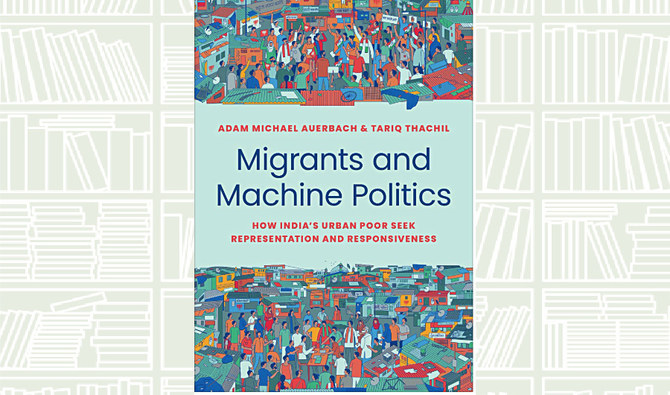
What We Are Reading Today: Migrants and Machine Politics

Short Url
Updated 09 January 2023
Follow

What We Are Reading Today: Migrants and Machine Politics

Authors: Adam Michael & Tariq Thachil

As the Global South rapidly urbanizes, millions of people have migrated from the countryside to urban slums, which now house 1 billion people worldwide. 

The transformative potential of urbanization hinges on whether and how poor migrants are integrated into city politics.

Popular and scholarly accounts paint migrant slums as exhausted by dispossession, subdued by local dons, bought off by wily politicians, or polarized by ethnic appeals.

“Migrants and Machine Politics” shows how slum residents in India routinely defy such portrayals, actively constructing and wielding political machine networks to demand important, albeit imperfect, representation and responsiveness within the country’s expanding cities.

Drawing on years of pioneering fieldwork in India’s slums, including ethnographic observation, interviews, surveys, and experiments, Adam Michael Auerbach and Tariq Thachil reveal how migrants harness forces of political competition—as residents, voters, community leaders, and party workers—to sow unexpected seeds of accountability within city politics. 


Book Review: Things We Do Not Tell the People We Love

Updated 20 February 2026
Follow

Book Review: Things We Do Not Tell the People We Love

It is always a pleasure to encounter a short story collection that delivers on every page, and British Muslim writer Huma Qureshi’s “Things We Do Not Tell the People We Love,” does exactly that.

Deliciously complex and devastating, the stories in this collection, published in paperback in 2022, are told mostly from the female perspective, capturing the intimate textures of everyday life, from love, loss and loneliness to the endlessly fraught relationships between mothers and daughters, friends and lovers.

Qureshi’s prose is understated yet razor-sharp, approaching her characters from close quarters with poignant precision. 

I found it particularly impressive that none of the stories in the collection fall short or leave you confused or underwhelmed, and they work together to deliver the title’s promise.

Even the stories that leave you with burning, unanswered questions feel entirely satisfying in their ambiguity.

Several pieces stand out. “Firecracker” is a melancholy study of how some friendships simply age out of existence; “Too Much” lays bare the failures of communication that so often run between mothers and daughters; “Foreign Parts,” told from a British man’s perspective as he accompanies his fiancee to Lahore, handles questions of class and hidden identity with admirable delicacy; and “The Jam Maker,” an award-winning story, builds to a genuinely thrilling twist.

Throughout, Qureshi’s characters carry South Asian and Muslim identities worn naturally, as one thread among many in the fabric of who they are. They are never reduced to stereotypes or a single defining characteristic. 

Reading this collection, I found myself thinking of early Jhumpa Lahiri, of “Interpreter of Maladies,” and that feeling of discovering a writer who seems destined to endure. 

Huma Qureshi tells the stories of our times— mundane and extraordinary in equal measure— and she tells them beautifully.