

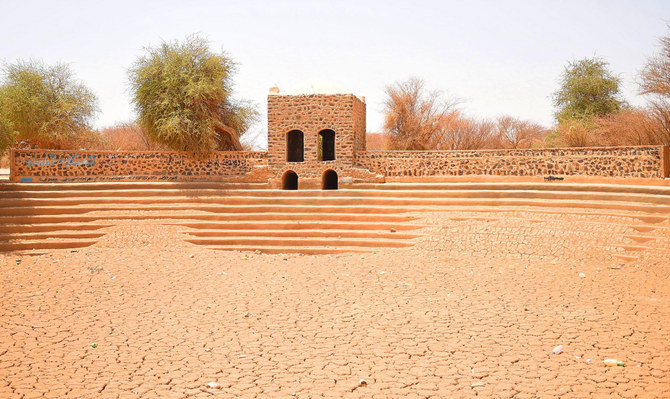
Saudi Heritage Commission registers 41 new historical sites

The commission aims to build a special database for registered archaeological sites. (SPA)
Short Url
Updated 09 January 2023
Follow

Saudi Heritage Commission registers 41 new historical sites

  • A nationwide conservation strategy has been established by the commission covering four categories: antiquities, urban heritage, handicrafts, and intangible cultural heritage

RIYADH: The Kingdom’s Heritage Commission has registered 41 new archaeological and historical sites in the National Antiquities Register, the Saudi Press Agency reported on Monday.

The registration of heritage sites is part of the commission’s efforts to discover, document, record and preserve Saudi Arabia’s heritage and historical sites.

The locations are in Taif governorate and its affiliated centers. They include palaces and traditional houses, as well as villages, castles, museums, towers, mosques, markets, and historical schools.

The most prominent sites are King Abdulaziz Palace in Al-Muwayh, Suleiman Mosque, Abdullah bin Abbas Mosque, the city center of Taif, and Souk Okaz.

Jasser Al-Harbash, CEO of the Heritage Commission, said that the body was taking steps toward discovering and documenting historical sites in all regions of the Kingdom, registering them in the National Antiquities Register, archiving and digitizing them, and then adding them to an advanced digital record.

The commission aims to build a special database for registered archaeological sites. It has also called on the public to report any newly discovered historical locations through the Balagh platform.

A nationwide conservation strategy has been established by the commission covering four categories: antiquities, urban heritage, handicrafts, and intangible cultural heritage.

The International Day for Monuments and Sites, also known as World Heritage Day, is celebrated each year on April 18, including in Saudi Arabia.


Saudi Arabia’s KAUST named FIFA’s first research institute in MENA

The canal in the King Abdullah University of Science and Technology campus. (Shutterstock)
Updated 10 February 2026
Follow

Saudi Arabia’s KAUST named FIFA’s first research institute in MENA

  • KAUST President Prof. Sir Edward Byrne said that the university’s selection as the fifth FIFA Research Institute in the world — and the first in the region — marks a significant achievement, reflecting Kingdom’s growing presence in international football

RIYADH: FIFA has designated the King Abdullah University of Science and Technology as its first research institute in the Middle East and Asia to support the development of innovative football research, the Saudi Press Agency reported on Tuesday.

The recognition highlights KAUST’s commitment to integrating sports, academic research and industry through advanced, high-level initiatives grounded in rigorous scientific methodologies, contributing to the advancement of football studies.

KAUST President Prof. Sir Edward Byrne said that the university’s selection as the fifth FIFA Research Institute in the world — and the first in the region — marks a significant achievement, reflecting Saudi Arabia’s growing presence in international football.

The accreditation aligns with national efforts to invest in research and development and promote the knowledge economy, supporting Saudi Vision 2030’s goals of building an advanced sports system based on innovation and sustainability.

The collaboration’s first project focuses on developing advanced AI algorithms to analyze historical FIFA World Cup broadcast footage, transforming decades of match videos into structured, searchable data, according to the KAUST website.

This work opens new opportunities to apply state-of-the-art computer vision techniques and deepen understanding of how football has evolved over time.

The second project uses player and ball tracking data from the FIFA World Cup 2022 in Qatar and the FIFA Women’s World Cup 2023 in Australia and New Zealand to compile comprehensive datasets capturing in-game dynamics.

These datasets provide deeper insights into human movement, playing techniques and performance dynamics through AI-driven analysis.