

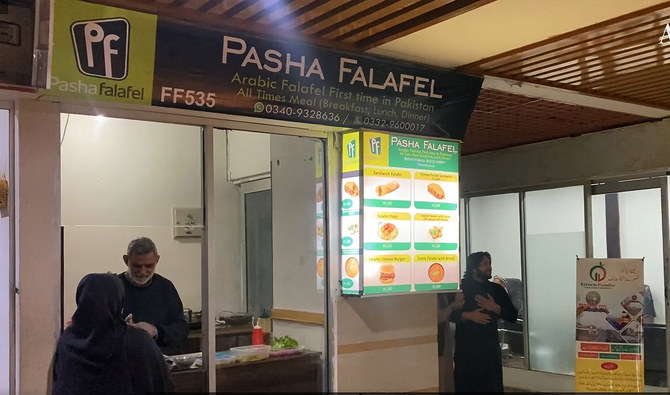
After setting up falafel snack bar in Peshawar, Iraqi man hopes to expand business in Pakistan

Nawaf Abbasi, owner of Pasha Falafel, interacts with a customer in Peshawar, Pakistan, on January 4, 2023. (AN Photo)
Short Url
Updated 08 January 2023
Follow

After setting up falafel snack bar in Peshawar, Iraqi man hopes to expand business in Pakistan

  • Nawaf Abbasi graduated from Saudi Arabia before moving to Pakistan in 1986 where he married a Pashtun woman
  • After serving as a language teacher for several years, Abbasi started serving Middle East’s ‘popular street food’ in Pakistan

PESHAWAR: A man of Iraqi origin, who decided to settle down in Pakistan more than three decades ago before establishing a snack bar serving falafel last year, plans to benefit from the popularity of Arabic cuisine in the country by expanding his business to other cities.

Nawaf Abbasi, 61, graduated from Saudi Arabia before moving to Pakistan in 1986 where he married a Pashtun woman and got new nationality. He remained associated with various education institutes in Khyber Pakhtunkhwa as a language teacher for 15 years. However, he ultimately decided to set up his small café, Pasha Falafel, to sell the “popular street food” that is consumed by millions across the Middle Eastern countries.

“I have been working in [the field of] education,” he told Arab News on Wednesday. “Now, I have started my own [falafel] business. My plan is to extend [it across] Pakistan. I am negotiating with two parties, one in Karachi and another in Lahore [to expand this initiative to other places].”

Abbasi said he made falafel by mixing chickpeas, broad beans and patty-shaped fritter, adding the cuisine was becoming popular with growing number of people.

His outlet serves the food as sandwich and burger along with an assortment of vegetables and sauces.

“When I heard about Pasha Falafel restaurant, I was too excited because I love and like Arabic foods,” said Mahnoor Khan, a female customer at the facility. “I tried sandwich and falafel cheese burger. The taste was very delicious and spicy and the prices were quite low.”

Asked if he still visited his country of origin, Abbasi said that lost his parents several years ago, though he continued to see his relatives in Iraq.

However, he said he was now permanently based in Pakistan where he lived with his wife and four children.

Responding to a question about his future plans apart from taking his business to other cities, he said: “I am going to introduce frozen falafel that will be available in super markets.”


Back from Iran, Pakistani students say they heard gunshots while confined to campus

Updated 8 sec ago
Follow

Back from Iran, Pakistani students say they heard gunshots while confined to campus

  • Students say they were confined to dormitories and unable to leave campuses amid unrest
  • Pakistani students stayed in touch with families through the embassy amid Internet blackout

ISLAMABAD: Pakistani students returning from Iran on Thursday said they heard gunshots and stories of rioting and violence while being confined to campus and not allowed out of their dormitories in the evening.

Iran’s leadership is trying to quell the worst domestic unrest since its 1979 revolution, with a rights group putting the death toll over 2,600.

As the protests swell, Tehran is seeking to deter US President Donald Trump’s repeated threats to intervene on behalf of anti-government protesters.

“During ‌nighttime, we would ‌sit inside and we would hear gunshots,” Shahanshah ‌Abbas, ⁠a fourth-year ‌student at Isfahan University of Medical Sciences, said at the Islamabad airport.

“The situation down there is that riots have been happening everywhere. People are dying. Force is being used.”

Abbas said students at the university were not allowed to leave campus and told to stay in their dormitories after 4 p.m.

“There was nothing happening on campus,” Abbas said, but in his interactions with Iranians, he ⁠heard stories of violence and chaos.

“The surrounding areas, like banks, mosques, they were damaged, set on fire ... ‌so things were really bad.”

Trump has repeatedly ‍threatened to intervene in support of protesters ‍in Iran but adopted a wait-and-see posture on Thursday after protests appeared ‍to have abated. Information flows have been hampered by an Internet blackout for a week.

“We were not allowed to go out of the university,” said Arslan Haider, a student in his final year. “The riots would mostly start later in the day.”

Haider said he was unable to contact his family due to the blackout but “now that they opened international calls, the students are ⁠getting back because their parents were concerned.”

A Pakistani diplomat in Tehran said the embassy was getting calls from many of the 3,500 students in Iran to send messages to their families back home.

“Since they don’t have Internet connections to make WhatsApp and other social network calls, what they do is they contact the embassy from local phone numbers and tell us to inform their families.”

Rimsha Akbar, who was in the middle of her final year exams at Isfahan, said international students were kept safe.

“Iranians would tell us if we are talking on Snapchat or if we were riding in a cab ... ‌that shelling had happened, tear gas had happened, and that a lot of people were killed.”