

Pakistani Taliban leader denies cease-fire breakdown, hints at continued talks with government

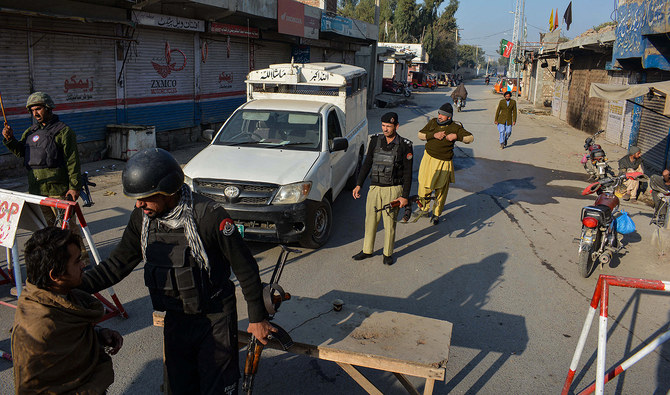
In this photo taken on December 19, 2022, police stand guard along a road they blocked after Taliban militants seized a police station in Bannu. (Photo courtesy: AFP/File)
Short Url
Updated 08 January 2023
Follow

Pakistani Taliban leader denies cease-fire breakdown, hints at continued talks with government

  • Mufti Noor Wali Mehsud says his faction launched ‘retaliatory strikes’ after cease-fire violations by Pakistani forces
  • The TTP leader issued his message after his radical network unilaterally announced to call off cease-fire in November

ISLAMABAD: A top leader of a proscribed militant network targeting Pakistani civilians and security forces has hinted at the possibility of continued talks with the government in a video message addressed to religious scholars of the country.

Mufti Noor Wali Mehsud is a senior leader of Tehreek-e-Taliban Pakistan (TTP), a conglomerate of various armed factions, which has taken responsibility of recent militant attacks in different Pakistani cities.

Pakistan witnessed a surge in extremist violence since TTP leaders decided to unilaterally call off a fragile cease-fire with the government in November, though Mehsud denied in his video clip that the truce had broken down.

“We continued to negotiate with Pakistan for about a year in talks that were mediated by the Islamic Emirate of Afghanistan and we are still open to cease-fire today,” he said. “Due to the cease-fire violations of Pakistani security forces, however, we allowed our mujahideen [freedom fighters] to launch retaliatory strikes.”

The TTP leadership is said to be based in Afghanistan, making Pakistani authorities remind the administration in Kabul in recent weeks it was their responsibility not to allow the Afghan territory to be used against neighboring states.

The country’s civilian and political leaders decided in a recent security meeting they would only negotiate with the Afghan interim administration, instead of TTP leadership, to address the problem of growing militant violence.

Mehsud also assured Pakistani religious scholars in the video that his group would listen to their advice if they thought its members had committed excesses while waging its armed struggle.


Walnut tree remains ‘under arrest’ for over a century, living symbol of colonial power in Pakistan

Updated 4 sec ago
Follow

Walnut tree remains ‘under arrest’ for over a century, living symbol of colonial power in Pakistan

  • British officer is said to have ordered chaining of the tree in 1898, a reminder of the absolute authority and psychological control enforced under colonial rule in Khyber Pass region
  • Locals and historians say the shackled tree survives as a physical memory of the Frontier Crimes Regulation era, when even nature could be punished to discipline subjects and display power

LANDI KOTAL, KHYBER: In the military cantonment of Landi Kotal, close to Pakistan’s Torkham border crossing with Afghanistan and the mouth of the historic Khyber Pass, a single walnut tree stands bound in heavy iron chains.

It has been this way for more than a century, a surreal, almost absurd monument to the power structures and punitive imagination of the British Empire’s rule in the tribal frontier.

Black shackles still brace parts of its branches, giving it the appearance of a theatrical installation. To locals, it is a wound that never fully healed, a reminder that even nature could be punished when authority wished to show dominance.

Local oral histories trace the origin of this bizarre imprisonment to 1898, when a British officer named James Squid, allegedly intoxicated, believed the tree was moving toward him and instantly ordered it arrested. Soldiers carried out the instruction and the walnut tree has never been freed since.

Muhammad Sardar, the caretaker who oversees the site today, recounted the story as it has been passed down for generations.

“This British military official at that time was drunk and thought this walnut tree was moving toward him to attack him,” he told Arab News. “The officer ordered to arrest this tree, hence the soldiers had to obey the order and arrest this tree.”

Whether the event unfolded exactly as described is impossible to verify, but historians and residents agree on what the continued chaining represented: the unquestionable authority of colonial power.

A LAW THAT COULD BIND PEOPLE — AND TREES

Landi Kotal was one of the most militarized points of the British-controlled frontier, a strategic chokepoint along the Khyber Pass, a route armies, traders and empires have used for thousands of years. To control the region, the British introduced the Frontier Crimes Regulation (FCR), a law that denied locals the right to appeal, hire lawyers or challenge government decisions. Entire tribes could be punished for the suspected action of one member.

The chained walnut tree is often interpreted as a physical embodiment of that era: a warning made visible.

Dr. Syed Waqar Ali Shah, Assistant Professor of History at the University of Peshawar, said the symbolism was deliberate.

“It was an assertion of their [British] authority, it was a symbol of their power. Right. It’s a funny thing as well, because it’s something which was under the influence of some intoxication,” he explained.

“The officer behaved or gave orders for the imprisonment of that particular tree under the influence of some intoxicants.”

Dr. Shah continued:

“It was something which was a symbol of colonial authority, assertion of their authority, of bureaucratic diplomacy, a symbol of their bureaucratic strength and power, and maybe some cultural encounter as well.”

He added that such displays endured because “it was a cultural link between the locals and the colonial power. So it was a reflection of that. But later on, they continued with it in the presence of FCR (Frontier Crimes Regulation) and regulations like this.”

Even once the officer sobered, the chains remained.

Dr. Shah believes that was intentional: psychological messaging meant to instill conformity and fear in people living under colonial law.

“Their objective and purpose was to make it a symbol of discipline for the masses. It was an exhibition of power, a sheer exhibition of power, a symbol that if we can do this to something which was inhuman … if they can deal with a tree like this, so the general public, they should be aware that discipline is very important.”

Landi Kotal’s older residents say their fathers and grandfathers retold the story long before Pakistan existed and long before independence movements dismantled the Raj.

Usman Khan Shinwari, a 26-year-old shopkeeper, said the story continues to live in households like a family inheritance.

“My grandfather would often narrate this story of the arrested tree,” he recalled. “My grandfather would say that it shows how the then rulers were treating the locals and what our ancestors had endured.”

Over a century later, long after the end of British rule and the formal abolition of the Frontier Crimes Regulation in 2018, the walnut tree remains exactly where it was chained, part spectacle, part scar.

Tourists sometimes come to photograph it. Others stand silently before it.

But for many in Khyber, it is neither attraction nor curiosity.

It is proof that power once flowed one way only. A tree could be punished, so people learned not to resist.