

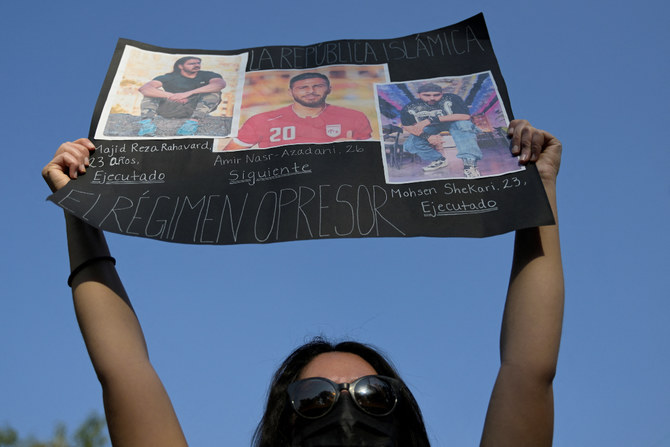

DUBAI: Iran said it executed two men Saturday convicted of allegedly killing a paramilitary volunteer during a demonstration, the latest executions aimed at halting the nationwide protests now challenging the country’s theocracy.
Iran’s judiciary identified those executed as Mohammad Karami and Mohammad Hosseini, making it four men known to have been executed since the demonstrations began in September over the death of Mahsa Amini.
The judiciary’s Mizan news agency said the men had been convicted of killing Ruhollah Ajamian, a member of the Iranian Revolutionary Guard’s volunteer Basij Force, in the city of Karaj outside of Tehran on Nov. 3. The Basij have deployed in major cities, attacking and detaining protesters, who in many cases have fought back.
It wasn’t immediately clear which court heard the two men’s cases. However, Iran’s internationally criticized closed-door Revolutionary Courts have handed down two of the death sentences.
The European Union said it was “appalled” by the executions.
“The EU is appalled by the execution of Mohammad Mehdi Karami and Seyyed Mohammad Hosseini arrested and sentenced to death in connection with the ongoing protests in Iran,” the spokesperson for EU foreign affairs chief Josep Borrell said in a statement.
“This is yet another sign of the Iranian authorities’ violent repression of civilian demonstrations,” he said.
“The European Union calls once again on the Iranian authorities to immediately end the strongly condemnable practice of imposing and carrying out death sentences against protesters.”
The US envoy to Iran, Robert Malley, said he was “appalled by the regime’s execution of two more young Iranians after sham trials,” and called on Iran to stop these executions.
“We and others across the globe will continue to hold Iran’s leadership accountable,” he added.
British foreign minister James Cleverly condemned the executions and urged it to “immediately end the violence against its own people.”
“The execution of Mohammad Mahdi Karami and Seyed Mohammad Hosseini by the Iranian regime is abhorrent,” Cleverly said on Twitter. “The UK is strongly opposed to the death penalty in all circumstances.”
French Minister for Europe and Foreign Affairs Catherine Colonna also called the executions appalling and said France reiterated its “opposition to the death penalty in all places and in all circumstances.”
Meanwhile, the Dutch government will summon the Iranian ambassador to the Netherlands for the second time in a month to voice its deep concerns over the execution of demonstrators, Foreign Minister Wopke Hoekstra said.
“Appalled by the horrible executions of demonstrators in Iran. I will summon the Iranian ambassador to underline our serious concerns and I call upon EU Member States to do the same,” Hoekstra said in a tweet.
Hoekstra said these actions underlined the need for the EU to impose stronger sanctions on Iran than are currently being considered.
The Netherlands also summoned the Iranian ambassador in The Hague last month to protest against the execution of demonstrators in the country.
Activists say at least 16 people have been sentenced to death in closed-door hearings over charges linked to the protests. Death sentences in Iran are typically carried out by hanging.
At least 517 protesters have been killed and over 19,200 people have been arrested, according to Human Rights Activists in Iran, a group that has closely monitored the unrest. Iranian authorities have not provided an official count of those killed or detained.
The protests began in mid-September, when 22-year-old Amini died after being arrested by Iran’s morality police for allegedly violating the Islamic Republic’s strict dress code. Women have played a leading role in the protests, with many publicly stripping off the compulsory Islamic headscarf, known as the hijab.
The protests mark one of the biggest challenges to Iran’s theocracy since the 1979 Islamic Revolution. Security forces have used live ammunition, bird shot, tear gas and batons to disperse protesters, according to rights groups.
(With AP, AFP and Reuters)


