

Abramovich’s trusts reorganized before Russia sanctions: report

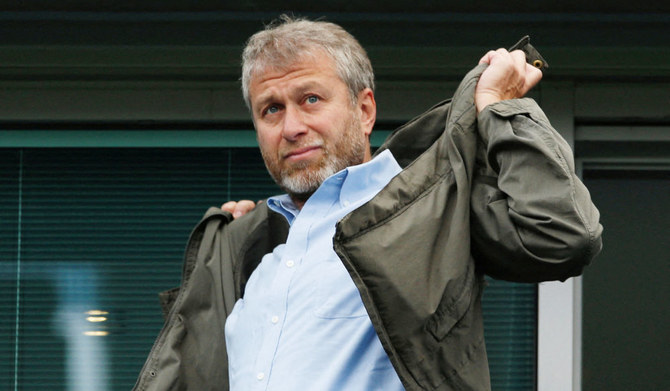
Roman Abramovich. (REUTERS)
Short Url
Updated 07 January 2023
Follow

Abramovich’s trusts reorganized before Russia sanctions: report

  • The 56-year-old former Chelsea Football Club owner is seen as a close ally of Russian President Vladimir Putin and has been sanctioned by Britain, the EU and Canada, though not the US

LONDON: Russian oligarch Roman Abramovich’s seven children became the beneficiaries of 10 offshore trusts holding assets worth billions of dollars shortly before he was hit with sanctions, Britain’s Guardian newspaper reported Friday.
They acquired the beneficial ownership of the secretive trusts with assets of at least $4 billion in early February 2022, three weeks before Russia invaded Ukraine, the Guardian said.
The “sweeping reorganization” of his financial affairs just prior to Abramovich then being sanctioned is detailed in leaked files from a Cyprus-based offshore service provider administering the trusts, the newspaper added.
An anonymous source shared the “large cache” of documents — dubbed “the Oligarch files” — with the newspaper, it reported.
They show that Abramovich’s children — five of whom are adults, with the youngest aged nine — became the trusts’ majority beneficial owners.
The reorganization happened just as Western governments were threatening to sanction Russian oligarchs if Moscow ordered an invasion of Ukraine.
It has previously been reported that his children, all Russian citizens, had been made beneficiaries of two trusts established to benefit Abramovich. But the extent of the changes now being reported was not previously known.
“The leaked documents raise questions about whether the changes to trusts were made in an attempt to shield the oligarch’s vast fortune from the threat of asset freezes,” said the Guardian.

The newspaper noted that the reorganization could hinder efforts to enforce sanctions against Abramovich and lead to more calls for his children to face asset freezes also.
The 56-year-old former Chelsea Football Club owner is seen as a close ally of Russian President Vladimir Putin and has been sanctioned by Britain, the EU and Canada, though not the US.
However, the US Justice Department seized two of his aircrafts last year, saying they had been used in violation of sanctions on Moscow over Ukraine.
Through the 10 trusts, Abramovich’s seven children now appear to be the ultimate beneficial owners of various trophy assets long linked to him, the Guardian said.
They include a host of luxury properties, super-yachts, helicopters and other private jets.
The changes — enacted around a month before the UK government sanctioned him on March 10 — left their beneficial ownership stakes in the trusts ranging from a collective 51 percent to 100 percent in some, the paper added.
Neither Abramovich nor MeritServus, the Cyprus-based offshore service provider that administers the trusts, would answer the newspaper’s questions about the arrangements. MeritServus cited privacy laws.
Abramovich, who holds Russian, Israeli and Portuguese citizenship, has denied financial ties to the Kremlin and filed legal action to overturn the EU’s measures.


Russia jails 15 for life over IS-claimed 2024 concert hall attack

Updated 3 sec ago
Follow

Russia jails 15 for life over IS-claimed 2024 concert hall attack

  • Eleven other men were also jailed for life for acting as accomplices and of having terrorist links
  • Four more men were handed sentences of between 19 and 22 years over their links with the attackers

MOSCOW: A Russian court on Thursday handed life sentences to four gunmen from Tajikistan, and 11 others it said were their accomplices, for the 2024 Crocus concert hall attack that left 150 people dead.
The March 2024 shooting spree was claimed by Daesh and was the deadliest militant attack in Russia in more than two decades.
Relatives of some of the victims stood in the grand Moscow military court as the verdict was read out.
Shamsidin Fariduni, Dalerdzhon Mirzoyev, Makhammadsobir Fayzov and Saidakrami Rachabolizoda — all Tajik citizens who went on a shooting spree in the building before setting it on fire — looked down as the judge sentenced them to life.
Eleven other men — some Russian citizens — were also jailed for life for acting as accomplices and of having terrorist links.
Four more men — including a father and his sons — were handed sentences of between 19 and 22 years over their links with the attackers.
The gunmen entered the concert hall shortly before a show by Soviet-era rock band Picnic. They went on a shooting spree before setting fire to the building, trapping many victims. The attack wounded more than 600 people. Six children were among those killed.
Uliana Filippochkina, whose twin brother Grigory was killed in the attack, flew from Siberia’s Novosibirsk for the verdict.
She said she was “satisfied” with the ruling and that she had looked the men who killed her twin in the eyes during their final statements in the trial.
“They didn’t explain anything, they tried to escape responsibility, appealing to the fact that they had wives and children... That they were under the influence of drugs,” she said.

- ‘No remorse’ -

“There was no sympathy or remorse whatsoever,” she added.
Her brother went to the concert shortly before his 35th birthday. The family were only able to identify what was left of his body weeks later, burying his remains in Novosibirsk.
The verdict came ahead of the second anniversary of the killings.
“For us all it’s like yesterday,” Ivan Pomorin, who was filming the Crocus Hall concert at the time, told AFP.
Lawyers said some of the victims are still being treated for their wounds, while others have severe PTSD, unable to sleep, use public transport or be in crowded places.
The four gunmen — aged 20 to 31 at the time — worked in various professions, among them was a taxi driver, factory employee and construction worker.
They stood in the glass defendant’s cage, surrounded by security guards.
According to media reports, Mirzoyev’s brother was killed fighting in Syria, possibly leading to his radicalization.
Hours after the attack, Russian police brought them to court with signs of torture — including one barely conscious in a wheelchair.

- ‘Redeem guilt with blood’ -

The attack came two years into Moscow’s war in Ukraine, with Russia — bogged down by the offensive — dismissing prior US warnings of an imminent attack.
The Kremlin had suggested a Ukrainian connection at the time of the attack, but never provided evidence.
Russia’s Investigative Committee said after the verdict it was “reliably established” that the attack was “planned and committed in the interests of” Kyiv.
It accused the men of also plotting attacks in Dagestan.
TASS state news agency reported this month, citing a lawyer, that two of them — Dzhabrail Aushyev and Khusein Medov — had asked to be sent to fight in Ukraine instead of a life sentence.
Throughout its offensive, Russia has recruited prisoners for its military campaign, offering a buy-out from their sentences should they survive.
According to the lawyer quoted by TASS, Medov said he wanted to “redeem his guilt with blood.”

- Anti-migrant turn -

Russia — already undergoing a conservative social turn during the war — upped anti-migrant laws and rhetoric after the attack.
This has led to tensions with Moscow’s allies in Central Asia, some of whom have confronted Russia and called on it to respect the rights of their citizens.
Russia’s economy has for years been heavily reliant on millions of Central Asian migrants.
But their flow to Russia dipped after Moscow launched its Ukraine campaign and some Central Asians also held back from going to Russia after the post-Crocus migrant crackdowns.