

Pakistani markets refuse to close early under government energy saving plan

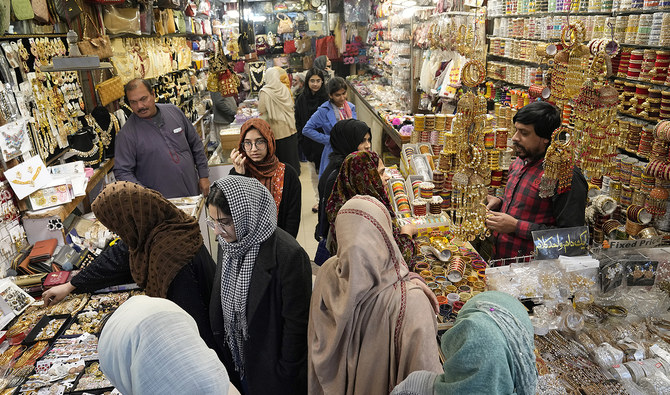
People visit a market for shopping in Lahore, Pakistan, Wednesday, Jan. 4, 2023. (Photo courtesy: AP)
Short Url
Updated 04 January 2023
Follow

Pakistani markets refuse to close early under government energy saving plan

  • The government ordered all malls, markets and restaurants to close by 8:30 p.m. to save energy
  • Traders say their businesses will significantly suffer since most people visit shops in the evening

PESHAWAR/LAHORE: Markets in major Pakistani cities on Wednesday spurned a new government directive to shut early under an energy conservation drive, in a blow to the cash-strapped country’s plans to curtail energy imports amidst an economic crisis.

Tuesday’s directive ordered all malls markets and restaurants to close by 8:30 p.m. to save fuels, whose imports have drained Pakistan’s foreign reserves leaving them at a level that barely covers a month’s worth of imports.

Reuters reporters in the nation’s largest cities of Lahore, Karachi and Peshawar, saw almost all major markets and malls staying open beyond the cut-off time on Wednesday.

“We outright reject this plan,” Mohammad Ishaq, president of the Sarhad Chamber of Commerce and Industry, a traders’ association in the northwestern city of Peshawar, told Reuters, adding that businesses that already faced security issues and energy shortages, would resist attempts to enforce it.

“This policy will kill me and my business, which starts after 8 p.m. when children come to my shop with their parents,” Muhammad Raza, a toy shop owner in the eastern city of Lahore, said.

Markets in major Pakistani cities traditionally remain open late into the night, in most cases up to 11 pm, as shoppers usually get out in the evenings.

In Karachi, Pakistan’s commercial hub, president of the Pakistan Traders Association, Mohammad Ajmal Baloch, also said local traders were reluctant to cut business hours short.

Businesses fear the new energy-saving curbs will further slow the economy, already weighed down by the aftermath of historic floods in August 2022, soaring energy costs and central bank rate hikes to tame decades-high inflation.

The central bank has halved its growth projections to 2 percent for financial year 2023 and Pakistan has struggled to quell default fears, with $1.1 billion in International Monetary Fund financing still awaiting approval.


Pakistan president in Bahrain to boost trade, defense and security ties

Updated 14 sec ago
Follow

Pakistan president in Bahrain to boost trade, defense and security ties

  • Asif Ali Zardari will meet Bahrain’s king and crown prince, discuss regional issues of mutual interest
  • Trade volume between Pakistan and Bahrain has increased from $500 million to $1 billion in recent years

ISLAMABAD: Pakistan President Asif Ali Zardari arrived in Bahrain late Tuesday on a four-day visit to enhance bilateral cooperation in trade, defense and security, Pakistani state media reported.

Pakistan and Bahrain have maintained close diplomatic, trade, investment and defense relations and have lately been focusing on strengthening their cooperation in key economic sectors.

The Pakistan president’s visit will be focused on bilateral, regional and international issues of mutual interest for both nations, according to the foreign office in Islamabad.

He will hold talks with King Hamad bin Isa Al-Khalifa and Crown Prince Salman bin Hamad, and address a reception held at the headquarters of the Economic Development Board in Manama.

“The visit seeks to reinforce Pakistan’s longstanding cooperation with the brotherly Gulf nation while expanding opportunities for collaboration in trade and economic partnership, defense and security and people-to-people ties,” the Radio Pakistan broadcaster said.

Islamabad and Manama established diplomatic ties in 1971. In recent years, the bilateral trade volume between the two countries has ranged between $500 million to around $1 billion, according to Pakistan’s foreign ministry.

Major exports from Pakistan to Bahrain include meat, vegetables, rice, tobacco and textile. Imports from Bahrain, on the other hand, include petroleum products, ferrous wastes and scrape and aluminum.

Both have established a Joint Ministerial Commission (JMC) at the level of foreign ministers to discuss trade and economic ties, take decisions mutually and supervise the implementation of these decisions. So far, only two sessions of the JMC have been held and the last one was held in Bahrain in July 2021.

Zardari’s visit takes place amid increasing economic engagement between the two nations following the Pakistan-Bahrain Investment Summit in May 2025. Both sides signed contracts worth $13 million during the summit.