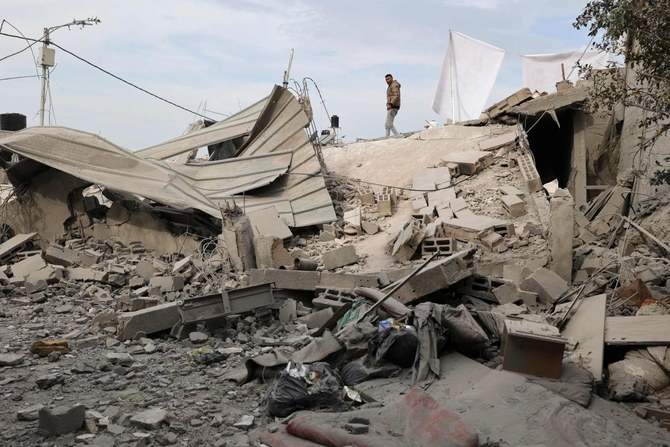
JERUSALEM: The Israeli military has demolished homes, water tanks and olive orchards in two Palestinian villages in the southern West Bank where some residents are at risk of imminent expulsion, residents and activists said Wednesday.
One of the villages whose structures were demolished on Tuesday is part of an arid area of the West Bank known as Masafer Yatta, which the Israeli military has designated as a live-fire training zone. Some 1,000 residents of the eight hamlets that make up Masafer Yatta are slated for expulsion, an order Israel’s Supreme Court upheld in May after a two-decade legal battle.
According to images shared by local residents and activists, armored vehicles escorted construction equipment to the demolitions in the villages of Ma’in and Shaab Al-Butum, which is part of Masafer Yatta.
Guy Butavia, an activist with the Israeli rights group Taayush, said the army razed five homes, animal pens and cisterns, spilling the contents of people’s lives out onto the cold desert.
“They come and demolish your house. It’s winter. It’s cold. What’s next? Where are they going to sleep that night?” he said.
Most residents of the area have remained in place since the ruling, even as Israeli security forces periodically roll in to demolish structures. But they could be forced out at any time.
Local officials and rights group said Israeli defense officials have informed them that they would soon forcibly remove more than 1,000 residents from the area.
“There is a genuine concern that a grave war crime will be committed,” said Roni Pelli, a spokeswoman for ACRI.
COGAT, the Israeli defense body that deals with Palestinian civilian affairs, declined to comment.
Both villages are in the 60 percent of the occupied West Bank known as Area C, where the Israeli military exercises full control under interim peace agreements reached with the Palestinians in the 1990s. Palestinian structures built without military permits — which residents say are nearly impossible to obtain — are at risk of demolition.
Tuesday’s demolition comes against the backdrop of a new government in Israel, headed by Prime Minister Benjamin Netanyahu, where proponents of Israel’s West Bank settlement enterprise hold influential portfolios and are expected to both drive up settlement building and suppress construction for Palestinians in Area C.
The families living in Masafer Yatta say they’ve herded their sheep and goats across the area long before Israel captured the West Bank in the 1967 Mideast war.
But Israel says the nomadic Arab Bedouin had no permanent structures when the military declared the area a firing and training zone in the early 1980s. In November 1999, security forces expelled some 700 villagers and destroyed homes and cisterns.
A twenty-year legal battle began the following year that ended in 2022 with the Israeli Supreme Court denying an additional hearing in October over the expulsion.
While previous Israeli governments have for decades demolished homes in the area, the current government is expected to step up demolitions in the area.


![]()

Israel demolishes parts of West Bank hamlet set for eviction
Short Url
https://arab.news/g9xcw
Israel demolishes parts of West Bank hamlet set for eviction
- Activist said the army razed five homes, animal pens and cisterns, spilling the contents of people’s lives out onto the cold desert


Latest updates


© 2026 SAUDI RESEARCH & PUBLISHING COMPANY, All Rights Reserved And subject to Terms of Use Agreement.