

PM arrives in Pakistan’s southwest, says rehabilitation of flood victims government’s ‘first priority’

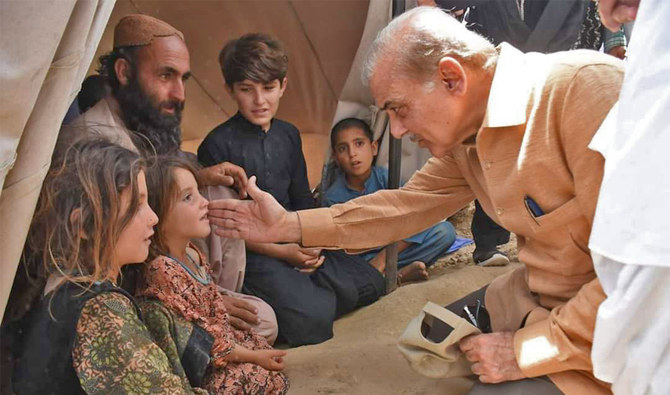
The file photo shows Pakistan Prime Minister Shehbaz Sharif (right) meeting the flood affected families in Balochistan’s Qila Saifullah district on August 1, 2022. (Government of Pakistan)
Short Url
Updated 04 January 2023
Follow

PM arrives in Pakistan’s southwest, says rehabilitation of flood victims government’s ‘first priority’

  • Unusually heavy rains killed over 270 in Balochistan, affected 34 districts in province
  • PM Shehbaz Sharif to review progress on rehabilitation, reconstruction efforts

ISLAMABAD: Prime Minister Shehbaz Sharif on Wednesday arrived in Pakistan’s southwestern Balochistan province on a day-long visit to meet flood victims, saying that rehabilitation of flood affectees was the government’s “first priority.”

Unusually heavy monsoon rains triggered flash floods— worsened by climate change— hit Pakistan in June last year, killing over 1,700 people and affecting 33 million others. According to the country’s disaster management authority, floods affected 34 districts in Balochistan, killing at least 270 people in the province.

Pakistan estimates losses from the floods to be over $30 billion. The South Asian country is struggling to stabilize its economy. Cash-strapped Pakistan is reeling from dwindling forex reserves, a widening current account deficit and a depreciating currency. The Pakistani government has repeatedly been making an appeal to the international community to donate to the flood victims so that they could be rehabilitated at the earliest.

Pakistan and the United Nations in Geneva will co-host the “International Conference on Climate Resilient Pakistan” to raise much-needed funds for flood victims on January 9 in Geneva, Switzerland. 

“Prime Minister Shehbaz Sharif said that the rehabilitation of the flood-affected people was the government’s first priority,” the state-run Associated Press of Pakistan (APP) reported. 

“The prime minister, who was on his way to the flood-ravaged Sohbatpur city of Balochistan for a day-long visit, was briefed aboard by Lt. Gen. Inam Haider Malik, chairman of Pakistan’s National Disaster Management Authority (NDMA) on the ongoing reconstruction and rehabilitation works.”

APP said that during the visit, Sharif will meet the province’s chief secretary to receive a briefing on the rehabilitation of flood survivors and reconstruction efforts.

The prime minister would also inaugurate the new building of the flood-ravaged Government Boys Secondary School of Kili Jiya Khan, the agency said.

PM Sharif said he plans to travel to Switzerland to highlight flood victims’ ordeal who are still residing in open areas.


At ECO meeting, Pakistan proposes ‘Regional Innovation Hub’ to curb natural disasters

Updated 21 January 2026
Follow

At ECO meeting, Pakistan proposes ‘Regional Innovation Hub’ to curb natural disasters

  • Pakistan hosts high-level 10th ECO Ministerial Meeting on Disaster Risk Reduction in Islamabad
  • Innovation hub to focus on early warning technologies, risk informed infrastructure planning

ISLAMABAD: Pakistan has proposed to set up a “Regional Innovation Hub on Disaster Risk Reduction” that focuses on early warning technologies and risk informed infrastructure planning, the Press Information Department (PID) said on Wednesday, as Islamabad hosts a high-level meeting of the Economic Cooperation Organization (ECO).

The ECO’s 10th Ministerial Meeting on Disaster Risk Reduction (DRR) is being held from Jan. 21-22 at the headquarters of the National Disaster Management Authority (NDMA) in Pakistan’s capital. 

The high-level regional forum brings together ministers, and senior officials from ECO member states, representatives of the ECO Secretariat and regional and international partner organizations. The event is aimed to strengthen collective efforts toward enhancing disaster resilience across the ECO region, the PID said. 

“Key agenda items include regional cooperation on early warning systems, disaster risk information management, landslide hazard zoning, inclusive disaster preparedness initiatives, and Pakistan’s proposal to establish a Regional Innovation Hub on Disaster Risk Reduction, focusing on early warning technologies, satellite data utilization, and risk-informed infrastructure planning,” the statement said. 

The meeting was attended by delegations from ECO member states including Pakistan, Türkiye, Azerbaijan, Iran, Kyrgyzstan, Tajikistan, Turkmenistan and Uzbekistan. Representatives of regional and international organizations and development partners were also in attendance.

Discussions focused on enhancing regional coordination, harmonizing disaster risk reduction frameworks, and strengthening collective preparedness against transboundary and climate-induced hazards impacting the ECO region, the PID said. 

ECO members states such as Pakistan, Türkiye, Afghanistan and others have faced natural calamities such as floods and earthquakes in recent years that have killed tens of thousands of people. 

Heavy rains triggered catastrophic floods in Pakistan in 2022 and 2025 that killed thousands of people and caused damages to critical infrastructure, inflicting losses worth billions of dollars. 

Islamabad has since then called on regional countries to join hands to cooperate to avert future climate disasters and promote early warning systems to avoid calamities in future.