

Pakistan thanks Saudi Arabia, Middle Eastern countries for helping flood victims

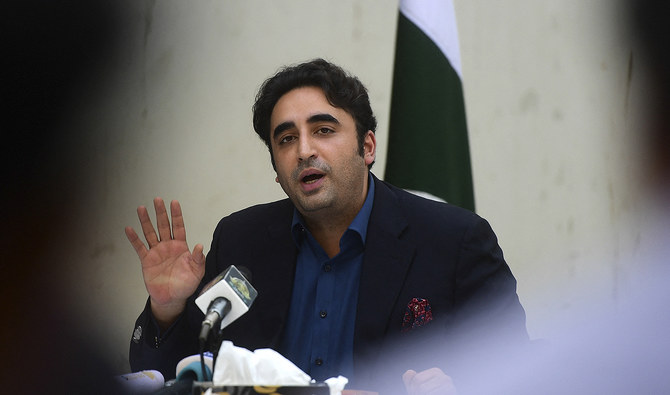
Pakistan's Foreign Minister Bilawal Bhutto Zardari speaks during a press conference in Karachi on October 15, 2022. (Photo courtesy: AFP)
Short Url
Updated 03 January 2023
Follow

Pakistan thanks Saudi Arabia, Middle Eastern countries for helping flood victims

  • Foreign minister Bilawal Bhutto-Zardari says in times of crisis, world did not leave Pakistan alone
  • Minister says floods damaged infrastructure of 50 percent of educational institutions in Sindh

ISLAMABAD: Foreign Minister Bilawal Bhutto-Zardari on Tuesday thanked Saudi Arabia, Middle Eastern countries, China, and the United States for helping flood victims in Pakistan, saying that in times of crisis “the world did not leave us alone.”

The record-breaking floods — worsened by climate change — hit Pakistan in June last year, killing more than 1,700 people, and affecting 33 million others. According to official data, in Pakistan’s southern Sindh province alone, the devastating floods affected 12 million people and killed almost 800.

Islamabad has sought the world’s help to scale up rehabilitation and reconstruction efforts in the country. As the winter season approaches, a large number of flood victims remain without shelter and are prone to diseases.

On Tuesday, the foreign minister told a group of journalists in Sindh’s Dadu district that flood victims were still in trouble. He said that at one point in time, one-third of the country was inundated with flood water, saying it was unprecedented in world history.

He thanked world powers, including Saudi Arabia, China, the US, and other countries in the Middle East for stepping forward and providing financial aid to Pakistan.

“[In times of crisis] the world did not leave us alone, it helped us. I am grateful to Saudi Arabia, the Middle East, China, and the US for helping flood victims,” Bhutto-Zardari told reporters. He thanked UN Secretary-General António Guterres for visiting Pakistan’s flood-affected areas.

The minister said the floods triggered a “doomsday before doomsday”, due to which the country is still struggling to overcome the effects of the calamity.

“Together, we have to make efforts to get people out of their misery as some areas of Sindh and Balochistan are still inundated,” he said. “Even places from where the water has receded are facing extensive devastation.”

He added that in the aftermath of the floods, the infrastructure of 50 percent of educational institutions across Sindh has been damaged due to which children have lost access to education.

“We will carry out a survey and will compensate flood victims accordingly,” the minister said, adding that the provincial government in Sindh would also provide interest-free loans to flood victims.

The minister also said that he would highlight the plight of the flood victims and talk about the future course of action related to climate change at the International Conference on Climate Resilient Pakistan, which is set to take place on January 9 in Geneva, Switzerland.


Pakistan approves first national gemstones policy, targets $1 billion exports

Updated 09 January 2026
Follow

Pakistan approves first national gemstones policy, targets $1 billion exports

  • Government seeks to overhaul certification, mining, processing to curb smuggling and boost value-added exports
  • Move follows broader push to tap Pakistan’s vast mineral wealth and attract much-needed foreign investment

ISLAMABAD: Pakistan has granted in-principle approval to its first national policy framework for gemstones and precious stones, aiming to reform the sector, align it with international standards and lift annual exports to $1 billion within five years, the prime minister’s office said on Friday.

The decision was taken during a meeting chaired by Prime Minister Shehbaz Sharif, which reviewed reforms for the largely underdeveloped gemstones sector despite Pakistan holding significant reserves of emeralds, rubies, sapphires, peridot and topaz.

The move comes as Pakistan intensifies efforts to monetize its untapped mineral resources amid fiscal pressures and an IMF-backed reform program. Over the past two years, Islamabad has hosted international minerals conferences and signed cooperation agreements with countries including the United States, Saudi Arabia and China to improve governance, attract foreign investment and move up the value chain in mining and minerals processing.

Despite officials estimating Pakistan’s gemstone reserves at around $450 billion, formal exports remain negligible, at about $5.8 million annually, due to weak certification systems, limited domestic processing capacity, widespread smuggling and fragmented regulation across federal and provincial authorities.

“Sharif has granted in-principle approval to a national policy framework to reform Pakistan’s gemstones and precious stones sector and align it with international standards,” the PM’s office said in a statement. 

“The Ministry of Industries and Commerce, after identifying challenges during the preparation of the national policy framework, has developed a comprehensive set of priority policy measures which aim to achieve $1 billion in gemstone-related exports within five years through sectoral reforms.”

According to the statement, the policy framework includes geological mapping to accurately assess reserves, the establishment of internationally accredited laboratories and certification regimes and the creation of a dedicated authority to regulate and promote the sector. The government also plans to set up a National Warranty Office and at least two centers of excellence this year to support training, research and value-added processing.

The policy prioritizes private sector participation, particularly encouraging young entrepreneurs, and seeks to shift Pakistan away from exporting raw stones toward domestic cutting, polishing and branding. The statement said this approach could significantly increase export earnings while generating skilled jobs.

The prime minister also directed the ministry of finance to ensure timely allocation of financial resources required to implement the reforms and stressed the need to involve provincial governments, industry stakeholders and international experts to address structural bottlenecks.

“Pakistani precious stones are renowned globally for their quality, and curbing smuggling while ensuring exports through legal channels will secure billions of dollars in foreign exchange,” the prime minister said, according to the statement.