

Pakistan rushes to bolster defenses at airports as COVID-19 surges in China

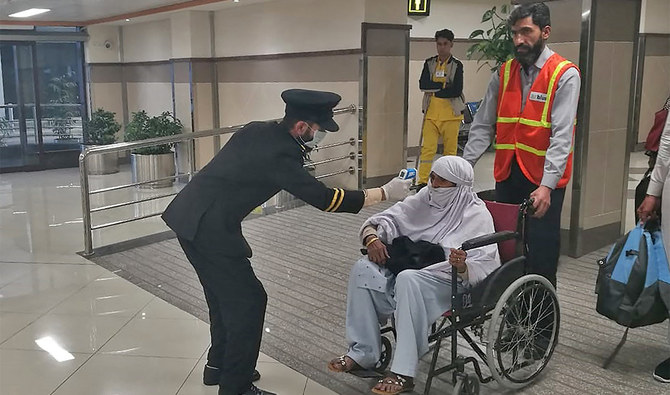
An airport official checks the temperature of a passenger upon his arrival at the Bacha Khan International Airport in Peshawar on January 27, 2020. (AFP/File)
Short Url
Updated 29 December 2022
Follow

Pakistan rushes to bolster defenses at airports as COVID-19 surges in China

  • Sindh announces coronavirus testing at airports for all inbound passengers from China
  • Cases are on the rise in China after Beijing’s decision to lift zero-COVID policies

ISLAMABAD: Pakistan’s Border Health Services this week called for a “heightened” level of screening and strict implementation of COVID-19 protocols at airports as the virus surges in neighboring China.

Pakistan’s Sindh province on Thursday also announced coronavirus testing at airports for all inbound passengers from China, joining several countries, including Italy and the United States, that have this week mandated testing for travelers from the world’s most populous nation, where cases are on the rise after Beijing’s decision to lift zero-COVID policies.

“The undersigned has already issued instructions to all the respective incharges/point of entry focal persons for maintaining a heightened level of awareness and alert for the rapid identification, detection, and isolation of any potential cases to prevent further transmission as a part of effective control and prevention measures,” Border Health Services said in a notification dated December 28.

The body said strict entry screening of all inbound passengers and pedestrians was already happening, while any suspected cases with signs and symptoms needed to be immediately reported.

“All incharges are advised to ensure strict implementation of infection prevention control (IPC) protocols at the points of entry, including disinfection/fumigation of passengers arrival areas, use of appropriate personal protective equipment (PPES) by the health care workers.”

Random sampling of all inbound passengers on international flights has been advised as part of the national response on all points of entry due to a surge of virus cases in “some countries,” the notification said in a clear reference to China.

The government of the southern Sindh province also issued its own protocols.

“All inbound passengers on flights from China to be tested for Covid-19 at the airports. In case of positive results, the persons shall be quarantined until they become negative for the contagion,” a circular said, adding that anyone showing coronavirus symptoms should be isolated and tested.

Sindh has also called for mandatory Pfizer boosters for all citizens who were vaccinated six months ago, particularly those aged 65 and above, and called for mandatory masks in public places and avoidance of large gatherings.

Pakistan’s current COVID-19 positivity rate stands at 0.53 percent and 95 percent of the country’s eligible population has been inoculated with a first, and 90 percent with a second, dose of coronavirus vaccines, according to data released by Pakistan’s National Disaster Management Authority on Monday.


Pakistan, China hold joint counterterrorism drills as military cooperation deepens

Updated 6 sec ago
Follow

Pakistan, China hold joint counterterrorism drills as military cooperation deepens

  • Warrior-IX exercise aims to boost counterterror coordination between the two nations’ armies
  • Drills come as both countries cite shared security concerns along regional militant routes

ISLAMABAD: Pakistan and China are conducting a two-week joint counterterrorism exercise, the Pakistan Army said on Thursday, marking another expansion in military cooperation between the two strategic partners.

The drills, known as Warrior-IX, run from Nov. 28 to Dec. 14 at Pakistan’s National Counter Terrorism Center (NCTC) in Pabbi, a major training hub for operations against militant networks that have carried out attacks across the country. Such exercises have become a recurring feature of Pakistan-China security ties, which span counterterrorism coordination, intelligence sharing, and defense technology partnerships.

Senior delegations attended the Distinguished Visitors Day on Thursday, including China’s ambassador to Pakistan, Jiang Zaidong, and Pakistan’s Chief of General Staff Field Marshal Syed Asim Munir. Officials observed field drills and received briefings on the objectives and scope of the exercise.

“The exercise reflects strong defense collaboration between Pakistan and China and reaffirms the commitment of both Armed Forces to working together for peace and stability,” the Pakistan military said.

According to the army, dignitaries viewed a range of counterterrorism demonstrations and praised the participating troops for their professionalism and operational readiness. China’s People’s Liberation Army (PLA) and Pakistan Army units regularly train together as both countries cite shared security threats, including attacks targeting Chinese nationals and projects inside Pakistan.

Pakistan and China have maintained one of Asia’s closest defense partnerships since the 1960s, rooted in shared strategic interests and long-term military cooperation. China is Pakistan’s largest supplier of military hardware, providing fighter aircraft, naval vessels, air-defense systems and armored platforms, including co-production of the JF-17 fighter jet under a major joint program launched in 1999. The two militaries routinely collaborate on training, intelligence exchange and counterterrorism coordination, and conduct regular joint exercises across all three services: army, navy, and air force.

Security cooperation has deepened further under the China–Pakistan Economic Corridor (CPEC), where Beijing has sought enhanced protection for Chinese workers and infrastructure targeted by insurgent groups. In recent years, the two sides have carried out joint counterterrorism drills, maritime security exercises in the Arabian Sea, and high-level defense consultations aimed at improving interoperability and responding to shared threats, including militant violence and regional instability. Both governments publicly describe their military ties as a “strategic partnership” and “ironclad friendship.”