

PM requests ‘high-level’ participation from Bahrain at UN conference on Pakistan floods

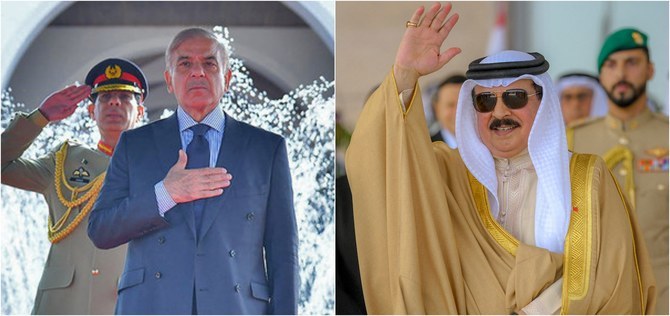
This combination of photos shows Pakistan’s Prime Minister Shehbaz Sharif (L) and Bahrain’s King Hamad bin Isa Al-Khalifa (R). (PID/AFP)
Short Url
Updated 28 December 2022
Follow

PM requests ‘high-level’ participation from Bahrain at UN conference on Pakistan floods

  • PM Shehbaz Sharif speaks to Bahrain’s King Hamad Bin Isa Al-Khalifa over the phone
  • UN conference in Geneva on January 9 aims to garner support for Pakistan after devastating floods

ISLAMABAD: Prime Minister Shehbaz Sharif spoke to Bahrain’s King Hamad Bin Isa Al-Khalifa on Wednesday to request “high-level participation” from the kingdom for an upcoming United Nations conference that aims to garner humanitarian aid for flood-affected Pakistan. 

Unusually heavy rains in mid-June killed over 1,700 people in Pakistan and damaged critical infrastructure in the country. Over 33 million people were affected by the deluges which, at one point in time, caused at least one-third of Pakistan to remain underwater. Pakistan estimates damages from the floods to be over $30 billion.

Pakistan will co-chair the conference in Geneva on January 9, 2023, titled ‘International Conference on Climate Resilient Pakistan’. It aims to garner humanitarian aid for the South Asian country in its rehabilitation and reconstruction efforts after the floods.

“Prime Minister Muhammad Shehbaz Sharif on Wednesday apprised King of the Kingdom of Bahrain Hamad Bin Isa Al-Khalifa of the ‘International Conference on Climate Resilient Pakistan’, to be held in Geneva on 9 January next year, and requested a high-level participation from Bahrain,” the state-run Associated Press of Pakistan (APP) said.

Al Khalifa expressed “firm support” for Pakistan’s initiatives to rehabilitate its people and carry out reconstruction in the flood-ravaged areas during the telephonic conversation, APP said.

PM Sharif highlighted the importance Pakistan attached to its historical and cordial ties with the Kingdom of Bahrain, the state-run agency said, adding that Al Thani reciprocated Sharif’s sentiments.

“The two leaders agreed to maintain close contact and work together on all issues of mutual interest,” it said.


Pakistan deputy PM directs authorities to monitor food prices ahead of Ramadan 

Updated 27 January 2026
Follow

Pakistan deputy PM directs authorities to monitor food prices ahead of Ramadan 

  • Prices of essential food items surge during holy month of Ramadan due to hoarding, profiteering by traders
  • Deputy PM Ishaq Dar directs authorities to prevent artificial price hikes, exploitation of consumers in Ramadan

ISLAMABAD: Pakistan’s Deputy Prime Minister Ishaq Dar on Tuesday directed authorities to monitor prices of essential food items ahead of Ramadan to prevent artificial price hikes and consumers from getting exploited, his office said. 

Pakistani increasingly shop for essential food items during the holy month of Ramadan, as millions across the country fast from dawn till sunset. Prices of essential food items surge during the holy month every year as traders often indulge in hoarding and profiteering. 

Dar chaired a meeting to review the availability and prices of essential commodities across the country on Tuesday, his office said. 

“DPM/FM [foreign minister] directed federal & provincial authorities to continue close monitoring, particularly in view of the approaching month of Ramazan, to prevent any artificial price hike or exploitation of consumers by unscrupulous elements,” Dar’s office said in a statement.

A central moon sighting committee in Pakistan, the Ruet-e-Hilal Committee, determines when Ramadan begins. The Islamic month is expected to start this year after mid-February, around Feb. 17 or Feb. 18.

Pakistan’s government also announces subsidies for the masses during the holy month to lower the prices of essential food items. 

In 2024, the Shehbaz Sharif-led government announced a Ramadan package comprising a subsidy of $26.8 million (Rs7.5 billion) to lower the prices of essential items for over 30,96,00,000 families.