


LONDON: “Syria is dead, desperate for someone to pull the plug.” This is how Nour, a 26-year-old nutritionist from Homs, summed up the situation in her home country, more than a decade on from the outbreak of a civil war and amid a worsening economic crisis.
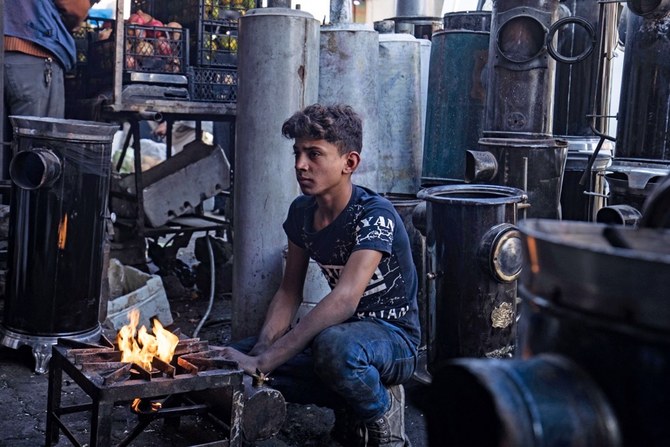
A shortage of fuel, which began to bite harder with the onset of winter, has paralyzed life in regime-controlled areas of Syria, including the capital Damascus, forcing authorities to suspend or reduce many essential public services.
On Dec. 5, the government almost doubled the price of fuel overnight. Daily power outages now last up to 22 hours on average, even in the capital’s upmarket neighborhoods. Many residents cannot afford to heat their homes as winter temperatures plunge.

Syrians queue to fill their tanks amid a fuel crisis that has sent living standards plummeting. (AFP)
Although the fighting between the government and rebel factions has subsided in recent years, Syria remains the site of one of the world’s biggest humanitarian crises, with millions of civilians still displaced, infrastructure in ruins, and much of the population living below the poverty line.
Syria’s isolation has deepened with the imposition in 2020 of the toughest US sanctions ever targeting the regime of President Bashar Assad.
“The current fuel crisis in government-controlled areas is not a novel aspect of the conflict economy in Syria,” Mohammad Al-Asadi, a Germany-based research economist at the Syrian Center for Policy Research, told Arab News.
The SCPR has tracked several major fuel shortages since 2020, but, according to Al-Asadi, “the current shortage is the most economically and socially impactful during the last couple of years.”
Syria’s Ministry of Internal Trade recently announced plans to sell industrial and commercial diesel at 5,400 Syrian pounds a liter — up from 2,500 Syrian pounds in late November — while petrol will be sold at 4,900 Syrian pounds a liter.
The price of fuel distributed through the state-owned Syrian Petroleum Company will remain at 2,500 Syrian pounds per liter.
The pent-up demand for fuel has had an adverse impact on the value of the Syrian pound, which hit a new record low on Dec. 10.
The dollar exchange rate on the black market surpassed 6,000 Syrian pounds for the first time, while the central bank’s rate stood at 3,015 Syrian pounds. In 2011, when the civil war began, the official rate was 47 Syrian pounds.
Reports say diesel and petrol shortages have resulted in severe overcrowding at bus terminals in both Damascus and outlying areas, as the government cut fuel allocations for minibus services — the cheapest mode of transport available to Syrians.

The situation is similar in Homs, geographically the largest governorate of Syria.
“After 1pm, minibuses stop operating, and we take any vehicle we find on the road to commute home,” said Nour. “Passengers sometimes get into fist fights over seats on minibuses and shared taxis.”
Khaled, a 21-year-old accounting student who gave only his first name, earns about 50,000 Syrian pounds a month from waitering. A shared-taxi trip from Zabadani, Rif Dimashq, to the Mezzeh highway in Damascus — a distance of just 48 km — cost him 6,800 Syrian pounds earlier this month.
By contrast, Khaled told Arab News: “I paid 3,300 for the same journey in mid-November.”
In practical terms, high inflation has meant a cost-of-living crisis, with prices of goods increasing across the board but real wages remaining stagnant.
“A computer programmer can make about 800,000 pounds a month in the private sector, but this is barely enough for rent, basic goods and transport costs,” a Damascus-based journalist, who asked not to be identified, told Arab News.
In December 2021, the minimum state salary was around 93,000 Syrian pounds, according to Shaam Times, a government-affiliated news website.
SCPR researcher Al-Asadi expects the national fuel shortage “to last as long as the multi-level fragmentation in the country lasts” — a state of affairs he says authorities are unlikely to address.
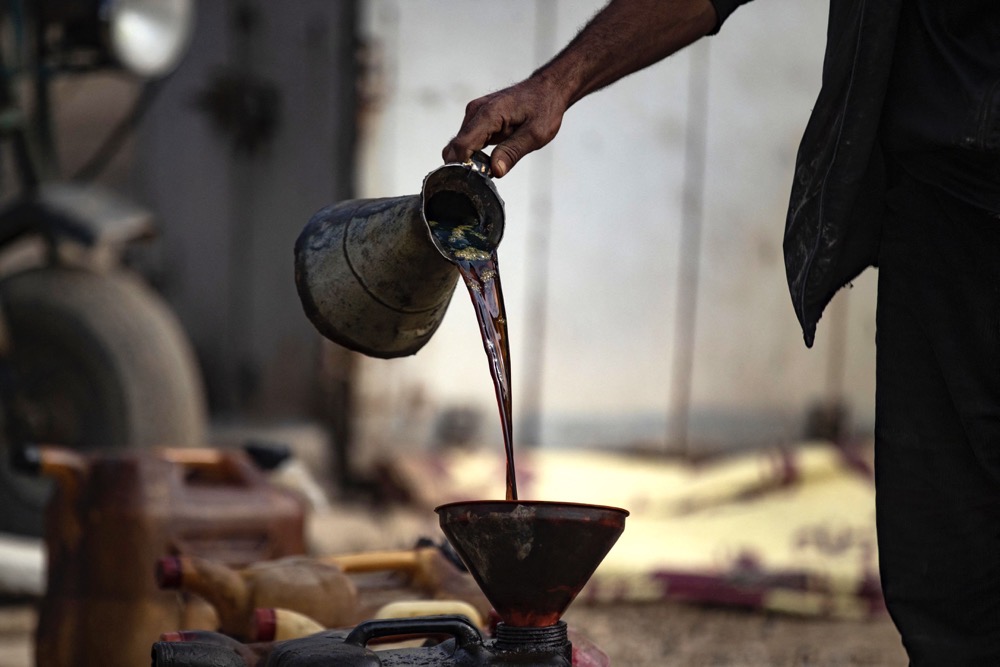
A Syrian man fills a container as he sells diesel beside a road amid a fuel crisis in northeastern Syria. (AFP)
“None of the local political powers in Syria has made real efforts to overcome deep socioeconomic challenges facing the country, including energy and fuel shortages,” he told Arab News.
“After 12 years of conflict, most efforts are still dedicated to directing the remaining financial, physical, and human resources to serve activities related to the war economy at the expense of restoring the normal economic cycle based on production.
“Hence, investments in alternative energy solutions have received little interest during the last decade.”
Oil revenues accounted for between 5 and 7 percent of Syria’s gross domestic product prior to the civil war. Total reserves are estimated at 2.5 billion barrels, with at least 75 percent of these reserves in the fields surrounding Deir ez-Zor, outside the regime’s sphere of control.
The Assad regime has repeatedly accused US forces deployed in the Kurdish-majority northeast of the country of “looting” Syrian oil, thereby contributing to the fuel shortage.
On Dec. 1, the Syrian state news agency SANA claimed that a convoy of 54 tankers, “loaded with plundered oil,” was spotted in Al-Yaarubiyah, in Hasakah province, traveling through the Al-Mahmudiyah border crossing into Iraq.
Northeast Syria has been largely self ruled since regime forces withdrew from the area in 2011 to fend off the uprising elsewhere in the country.
In the summer of 2014, Daesh militants exploited this power vacuum, seizing control of several major towns, including Raqqa, and many of the region’s lucrative oilfields.

“Without an inclusive political arrangement, conclusive solutions for such shortages remain far away,” said Mohammad Al-Asadi, Research economist at the Syrian Center for Policy Research. (Supplied)
A coalition of Arab and Kurdish militias, later dubbed the Syrian Democratic Forces, soon dislodged the extremist group with US military support, taking charge of the oilfields.
The Autonomous Administration of North East Syria (AANES), which assumed control of these territories, began selling this oil to neighboring countries and to the Assad regime.
In 2019, President Donald Trump announced he was withdrawing US forces from northeast Syria but leaving a small contingent to secure the oil.
In the same month, it was announced that US troops would be deployed to Deir ez-Zor to help the SDF retain control of oil fields from Daesh.
Often unable to secure enough fuel supply from its Iranian allies, the Assad government has pressured the AANES to provide more fuel to regime-held areas by withholding essential supplies like food, medicine, and building materials.
In a 2021 report, the Washington Institute for Near East Policy said that while the US administration has denied looting Syrian oil, it has implemented a “morally and legally dubious plan,” which involved supporting its Kurdish allies by keeping the oil “out of the hands of the Assad regime” and “helping to refine and sell it.”
The general consensus of Syria analysts is that the modest US involvement is not the primary cause of the current fuel crisis.
“Although sanctions and oil looting from the oil-rich eastern areas to the neighboring Iraqi Kurdistan region contribute to deepening the fuel crisis in the country, these are not the most important factors,” Al-Asadi told Arab News.
“The key drivers for the renewed fuel crisis — and all similar socioeconomic challenges — cannot be disconnected from the nature of the political economy that has prevailed in the country during the last decade, particularly aspects related to political fragmentation, subordination to foreign political actors, and dominating major resources and investment opportunities by allies.”
To make matters worse, aid workers say the Russian invasion of Ukraine in February this year pushed the humanitarian crisis in Syria to the back burner.
After spending about two weeks in Syria in November, Alena Douhan, the UN special rapporteur on human rights, claimed that the current US, EU and UK sanctions “may amount to crimes against humanity.”
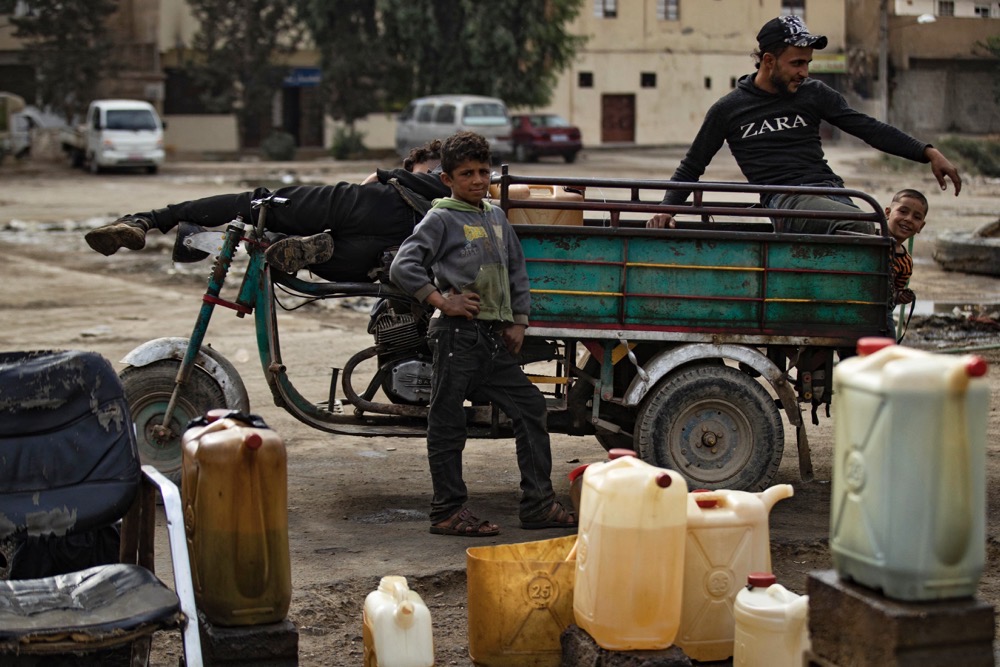
A Syrian man sells fuel at a makeshift roadside stall outside Raqqa. (AFP)
Douhan called for the immediate lifting of the sanctions as they “harm human rights and prevent any efforts for early recovery.”
Even some critics of the Assad regime say economic sanctions have done little to bring Syria’s warring parties closer to a political solution, all the while further impoverishing the population.
“The Assad regime is not going anywhere, so many observers increasingly question the utility of sanctions that harm not only the regime, but the Syrian people as well,” David Romano, professor of Middle East politics at Missouri State University, told Arab News.
“While there are provisions for things like export waivers for items of humanitarian importance for the Syrian people, in practice, the American and European sanctions on Syria have seriously harmed an already crippled economy — country wide,” he said.
On Dec. 5, residents of Suwayda in Syria’s southwest took to the streets to protest against falling standards of living. The demonstration quickly escalated into clashes with local security forces, leaving two people dead and eight injured.
“Ordinary people’s suffering is expected to increase,” said Al-Asadi. “(Particularly) workers relying primarily on transportation to secure their livelihoods, such as farmers, taxi and microbus drivers, and workers in the delivery sector.”
Owing to rising transportation costs for many commonly traded goods and services, he expects the current fuel shortages “to last until mid-January 2023 at least,” inflationary pressures to increase, and many businesses “to face major interruptions. Although some oil tankers are expected to reach Syria during the coming few weeks, the amounts supplied may not be sufficient to overcome the crisis.”
Instead of finding solutions to the fuel crisis, the government is shifting “the burden of the conflict to households,” Al-Asadi told Arab News, adding that “without an inclusive political arrangement, conclusive solutions for such shortages remain far away.”


