

Egypt government denies plans to cede Nile River ports to a foreign country

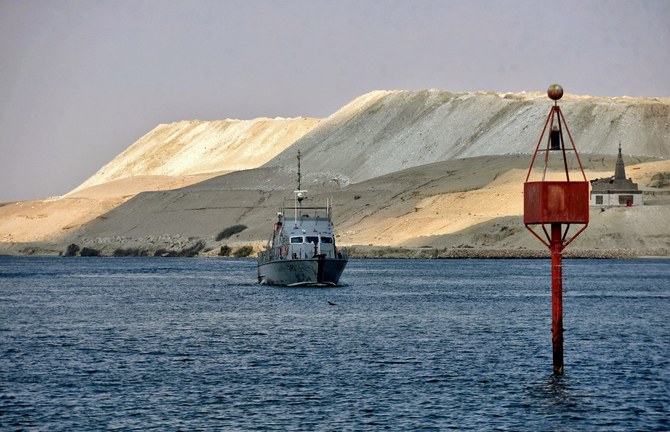
An Egyptian navy craft patrols in the Suez Canal. (File/AFP)
Short Url
Updated 26 December 2022
Follow

Egypt government denies plans to cede Nile River ports to a foreign country

  • Aim is to attract private investment, says cabinet
  • Single authority to issue licenses for goods, passengers

CAIRO: Egypt has dismissed claims that it plans to cede the ports of the Nile River to a foreign country under a law that reorganizes the General Authority for River Transport.

The Egyptian government said that the law only aims to encourage investment.

In an official statement, the nation’s cabinet rejected as untrue information published on some websites and social media platforms.

The cabinet’s media center urged all media outlets and social media users to first verify information before publishing, to prevent public confusion.

The cabinet’s media center said that it had contacted the Ministry of Transport, which denied these reports.

The ministry emphasized that the ports are wholly owned by the state and will remain under its control.

The River Transport Authority, established by presidential decree No. 474 of 1979, is the legal entity meant to oversee the smooth operation of this aspect of the nation’s transport system.

According to the statement, the draft law aims to encourage private sector investment in river transport without selling or ceding ownership of any ports.

The law ensures that there is one entity that issues licenses for transporting passengers, goods, missions, materials of all kinds, and the management and operation of shipping lines and ports.

It emphasized that public utility powers will be granted to investors — whether Egyptian or foreign — for the purpose of establishing, managing, operating, maintaining, and exploiting ports, river anchorages, and navigational routes under a contract system.

Depending on the nature of each project, the law also has conditions and procedures that guarantee the protection of government facilities. These facilities have to be in good condition and free of any fees when contracts expire.

The General Authority for River Transport is the sole authority to issue navigational licenses for mechanized and non-mechanized river units, fixed pontoons, floating hotels and crews working on them, and commitment lines for ferries of all kinds.

It also has complete jurisdiction over licenses for berths and river ports on the Nile and its navigational branches, which would ensure safety and security standards are upheld — whether for passengers or goods.



Historic decree seeks to end decades of marginalization of Syria’s Kurds

Updated 4 sec ago
Follow

Historic decree seeks to end decades of marginalization of Syria’s Kurds

DAMASCUS/RIYADH: A decree issued by President Ahmad Al-Sharaa on Friday marks a historic end to decades of marginalization of Syria’s Kurdish minority and seeks to open a new chapter based on equality and full citizenship in post-liberation Syria.

The presidential action, officially known as Decree No. 13, affirms that Syrian Kurds are an integral part of the national fabric and that their cultural and linguistic identity constitutes an inseparable element of Syria’s inclusive, diverse, and unified national identity.

Al-Sharaa’s move seeks to address the consequences of outdated policies that distorted social bonds and divided citizens.

The decree for ⁠the first time grants Kurdish Syrians rights, including recognition of Kurdish identity as part of Syria’s national fabric. It designates Kurdish as a national language alongside Arabic and allows schools to teach it.

Al-Sharaa’s decree came after fierce clashes that broke out last week in the northern city of Aleppo, leaving at least 23 people dead, according to Syria’s health ministry, and forced more than 150,000 to flee the two Kurdish-run pockets of the city. The clashes ended ⁠after Kurdish fighters withdrew.

The Syrian government and the Kurdish-led Syrian Democratic Forces (SDF), that controls the country’s northeast, have engaged in months of talks last year to integrate Kurdish-run military and civilian bodies into Syrian state institutions by the end of 2025, but there has been little progress.

The end of an era of exclusion

For more than half a century, Kurds in Syria were subjected to systematic discriminatory policies, most notably following the 1962 census in Hasakah Governorate, which stripped thousands of citizens of their nationality and deprived them of their most basic civil and political rights.

These policies intensified after the now-dissolved Baath Party seized power in 1963, particularly following the 1970 coup led by criminal Hafez al-Assad, entrenching a state of legal and cultural exclusion that persisted for 54 years.

With the outbreak of the Syrian revolution in March 2011, Syrian Kurds actively participated alongside other segments of society. However, the ousted regime exploited certain separatist parties, supplying them with weapons and support in an attempt to sow discord and fragment national unity.

Following victory and liberation, the state moved to correct this course by inviting the Kurdish community to fully integrate into state institutions. This approach was reflected in the signing of the “March 10 Agreement,” which marked an initial milestone on the path toward restoring rights and building a new Syria for all its citizens.

Addressing a sensitive issue through a national approach

Decree No. 13 offers a balanced legal and political response to one of the most sensitive issues in modern Syrian history. It not only restores rights long denied, but also redefines the relationship between the state and its Kurdish citizens, transforming it from one rooted in exclusion to one based on citizenship and partnership.

The decree shifts the Kurdish issue from a framework of conflict to a constitutional and legal context that guarantees meaningful participation without undermining the unity or territorial integrity of the state. It affirms that addressing the legitimate demands of certain segments strengthens, rather than weakens, the state by fostering equal citizenship, respecting cultural diversity, and embracing participatory governance within a single, centralized state.

Core provisions that restore dignity

The decree commits the state to protecting cultural and linguistic diversity, guaranteeing Kurdish citizens the right to preserve their heritage, develop their arts, and promote their mother tongue within the framework of national sovereignty. It recognizes the Kurdish language as a national language and permits its teaching in public and private schools in areas with significant Kurdish populations, either as an elective subject or as part of cultural and educational activities.

It also abolishes all laws and exceptional measures resulting from the 1962 Hasakah census, grants Syrian nationality to citizens of Kurdish origin residing in Syria, including those previously unregistered, and guarantees full equality in rights and duties. In recognition of its national symbolism as a celebration of renewal and fraternity, the decree designates Nowruz Day (21 March) as a paid official holiday throughout the Syrian Arab Republic.

A call for unity and participation

In a speech following the issuance of the decree, President Ahmad al-Sharaa addressed the Kurdish community, urging them not to be drawn into narratives of division and calling on them to return safely to full participation in building a single homeland that embraces all its people. He emphasized that Syria’s future will be built through cooperation and solidarity, not through division or isolation.

The decree presents a pioneering national model for engaging with diversity, grounded not in narrow identities but in inclusive citizenship, justice, and coexistence. The decree lays the foundations for a unified and strong Syria that respects all its components and safeguards its unity, sovereignty, and territorial integrity.