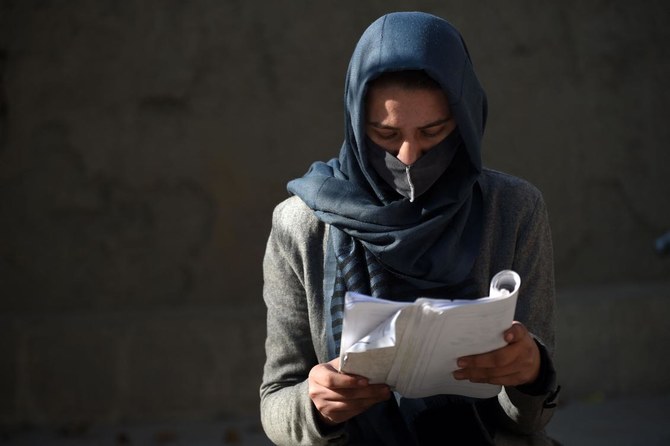

LONDON: Four international aid agencies including Save the Children said on Sunday they were suspending their humanitarian programs in Afghanistan in response to the Taliban-run administration’s order to stop female employees from working.
The administration on Saturday ordered all local and foreign non-governmental organizations (NGOs) not to let female staff work until further notice. It said the move, which was condemned globally, was justified because some women had not adhered to the Taliban’s interpretation of Islamic dress code for women.
Three NGOs — Save the Children, Norwegian Refugee Council and CARE International — said in a joint statement that they were suspending their programs as they awaited clarity on the administration’s order.
“We cannot effectively reach children, women and men in desperate need in Afghanistan without our female staff,” the statement said, adding that, without women driving the effort, they would not have reached millions of Afghans in need since August last year.
Separately, the International Rescue Committee (IRC) said in a statement that it was suspending its services in the country, citing similar reasons. IRC said it employs more than 8,000 people in Afghanistan, over 3,000 of whom are women.
The suspension of some aid programs that millions of Afghans access comes at a time when more than half the population relies on humanitarian aid, according to aid agencies, and during the mountainous nation’s coldest season.
Save the Children, Norwegian Refugee Council and CARE International also highlighted the effect of the ban on female staff on thousands more jobs in the midst of an economic crisis.
Germany’s Foreign Minister Annalena Baerbock on Sunday also called for a “clear reaction from the international community.”
And the Organization of Islamic Cooperation called the ban “self-defeating and disserving the interests of Afghan people,” and called on the Taliban to reverse its decision.
Italy said was “deeply worried about the decision of the de facto authorities to prevent female humanitarian relief staff to work in Afghanistan.”
The foreign ministry said it was an unacceptable decision contrary to the principles of humanitarian law.
“Women’s role in relief activities is irreplaceable,” it added.
The Organization of Islamic Cooperation said the fundamental rights of Afghan women have been dealt yet another severe blow.
OIC Secretary General Hissein Taha expressed his exacerbated concerns over the ban, and said the “move reflects a willful policy by the de facto leadership apparently seeking to further impact Afghan women’s rights.”
He called on the Taliban administration to “revisit the decision for the sake of social inclusion of women and the undisrupted continuation of the much-needed international humanitarian safety net in Afghanistan.”
Earlier, international aid agency AfghanAid said it was immediately suspending operations while it consulted with other organizations, and that other NGOs were taking similar actions.
The International Committee of the Red Cross in Afghanistan also on Sunday expressed concern at the move and an earlier bar on women from attending university, warning of “catastrophic humanitarian consequences in the short to long term.”
“Obliged to comply”
A spokesman for the Taliban administration, Zabihullah Mujahid, hit back at the criticism, saying all institutions wanting to operate in Afghanistan are obliged to comply with the rules of the country.
“We do not allow anyone to talk rubbish or make threats regarding the decisions of our leaders under the title of humanitarian aid,” Mujahid said in a post on Twitter, referring to a statement by the head of US Mission to Afghanistan.
Chargé d’Affaires Karen Decker had taken to Twitter to question how the Taliban planned to prevent hunger among women and children following the ban. She pointed out that the United States was the largest humanitarian aid donor to the country.
(With Reuters and AFP)