KABUL: The Taliban government on Saturday ordered all foreign and domestic non-governmental groups in Afghanistan to suspend employing women, allegedly because some female employees didn’t wear the Islamic headscarf correctly. They also separately banned women from attending religious classes at the mosques in the capital of Kabul.
The bans are the latest restrictive moves by Afghanistan’s new rulers against women’s rights and freedoms, coming just days after the Taliban banned female students from attending universities across the country.
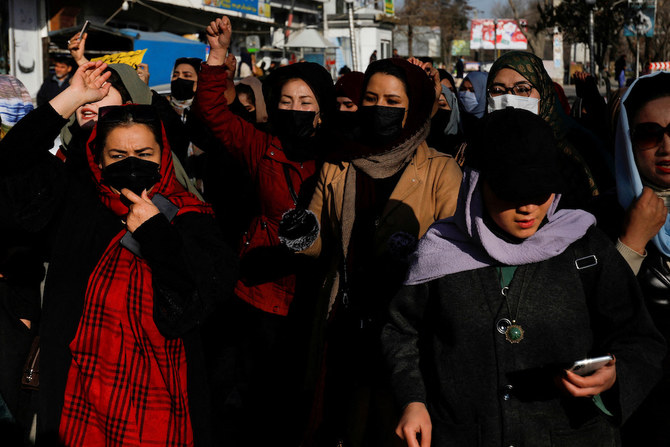
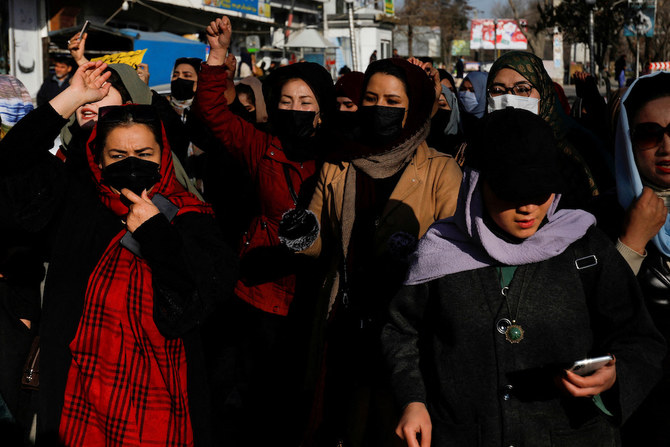
Afghan women have since demonstrated in major cities against the ban — a rare sign of domestic protest since the Taliban seized power last year. The decision has also caused international outrage.
The NGO order came in a letter from Economy Minister Qari Din Mohammed Hanif, which said that any organization found not complying with the order will have their operating license revoked in Afghanistan. The ministry’s spokesman, Abdul Rahman Habib, confirmed the letter’s content to The Associated Press.
The ministry said it had received “serious complaints” about female staff working for NGOs not wearing the “correct” headscarf, or hijab. It was not immediately clear if the order applies to all women or only Afghan women working at the NGOs.
More details were not immediately available amid concerns the latest Taliban move could be a stepping-stone to a blanket ban on Afghan women leaving the home.
“It’s a heartbreaking announcement,” said Maliha Niazai, a master trainer at an NGO teaching young people about issues such as gender-based violence. “Are we not human beings? Why are they treating us with this cruelty?”
The 25-year-old, who works at Y-Peer Afghanistan and lives in Kabul, said her job was important because she was serving her country and is the only person supporting her family. “Will the officials support us after this announcement? If not, then why are they snatching meals from our mouths?” she asked.
Another NGO worker, a 24-year-old from Jalalabad working the Norwegian Refugee Council, said it was “the worst moment of my life.”
“The job gives me more than a ... living, it is a representation of all the efforts I’ve made,” she said, declining to give her name fearing for her own safety.
The UN condemned the NGO order, and said it will seek to meet with the Taliban leadership to get some clarity.
“Taking away the free will of women to choose their own fate, disempowering and excluding them systematically from all aspects of public and political life takes the country backward, jeopardizing efforts for any meaningful peace or stability in the country,” a UN statement said.
Ramiz Alakbarov, the UN deputy special representative for Afghanistan and humanitarian coordinator, told Reuters that although the United Nations had not received the order, most of its activities were carried out by non-governmental organizations (NGOs) it contracts and would be heavily impacted.
“Many of our programs will be affected and we won’t be able to implement them because, unless we have participation of female staff in the assessment of humanitarian need, in identification of beneficiaries, in providing the aid and distributing the aid, then we will not be able to implement them,” he said.
“There’s never a right time for anything like this ... but this particular time is very unfortunate because during winter time people are most in need and Afghan winters are very harsh,” said Alakbarov.
He said his office would consult with NGOs and UN agencies on Sunday and would seek to meet with Taliban authorities for an explanation.
“An important principle of delivery of humanitarian aid is the ability of women to participate independently and in an unimpeded way in its distribution so if we can’t do it in a principled way then no donors will be funding any programs like that,” Alakbarov said.
The European Union — a major funder of aid organizations that work in Afghanistan, though it does not recognize the Taliban as the country’s official government — condemned the decision and said it was assessing “the impact it will have on our aid on the ground.”
“Our foremost concern will continue to be the welfare, rights, and freedoms of the people of Afghanistan,” Nabila Massrali, spokeswoman for EU foreign policy chief Josep Borrell, told AFP in a statement.
US Secretary of State Antony Blinken warned that the ban order would disrupt aid delivery and could be “devastating” for Afghanistan.
“Deeply concerned that the Taliban’s ban on women delivering humanitarian aid in Afghanistan will disrupt vital and life-saving assistance to millions,” Blinken tweeted. “This decision could be devastating for the Afghan people.”
In another edict, a spokesman for the Ministry of Hajj and Religious Affairs, Fazil Mohammad Hussaini, said late Saturday that “adult girls” are barred from attending Islamic classes in mosques in Kabul, although they could still go to standalone madrassas, or religious schools.
He gave no further details, and did not elaborate on the ages affected with the ban or how it would be enforced. It was also not explained why the measure only applies to Kabul mosques.
Earlier on Saturday, Taliban security forces used a water cannon to disperse women protesting the ban on university education for women in the western city of Herat, eyewitnesses said.
According to the witnesses, about two dozen women were heading to the Herat provincial governor’s house on Saturday to protest the ban — many chanting: “Education is our right” — when they were pushed back by security forces firing the water cannon.
Video shared with the AP shows the women screaming and hiding in a side street to escape the water cannon. They then resume their protest, with chants of “Disgraceful!”
One of the protest organizers, Maryam, said between 100 and 150 women took part in the protest, moving in small groups from different parts of the city toward a central meeting point. She did not give her last name for fear of reprisals.
“There was security on every street, every square, armored vehicles and armed men,” she said. “When we started our protest, in Tariqi Park, the Taliban took branches from the trees and beat us. But we continued our protest. They increased their security presence. Around 11 a.m. they brought out the water cannon.”
A spokesman for the provincial governor, Hamidullah Mutawakil, claimed there were only four-five protesters.
“They had no agenda, they just came here to make a film,” he said, without mentioning the violence against the women or the use of the water cannon.
There has been widespread international condemnation of the university ban, including from Saudi Arabia,the UAE, Qatar and Turkiye, as well as warnings from the US and the G7 group of major industrial nations that the policy will have consequences for the Taliban.
An official in the Taliban government, Minister of Higher Education Nida Mohammad Nadim, spoke about the ban for the first time on Thursday in an interview with the Afghan state television.
He said the ban was necessary to prevent the mixing of genders in universities and because he believes some subjects being taught violated the principles of Islam. He also added the ban would be in place until further notice.
Despite initially promising a more moderate rule respecting rights for women and minorities, the Taliban have widely implemented their interpretation of Islamic law, or Sharia, since they seized power in August 2021.
They have banned girls from middle school and high school — and now universities — and also barred women from most fields of employment. Women have also been ordered to wear head-to-toe clothing in public and have been banned from parks and gyms.
Afghan society, while largely traditional, had increasingly embraced the education of girls and women over the past two decades of a US-backed government.
In the southwestern Pakistani city of Quetta, dozens of Afghan refugee students protested on Saturday against the ban on female higher education in their homeland and demanded the immediate reopening of campuses for women.
One of them, Bibi Haseena, read a poem depicting the grim situation for Afghan girls seeking an education. She said was unhappy about graduating outside her country when hundreds of thousands of her Afghan sisters were being deprived of an education.
(With AP, AFP and Reuters)